Pages

Wednesday, October 31, 2012

A Message Across Aeons

This was something that was discussed in my house with some frequency as a child, and so I was most humored when James Hutchings at Teleleli wrote about the basic problem of communicating the danger of toxic waste sites to future generations.


Think about it.  The above radiation symbol looks a little like an angel, or a wheel.  It could be a holy symbol, or a mystical artifact.  After several generations, its original intent could be lost.

Other symbols suffer the same problem.  If you put a sign with a whole human body, and an arrow pointing to a skeleton, a future culture could easily interpret this in reverse and assume they've found an ancient, buried life elixir.

The challenge involves determining how to communicate with a culture that does not yet exist.  Several ideas have been proposed, and redundancy has been encouraged.  The current idea is to make burial sites look as foreboding as possible, as if the very land itself is sick and dissuades travelers from staying.  Others wish to put warnings in as many languages as possible, and leave spaces so that future cultures may write warnings in their local languages.  Other ideas include passing tales of the land into oral history — essentially building new mythologies to warn people of the sickness in the land.

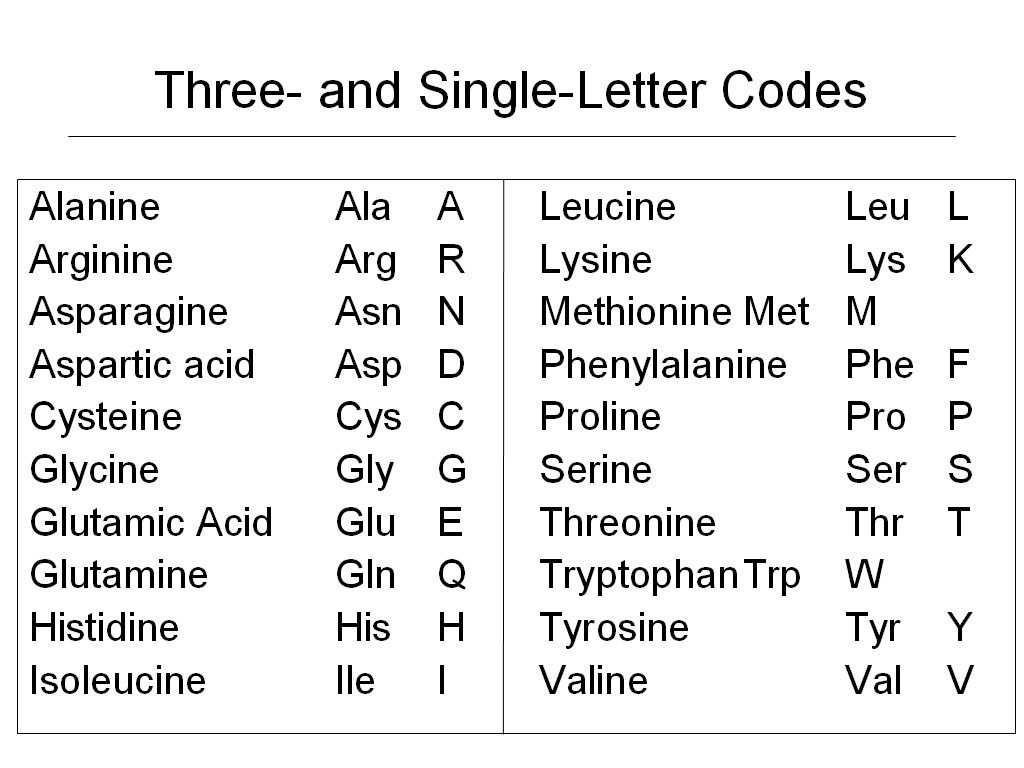
Various ideas have been proposed regarding the last — some have suggested putting strangely-colored plants in the region, or plants with warning messages encoded in their DNA (there is an alphabet associated with the genetic code, so this is entirely feasible).  Another idea involves inserting genetic code into cats (domesticated cats being considered more-or-less constant human companions) that causes them to change color in the presence of radiation.  This trait will then be seeded into collective culture by use of myth and fairy tales (if a cat changes color, the land is sick and you should leave).  Some have suggested an "atomic priesthood," which would tend to these sites and keep away interlopers.  My personal favorite is simply placing a large concentration of human remains on the site so as to ward off any future seekers.

For obvious reasons, all markers must be large and lack value, lest they be moved by future civilizations.

Of course, many theorists suggest that marking the site in any fashion marks it as valuable (something any DM can appreciate), and that the wisest course of action is to avoid marking the site at all.

That certainly flows with the James Raggi mindset, anyway.

In addition to Hutchings' article at Teleleli, further information is available at Damn Interesting, Wikipedia, and Grist.

Gaming applications are obvious to anyone who plays D&D, Gamma World, or any similar sort of post-apocalyptic game.  Dungeon delvers in particular are famous for ignoring blatant warnings of danger to go raiding tombs, and so would be perfect for this sort of thing.

Lemons from the Hedge

Back from when I ran False in Some Sense, Nicole happened to record a segment from Story 6, Chapter 2.  In this, William Puckett, recently stolen by the True Fae and returned as a changeling, brings an enchanted fruit from the Hedge to a suspected Fetch by the name of Officer Hayward.  Hilarity ensues.

Happy Halloween!

Monday, October 22, 2012

Sharpened Hooks: The Divine Order of the Mediatrix

The Roman Catholic Church has been accused of corruption and mired in scandal throughout the centuries, but all these pale in comparison to the bloody work Mother Church must perform.  Were the governments of the world to learn of the state of affairs, the controversy would likely destroy the Church.

The unfortunate side effect is that the world would probably die with it.

Hernán Cortés declared himself victorious over the Aztec Empire on August 13, 1521, when he and Xicotencatl the Younger took Tenochtitlan.

Had he known how wrong he was, he likely would have left the Aztecs to their bloody work.

The few scholars in the know differ about what happened.  Most agree that the Aztecs encountered ancient deities and accidentally awoke them, but managed to find a way to placate them with blood sacrifice.  Some theories claim that the conflict between these deities shaped the New World — as the Mexicas saw a vision of an eagle eating a snake atop a cactus, a symbolic battle for the identity of the young United States centered around whether a serpent or eagle should be the national animal.  One theory tells a convoluted tale of cocaine mummies and a pre-Colombian trade route between Egypt and Central America, claiming that the mummified corpses of the deities Horus and Set were conveyed to the New World, and their spirits forced nightly to do battle with Apophis.  (Some wags, reading too many Conan the Barbarian tales, claim Set is the snake-deity.)

Whatever the case, the original Mexica people awoke something great and terrible, something which had to be placated with bloody sacrifices.  When Cortés destroyed the Aztec Empire, he destroyed the last members of a cult dedicated to keeping these deities asleep (or providing the energy they need to keep the world turning, depending upon the source).

Having uncovered the secret, Cortés and his men were forced to take up the duties of the priesthood.  What had begun as a tale of God, gold, and glory ended as a horror story.  Fearing for his soul, he contacted the Catholic Church.

Based on this information, a secret cult arose within the Church.  Dedicated to keeping the dread gods asleep and keeping their existence secret, this group of monks started the terrible work of providing new sacrifices.  The cult likely took the name of the Divine Order of the Mediatrix in the 17th century, attempting to forge a symbolic connection with the grace of the Virgin Mary as well as the comparatively recent (and culturally native) Our Lady of Guadalupe and the pagan goddess Tonantzin that preceded her.

The Divine Order of the Mediatrix is a small order of monks with a special dispensation from the Holy See to perform the sacrifices necessary to keep the world turning, and to hide all evidence of this conspiracy.  Traditionally, the Pope is unaware of the Order of the Mediatrix, although some certainly are.  Typically, it is the quiet ranks of scholars, cardinals, and administrative personnel that organize and maintain the secret.

As for the order's methods, they are just as bloody as one might imagine.  Numbers vary, but one might estimate roughly 40 serial killers active at any given time worldwide.  At least one is probably a Mediatrician.  It is also likely that a sizable portion of the missing persons reported each year (roughly a million, according to some reports) are similarly victims of the Order of the Mediatrix.

As for using this in a game, an early modern game might feature the Divine Order of the Mediatrix as it struggles to survive and perform its grim work.  A modern-day game might feature the Mediatricians as the current conspiracy of killers for Christ, struggling to maintain their faith amidst modern technology and raw, cosmic horror.

In addition to the order of monks from which the Divine Order of the Mediatrix derives its name, the Mediatricians are aided by a cadre of exorcist-priests, therapists, and lay people who are necessary to keep the organization running.

(You can probably blame this all on my recent viewing of The Cabin in the Woods, along with my recent reading of The God That Crawls.  I'm going to say that there's probably a fair share of Delta Green, too.)

Friday, October 19, 2012

159 XP for a Level-0 Commoner

A British man, armed with a basic metal detector, finds 40 Roman gold coins.  He and a few others return to the site, and find 119 more.

The haul is reported to be worth roughly £100,000 ($160,000).

Neat stuff.  Read about it here.

Deadlands, Part XXV

When last we left our heroes, the survivors (relatively speaking) reunited, attempted to engage Bashiel, received some information and supplies from the Army, and prepared to go to the town of Buena Vista, Virginia.

The next few days are a flurry of activity.  The group gets supplies from the Army and whatever stores are open in town.  David Hood settles Father Seward's debt with the silversmith.  The group also informs the newly-arrived representatives of the Catholic Church about the Doomsday Clock, and they agree to move it.  As David Hood speaks French, Father Seward speaks Spanish, and Rufina speaks Mandarin, the group copies the ritual required to stop the clock into English, French, Mandarin Chinese, and Spanish.  Copies are given to the Catholic Church and also placed within the Hood family Bible for safe-keeping.

It is also noteworthy that crows have started following Father Seward.

Finally, the funerals begin.  There are funerals for the Hood family, funerals for the lawyers at Seward & Taft, and the group has a small funeral for Jake.  As they finish speaking their remembrances of Jake, Cobb arrives.  Father Seward asks him, "Do you want to say any words, Scratch?"  Cobb shoots him an angry, chilling look before breaking into a smile and stepping upon the grave to put out his cigarillo on the headstone.  Ruby spits on him, and he shoots her a similar look.  His expression then lightens, he wipes off the spit, looks at it, and says, "Yeah, that's fair."  He then takes his leave.

This prompts a discussion with their new companion Rex, who knows nothing of Cobb.  It is explained that he is the Devil trapped in human form due to a lost wager in Georgia many years ago.  Additionally, he drove David Hood's family to madness, stole Father Seward's daughter, trained Jake in the black arts, and had a presence at Ruby's wedding (possibly because the Hellgate he used to access the world initially existed on her family's plantation plot).  This prompts Rufina to realize something, and she pulls Father Seward aside to explain a dream-vision she had.  A female shaman led four men — each representing a different animal, specifically a wolf, a bear, an eagle, and a crow — in a ritual to purify their corrupted land.  The purification required the four to ritually rape a young girl, evidently Father Seward's daughter by description.

She also indicates that she is familiar with the spirit inside Seward, and that the creature should never be allowed to meet Henrietta.  Perhaps there is a way to exorcise this entity?

No funeral is held for John Michael Patrick O'Flahertie as Ruby wants him to be remembered in Georgia.  Shortly thereafter, Father Seward quietly goes down to the pier.  He explains his purpose to a nearby clergyman (the Catholic Church has people watching the Doomsday Clock until it can be quietly moved), and then dives into the water and gets a piece of the charred riverboat where John O'Flahertie died (the thought of trying to find his remains is outweighed by the fear of accidentally stumbling into the Clock and reactivating it).

Finally, the group has settled its affairs.  The party needs to travel to Connecticut by wagon so that they may catch a train headed south to Richmond, Virginia.  From there, they should be able to travel by foot, horse, or wagon to Buena Vista.

The journey to Connecticut is rainy, and is marred by one strange occurrence.  The group becomes aware of a follower behind them, and they manage to determine that the rider (in Union uniform) is slumped over his horse.  Father Seward, gifted with far sight from his time beyond the grave, sees that the rider is probably dead and the horse is badly malnourished.  As the rider approaches, his head raises and declares a letter for Jeb.  Everybody is wary, but when Father Seward goes to grab it, the mail carrier pulls it away.  Jeb grabs the letter, and the rider declares that there is no more mail.  He rides back the way he came.

As Jeb cannot read, David Hood reads the letter.  It is correspondence from one Sullivan to his very dear Sarah, and is evidently a wartime love letter.  It is dated July 14, 1861.  Nobody can determine any relation to Jeb, but they decide that perhaps they can find answers on their journey.

The train ride is uneventful, a welcome respite from the past few weeks.  When they arrive in Washington, D.C., they decide to take a day to inquire at the Army archives.  The request is fruitful — using a letter of marque from General Sully, they are able to gain the services of an archivist who says he will attempt to see what he can learn by tomorrow morning.  They wander around D.C. in the meantime, and one of the crows following Seward settles on his shoulder and pecks at him.  He takes a swing at it and it flies off, prompting a question about what they mean.  Father Seward explains that they are psychopomps in some Indian cultures,  meant to convey the dead to the World Tree.  When everybody asks how he knows that, he explains that he read a great deal both theologically and for personal research.  He also takes the opportunity to explain what Rufina told him about his daughter.

The next morning, they visit the archivist and learn that the letter possibly refers to one General Sullivan Ballou, killed by sniper fire at Bull Run.

Jeb, incidentally, was a sniper at Bull Run.  He admits that he recalls little about what happened there, as an explosion seems to have damaged his memory.

David Hood records the archivist's name — Thomas Johnson — and suggests that he will pass it along to General Sully.  The group then catches the train to continue onto Richmond.

While on the train, they discussed whether they would attend to Ruby's business in Richmond or the mysterious business in Buena Vista first.  They decide on Ruby's business.

As such, they agree to accompany Ruby to meet her estranged husband, Brent Manning.  They arrive to his estate by carriage, and find a black bow tied over the gate; the house is obviously in mourning.  The group wonders about who died; Father Seward suggests that Manning probably heard about the trouble in Boston and presumes Ruby dead.

An old Negro attendant answers their summons and seems very surprised when they say that Ruby O'Flahertie wishes to speak with Mr. Manning.  He trundles off.  A gunshot is heard within the house, and the butler is seen running back outside, followed by a disheveled man.  He has a gun in one hand, a bottle of liquor in the other, and appears to be wearing a woman's bathrobe over his pajamas.  He is admonishing the butler for playing dirty tricks on him.

Another man follows the drunken Brent Manning.  He, on the other hand, is well-dressed, but he is unknown to Ruby.  He appears to be comforting Brent.

As Brent approaches, Ruby steps out and addresses him.  He is shocked and begins weeping tears of joy; he runs for the gate, stumbles, stands up, and attempts to open the gate.  Unable to maneuver around the bow, he shoots it, sending shreds of black ribbon everywhere.  He finally pushes the gate open.

He runs at Ruby but meets her hand instead, as she pushes the disheveled Brent away.  Rex snatches his pistol while he's preoccupied.

Blubbering, he describes how distraught he was when he heard about the troubles in Boston, to which his companion replies, "Yes, he was inconsolable," while his hand slips into Brent's.

***************************

We play a little fast and loose with history (the poker game should bear that out), but having a primary document from history appear is still pretty neat.  (One of the things I really enjoy about games set in the "real world" is the fact that it is easier to establish verisimilitude than it is in fictional settings.)

(And for the GM: don't worry, I only looked for the text of the letter given the details you gave us.  I didn't look up any details regarding Sullivan himself, so your plot secrets are safe.  For now.)

Also, after slogging through a world of occult horror, the revelation of Brent Manning's homosexuality was unexpected but incredibly relieving.  Contrary to the typical attitudes of the time, I'm guessing the group as a whole doesn't care about his sexual orientation because he's not engaging in assault, murder, cannibalism, or attempting to end the world.

I'm guessing Cobb only appeared because he has a vested interest in Ruby's family, but we don't know that for sure.  Manning could still be some sort of psycho-killer cannibal occultist, I guess, but he's hopefully mundane.

Hopefully.

Wednesday, October 17, 2012

Persons of Interest: Loturik the Bound, Kolyarut

Loturik the Bound

Loturik the Bound is one of the Inevitables, order-aligned extraplanar constructs originating from Mechanus (and thusly making them spiritual kin to the Modrons).  Specifically, Loturik is a Kolyarut, a type of Inevitable that hunts oathbreakers.  They are known to be the most personable of the Inevitables because they will actually deign to speak to their chosen prey, and may even attempt to negotiate a settlement (so, rather than killing the oathbreaker, they may simply convince the person to uphold the broken bargain).

In this case, Loturik the Bound is occasionally seen around Sigil, and is identified as a member of the Planar Trade Consortium.  Scholars can think of no reason why a Kolyarut would willingly serve any authority less than its duty, but rumors suggest that Loturik, as his moniker suggests, is bound to the will of the Planar Trade Consortium.

Rumors suggest that no less authority than Estevan himself (an oni mage and a key leader of the Consortium) tricked this rogue Kolyarut into forging an oath with the wily magus.  If this is true, Loturik is bound to serve because it cannot break its own oath without defying its base nature.

Loturik is currently thought to be gathering adventuring parties to help cultivate the town called Skyfall in a grim and distant Prime Material World known as Carcosa.  Special attention is to be paid to the ruins below the town, as there is apparently wealth to be had down there.

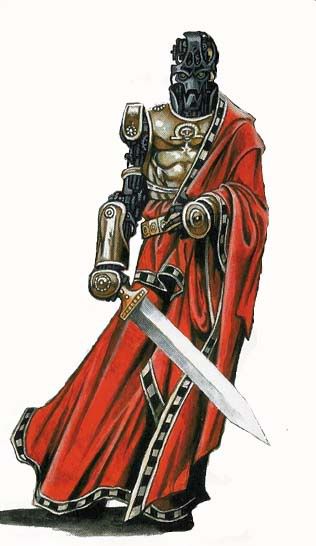
(Also, the above image was found on http://www.themistway.com/Ravenloft-Session14-DMC.html at the phrase, "human-shaped clockwork automaton.")

Print Friendly