Wednesday, October 5, 2011


Foiled Again...Again!
Sharpened Hooks: The Slender Man Mythos (addendum)
Then again, since I mentioned the Black Lodge, maybe the Slender Man is merely a cultivator of garmonbozia.
Monday, October 3, 2011
Sharpened Hooks: The Slender Man Mythos
Also, there's a lot of exposition before I discuss this in terms of roleplaying, so just bear with me.
A friend recommended Marble Hornets, only explaining that it is a horror series on YouTube, and it is somehow related to Creepypasta. I started watching it.
It's pretty good, although the acting is a bit wooden. It's well-paced, though, and has a lot of neat concepts — in execution, it has similarities to John Dies at the End, primarily in some of the creepy events and the unreliability of perception (Marble Hornets has much less humor, and shies away from crude humor entirely).
Also, the Slender Man isn't quite a spoiler — you catch a glimpse of him in episode 1, and can pretty well figure out where everything is headed.
All-in-all, I'd recommend Marble Hornets. It's a time investment, but try the first twenty for a good cross-section; if it falls flat, you haven't wasted your time on the whole series (and if you find it too frightening, as some viewers do, you probably won't make it all the way through, but at least you know).
Of course, this isn't a review of Marble Hornets. This is more a discussion of the Slender Man mythos. The following information may be repeated on the above TV Tropes entry, so feel free to skim as necessary (though I'd recommend reading both, as each will likely emphasize different things).
Before Marble Hornets, I was aware of this phenomenon. I knew that he originated from a Something Awful thread within the past ten years, he is tall and thin and wears a business suit, and he steals people away. Or something.
After seeing Marble Hornets and mucking around in the internet hive-mind, I learned some stuff.
As it turns out, the Slender Man was created in 2009 on a Something Awful thread entitled "Create Paranormal Images" (I somehow thought it was earlier). The concept went viral pretty quickly; people started developing the Slender Man in an exercise of collaborative storytelling across the Web (most typically wikis, blogs, and YouTube; all the classic Web 2.0 buzzwords). Though stories do not necessarily agree on his capabilities, the following attributes have been codified enough to repeat throughout media:
• He's tall and thin and wears a black business suit. He is usually depicted standing at about ten feet tall, though he is occasionally depicted indoors, presumably with standard eight-foot residential ceilings (it's possible he can alter his body proportions, like Cthulhu). His face is indistinct, either because he appears differently to each person, or because he doesn't have a face.
• He can stretch his limbs, or grow extra limbs, or grow tentacles. This is used to catch prey, to induce fear in prey, and to hypnotize prey. Bottom line: his limbs and stature should appear unnerving, disproportionate, and distinctly unnatural. The Slender Man is hardly the Vitruvian Man, instead residing in the Uncanny Valley.
• He is typically encountered in wooded areas. His tall, thin appearance is reminiscent of a tree — there are suggestions that this is camouflage, and he is either a man impersonating a tree, or a tree impersonating a man (note that "man" is not an accurate description in either case). This further relates to the idea that he might be a nature spirit (probably a vengeful one who kills intruders in his woods) or a member of the Fair Folk.
• He is associated with abnormal and UFOlogy events, such as electromagnetic interference and missing time (and his presence can upset animals).
• He is typically invisible, only appearing to his victims. He may also be captured on film, even by people who have not yet seen him. This does appear to be the beginning of a cycle that attracts his attention, though.
• The Slender Man has no canonical origin; only hints are provided. In addition to the above theories, some have suggested that he's a member of the restless dead. The most enduring idea is that he's a tulpa — we dreamed him into being, and now we have to live with that fact. In that case, he literally didn't exist until Victor Surge made his post on the Something Awful forums in 2009.
• Maybe the Slender Man can die, but nobody's figured out how to do it yet. Presumably, this is for narrative reasons (if you kill him, you basically end all Slender Man blogs currently running), but it's equally possible that he cannot be killed.
I'm intrigued by the mythos because it has all the good hallmarks of a roleplaying scenario, and there are a lot of resources in place. You could easily do this two ways in a modern day game:
1) Say the characters are friends of somebody, like Jay from Marble Hornets. Give them a DVD with the first, say, 18 episodes. Say that came in the mail, but Jay's gone missing. Let them pick up the investigation where he left off.
2) The PCs run afoul of the Slender Man, but they have help — they can use all the resources on the internet. So, they can ask M for advice, and peruse what others have done.
I like this because I love making handouts, but making short films for your PCs to find can be rather time-consuming (although I still plan on doing it when I have a good idea that I can easily implement). This not only generates enough content to keep them busy for weeks or months or years of gaming, it creates a ready-to-run sandbox plot for your PCs; you need to keep moving to avoid the Slender Man, and hopefully you can find enough data to actually defeat him. Weird things will happen along the way.
Depending upon the setting (the GM could always run this game in an established modern setting like the World of Darkness or Call of Cthulhu, after all), the PCs might encounter other weirdness, as well.
One more thing: the Slender Man is typically postmodern, but the astute will recognize strains of UFO mythology and the Fair Folk. Carl Sagan connects all these concepts in his book The Demon-Haunted World (you can find the book in pdf format here), suggesting that fairies and aliens are all components of a common psychological construct among humans, connected with dreams and sleep paralysis. As such, it's entirely possible to include the Slender Man in historical games or fantasy games (for that matter, you could run a psychological thriller where the Slender Man is all in the PCs' heads). Here's an example, incorporating Slender Man mythology in D&D:
The twisted, gnarled woods to the east are best avoided. The trees are spindly — useful for kindling, but typically too small for timber. Some might use the wood for simple huts if the forest were not haunted.
Many tales are told about those woods — that the forest is filled with strange, fey predators; that the forest holds a cult, or even stranger inhabitants; or that the forest even holds a portal leading to a forgotten and ancient temple of some old dualism religion.
The truth is this: the region was once a place of tall trees, guarded by treants and all manner of plant creatures. It is entirely possible that a gate to another plane once existed in these woods (in fourth edition, these woods could be close to the Feywild). Some previous settlement scattered the guardians of this place, scouring the land for timber and coal. Poorly-considered agricultural practices stripped the land of nutrients, nearly ruining it forever.
Something happened. Maybe one of the creatures became corrupted by the horrors wrought upon the land, or maybe a vengeful druid cast one final spell. Since that time, something horrible has stalked the forest, and no one dares enter those woods. The forest has since regrown.
Now, the forest's only inhabitants are a group of masked druids who worship the nameless thing that defends the forest. It is tall, pale, and faceless. Clad in black robes, it wanders the forest — it attacks intruders relentlessly, disemboweling them and impaling them on the trees as a warning. This creature might be immortal, but no one has ever survived the woods long enough to investigate and research it.
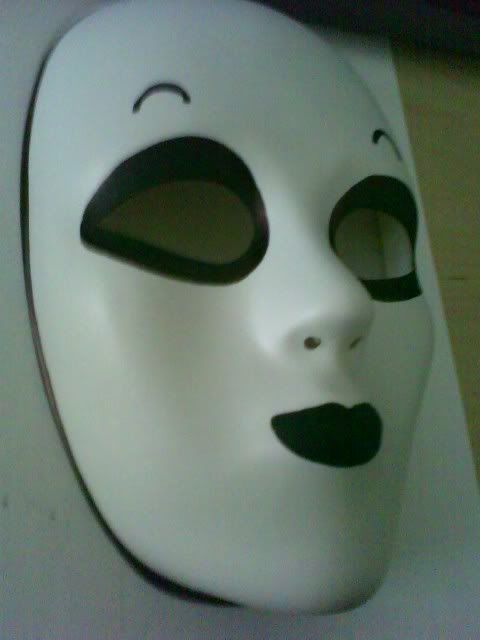
The ultimate motives of the druids are unknown; worship is merely the most likely explanation. Some claim the druids may wish to keep interlopers away from the woods, while others claim they wish to actively bring more sacrifices for the Slender Man.
Edit: There's now a brief ramble on the Slender Man on the next post.
Sunday, October 2, 2011
Liquid Green Stuff?
Perhaps it will be of interest for any miniature artists out there?
Saturday, October 1, 2011
Blog Post Aggregation
This post at Tears of Envy gives a link to Women Fighters in Reasonable Armor as well as a College Humor video about the same topic. I was never the sort to get up in arms about that sort of thing, but at the same time, I don't think I've ever had a female NPC (or PC, for that matter) in revealing armor. So there you go. The link, above, is also just a good resource for images of medieval/fantasy women, so if you need a good character reference picture, you might as well look around there.
Looking around on Women Fighters in Reasonable Armor then brought me to the D&D for Dads series at Art by Stowe. This is a series of resources to bring D&D to children ten and younger, a topic about which I have previously written. You can also get a pdf file of some sheets at this megaupload link, though I have not yet had the opportunity to examine the document itself.
Review: Unknown Armies
Unknown Armies is my favorite game. I may have mentioned this before?
I've heard it described as Quentin Tarantino's Call of Cthulhu. The revised edition has the subtitle, "A roleplaying game of power and consequences." The original edition has the subtitle, "A roleplaying game of transcendental horror and furious action."
That's fairly accurate.
Unknown Armies takes the basic premise of Call of Cthulhu and inverts it: rather than the horror arising from the fact that humanity is basically impotent and powerless in a cruel and uncaring universe, the horror arises from the fact that humanity has ultimate power (and ultimate responsibility). You did it.
This isn't obvious at first, of course. A typical starting character has had an odd experience or two, and now seeks the secrets of the occult underground. The more one explores the occult underground, the more one learns about the secrets of the world, and the more your ultimate responsibility makes sense.
Before you hit the high-concept premise, though, you find the weirdness of the setting. Postmodern magic is the rule; there's a ritual that requires you to wrap yourself in VHS magnetic tape as a ritual component. A thousand little conspiracies vie for power — the more attention-grabbing ones are a cult of pornographers and a group hidden within the corporation of an iconic American brand. Having access to magic gives you power, but also tends to limit you in ways that make being mundane a perfectly viable option (as the game says, using a gun is easier than using magic, and scrying isn't nearly as useful as satellites and cell phones).
I'm not inclined to say much — like many occult/conspiracy games, the game benefits heavily from secrecy — but I highly recommend it for the setting alone. It starts out modern and familiar, but quickly gets weirder the deeper you go.
As for the system, it is fast and elegant. Like Call of Cthulhu, it's a d100 system, but it skews lower than most. The average stat (Body, Speed, Mind, or Soul) runs at 50%, but the average skill is considered professional around 30%. However, that 30% assumes you are in a life-threatening situation — a General Education of 30% only makes you roll a 30 or less on a d100 if you are, say, completing a math test with a gun to your head. So, rather than taking penalties when the going gets rough, you tend to get bonuses when things are less tense. As one would suspect, this helps speed the game along.
Skills are also freeform. Rather than choosing from a skill list (though they do have examples), you can invent your own skills. The GM applies common sense as to whether a skill applies, so even a narrow skill should still be useful (for example, 17th Century French Art might also cover your General Education skill, so that you know the basic things everyone should know, but you just happen to be most knowledgeable about your particular specialty). I've heard complaints about that system, but I actually like it because I tend to worry less about where to put my points — my character is still appropriately well-rounded if I have too few, and I can always think of more descriptive qualities if I have too many points.
There are a few other peculiarities of the system. Combat is fast (that one d100 roll tells whether or not you hit, and how much damage you do) and frequently deadly (for example, a critical hit instantly kills or incapacitates the opponent); I've run a couple of one shots, and combat usually lasted two rounds, ending with an unconsciousness or a death. For that matter, the combat chapter opens with six ways to avoid a fight (which I thought was a brilliant touch). People who are not combat veterans take sanity checks just for being attacked, so it's entirely possible to end a combat by shooting at someone (in a one shot, a brainwashed terrorist who had never actually been in a violent situation surrendered when a character fired at him, missed, and killed someone else; he was so shaken that he ran and hid). Also, though this can be done in any system, Unknown Armies rules state that the GM should track all hit points, only describing character conditions in terms of actual injuries and impressions (you have a bullet wound in your right shoulder and you think your left leg is broken; you feel a little light-headed and the edges of your vision pulse red). This uncertainty helps keep characters from being totally cavalier about combat, as they never know how close they are to dying.
As for the sanity system, the downward slide of Call of Cthulhu is, instead, a delicate balancing act in Unknown Armies. If you're in the middle, you're vulnerable to shocks, but you're otherwise okay. If you're at one end, you're a pile of quirks and mental illnesses. If you're at the other end, you're highly-resistant to further mental shocks, but you're a sociopath, incapable of basic human empathy.
As for magic, that's one of the secrets of the setting, but as previously noted, magic comes with its own drawbacks, typically constricting the magician's behavior. As such, normal mortals have an edge in the setting because they can still relate to their fellow humans without risking their magic (and as noted, modern technology is frequently more reliable than magic effects, anyway).
If you like modern occult conspiracy settings, I highly recommend this one. If I ever have the time to run on Constantcon, I was contemplating Unknown Armies because it's so fast. Though I should really just awaken early one morning for the Caves of Myrddin, because they sound awesome. I mean, the caves descend into the upper levels of Hell, how could they not be awesome?
Edit (5-9-2016): If you liked this review, check out my review of Unknown Armies, third edition, or my actual play report for UA3.
Subscribe to:
Posts (Atom)