Pages

Showing posts with label never read the comments. Show all posts

Monday, August 12, 2024

Advice in Practice: On the Simulacrum Spell

I've talked before about what I think makes for effective games that keep players wanting more (namely listening to the players and establishing real stakes as described in this blog post), but I recently encountered a Reddit thread wherein the original poster was asking about advice for trying to limit the 5e version of the simulacrum spell. The rule for 5e simulacrum is that a given caster can only cast one instance of simulacrum at any given time, but those simulacra could use their one cast of simulacrum on the caster, creating an infinite army of wizards given enough time and powdered rubies. The redditor in question was worried about this "exploit," and was asking for advice.

While a lot of advice in the comments suggests, "go ahead and limit it, you're the GM," I don't find that satisfying, because I tend to think the inflection points of a thing are usually the most interesting part. So in keeping with establishing real stakes, here was my response. A specific example that is potentially broadly applicable; when your players can do something wild and creative that seems like it will upend your carefully crafted world, let them do it! But also, brainstorm the ripple effects this action will have. Nothing happens in a vacuum, and the world keeps moving while the players wait.

(Also, part of the joy of being a powerful wizard in any role-playing game system is doing wild, impossible things. Don't take that from your players!)

I replicate my response below:

As the DM, you are perfectly within your rights to limit aspects of the rules or setting. That's technically the end of the discussion, although I might canvass the entire player group and see what they think.

But personally? I wouldn't limit simulacrum. I'm usually in favor of whatever nonsense my players want to do.

However, there is always a cost.

Each casting of simulacrum costs 1,500gp and takes twelve hours, which means you can functionally only cast it once per day despite your spell slots. (If your characters have folded time or don't need to sleep, then maybe you get two castings if you have the spell slots. Wish obviously changes the calculus of these assumptions, but it does that anyway.)

That means your magic-user's clone army takes weeks to amass. If anything else is happening at the moment, it continues to happen while they're doing this. If the other players don't want to wait, then they get to go have adventures while the wizard sits in their laboratory and makes simulacra all day.

And what about ruby dust? Your player might have plenty of rubies (a single "typical" 5,000gp ruby as described in the treasure portion of the Dungeon Master's Guide yields enough powder for 3 1/3 castings of simulacrum), but will probably have to get more to amass an army over the course of months. That means they have to go delving, or mining, or trading. How many rubies are in a typical settlement, anyway? A typical mine? Is the queen willing to pry every ruby out of her crown to power your simulacra?
All of this to say: the spell is not instantaneous, and it's not without cost. Casting simulacrum takes time and resources, the sort of large-scale project that someone notices and tends to engender strong opinions. What do the NPCs do when they realize a wizard is casting simulacrum over and over again? What do they do when they realize a wizard has 50 rubies on hand? (Worth at least 250,000gp; the GDP of whole city-states.) What do the other player characters do when they realize the wizard is going to spend the next two months blasting through their wealth to build clones?

Are things so quiet in the world that the characters can afford to wait while the wizard performs their Great Work in their ivory tower? Is there no political or religious organization in your setting that would be very interested in these activities? Is the villain merely sitting idly while the players gather a magical army vulnerable to antimagic?

I don't know the parameters of your campaign. But I do know that player decisions don't happen in a vacuum, and in high-level games, they have consequences. Big consequences. What are the consequences of this choice?

Play to find out.

Friday, July 18, 2014

Review: Dungeons & Dragons, Fifth Edition

Based upon the Basic Rules and Starter Set, it's emphatically D&D.  (It even says it on the cover!)

We can all go back to our lives now.

Wednesday, January 23, 2013

Dungeons & Dragons Classics

So they finally did it.  Wizards of the Coast released its back catalogue on pdf, meaning that you can now purchase and download materials from all editions of Dungeons & Dragons.

It's formatted basically like DriveThruRPG/RPGNow, so the format should be familiar to most gamers.  (Unsurprisingly, Dungeons & Dragons Classics is part of the DriveThruRPG/RPGNow system, and you can use your login information to access it.)

Go ahead and check out Dungeons & Dragons Classics.

Friday, December 14, 2012

Crux of Eternity replay

Two replays for the price of one today: Crux of Eternity on Obsidian Portal is relatively up-to-date.  Read about it if you want.

The PCs are currently wandering the mean streets of Scandshar, attempting to learn about the fate of a missing abolitionist agent.  Also, by the sound of his voice, the most powerful crime lord in the city might be an undisputed champion of freestyle.

Also, I stuffed a Marx Brothers reference in my game in the person of Lydia the Tattooed Lady.  Naturally, you should probably hear the original song to add some culture to your bacterial culture:

Friday, October 19, 2012

159 XP for a Level-0 Commoner

A British man, armed with a basic metal detector, finds 40 Roman gold coins.  He and a few others return to the site, and find 119 more.

The haul is reported to be worth roughly £100,000 ($160,000).

Neat stuff.  Read about it here.

Monday, September 10, 2012

Some Stuff You Should Know

Things are busy again, so it's time for some random stuff that might interest you.

Tori Bergquist at Realms of Chirak really hit the nail on the head the other day regarding AD&D vs. 4E.  I have certain RPG preferences, but I ultimately don't care what I run or play as long as I'm excited about it; there are reasons why D&D 4e is cool and there are reasons why AD&D 1e is also cool.  I play D&D for different reasons than WoD or UA, for example.

Tremendous Torr brought The Lovecraft Engine to my attention.  This site remixes Lovecraftian nouns and adjectives to craft a random Lovecraftian description, offering such gems as "a quavering fluid" and "that incongruous, blasphemous, necromantic phantasy."

The meat of this post has to do with another blog plug for a good friend.  About ten months ago while plugging Role-Player Hater (and he seriously needs to start posting again when he's not making metal or making metal), I mentioned my good friend and hetero life mate Nicole — I've known her so long that I remember roughly when she entered my Monkeysphere, but I don't actually remember ever meeting her.  Well, she just started a blog.  As it's just started (and only has one post at the time of this writing), I don't quite know what the focus will be, but I can speak to the quality of her writing and can vouch that it will likely be worth your time.  Presently, all signs point to a little bit of everything nerd-related with a focus on crafting — sewing, costuming, and suchlike.  (You're probably better off just reading the first post and seeing if it interests you.)  If any of that stuff strikes your fancy, go ahead a take a look at A Really Well-Made Buttonhole.

Thursday, August 9, 2012

Blogman: Year One

A year ago, I'd been reading D&D With Porn Stars and I gave into the most perverse urge.

...I started a blog.

I'm still not sure how I feel about the whole enterprise, but I try to keep up with it weekly.  I usually end up posting a couple of times a week.  I'm still not sure I've hit my stride with all this business, but there it is.

In the past year, I've gone from running one game and occasionally playing in another to running one game, occasionally running two others, and playing in two other games.  The focus has been increasingly on D&D and its variants, although I get occasional forays into my much-beloved modern/occult/horror/conspiracy genre I so thoroughly enjoy.

I've delved into the OSR a little, even contributing to Secret Santicore 2011, because I like fast and furious rule sets.  My fourth edition game is fun, but hour-long combats and predictable character advancement are a bit outside my niche.  (I used to think World of Darkness combat was sometimes overlong, and then I played fourth edition.)  The fast, simple, what-the-heck-ever-ness of the OSR, coupled with the wholesale adoption of FLAILSNAILS, really hits a lot of places I enjoy.  That having been said, I still think Unknown Armies just about hits everything I appreciate in a rules-and-setting package — I'd likely adapt its design elements and aesthetic to any homebrew system I'd create.

Anyway, I might as well take the opportunity to revisit some things that readers seemed to particularly like as well as some things that I particularly enjoyed.

Readers' Choice

Carcosa replays

Guest Spot: Vampire: the Masquerade Conversion

Review: The Blasphemous Brewery of Pilz

Review: Carcosa

Review: Fiasco

Review: Isle of the Unknown

Wednesday Werk

Author's Choice

Down the Glen Tramp Little Men

Free RPG Day in Review

Fiasco: Play Report

Review: Unknown Armies

Sharpened Hooks: The Cursed Throne of the Sun

Sharpened Hooks: Fun with Wilderlands of High Fantasy

Sharpened Hooks: The Slender Man Mythos

Gaming
Since I've been fortunate enough to actually play more recently, here's a list of games I played or ran at some point in the last year:

Games I Played

Owlbear Stabbings

Games I'm Playing

Deadlands

The Salzenmund Apophaſiſ

Games I Ran


Nasty, Brutish, and Short

True in Some Sense

The Truth Shall Set You Free

World Pulse Remix: All the Agents


Games I'm Running

Crux of Eternity

Monday, July 23, 2012

Some Rambling on Morality

So this podcast with Vincent Baker prompted this post on G+ by Zak Smith which prompted this post by Patrick Stuart which prompted this post by noisms.

Go ahead and check those out if you have time; the posts are short, but the podcast is somewhere in the forty-minute neighborhood (although you can probably manage without listening to the whole thing if you're pressed for time).

Anyway, the dialogue boils down to morality in games — namely, is morality a value that should concern us in gaming?  If we do bad things in games, are we bad people?

There's an article by Stephen King that's been floating around for a while, and it's called "Why We Crave Horror Movies."  The central thesis is that we watch horror movies as a form of catharsis (which is hardly surprising), but that the cathartic experience is the release of our darker emotions.  At the beginning of the ninth paragraph, he writes, "The potential lyncher is in almost all of us [...] and every now and then, he has to be let loose to scream and roll around in the grass."  He goes on to say that we are all conditioned to conform to the expectations of society, "But anticivilization emotions don’t go away, and they demand periodic exercise."  He continues, saying, "If we share a brotherhood of man, then we also share an insanity of man. None of which is intended as a defense of either the sick joke or insanity but merely as an explanation of why the best horror films, like the best fairy tales, manage to be reactionary, anarchistic, and revolutionary all at the same time."

He ends by summarizing this activit as something we do to "keep the gators fed."

So what does this have to do with role-playing?

I'd be hard-pressed to recall which World of Darkness book mentioned it (probably The Book of Madness, although I cannot precisely recall), but one of them referenced the whole "keeping the gators fed" idea, particularly in regard to playing villains.

I accept this behavior.  To throw more quotes at you, Mr. Rogers tells us, "Play is often talked about as if it were a relief from serious learning.  But for children play is serious learning.  Play is really the work of childhood."  Among organisms that play, most do so as a dry-run of adulthood — baby animals play to practice evading predators or catching prey, while humans practice running a household or engaging in basic mercantile behavior.  This is largely conjecture on my part, but I doubt we ever really escape this behavior.  We're always preparing for possibilities and eventualities, and in this vein, we continue to undergo that catharsis.

In my role as GM, I don't set any limits on the PCs' behavior (obviously, every world has a status quo, and my NPCs will gladly impose morality upon you).  In the confines of the game, the players are presumably friends and the environment is presumably "safe."  If you want to be moral paragons, or typically amoral murderhobos, or the most vile rapists and thieves imaginable, I don't really have a preference.  As long as everyone is comfortable, I don't have a problem with it.

That's the rub.  Everyone, as a player, should feel safe gaming in my group.  The world might be deadly, and you might not be able to trust the other characters as some of the must cutthroat bastards imaginable, but as long as everyone's having fun, there is nothing wrong.  If you want to play Black Spiral Dancers or Nephandi or Sith or Carcosan sorcerers, make sure everyone is on board and make the most of the downward slide.

Strangely, though, this is never an issue.  I never really lead the players one way or another with regard to morality, and most groups have an emergent tone that appears as gameplay progresses.  Torturing the bad guys would be relatively out of the question in The Imperial City (with a couple of notable character exceptions — E. M. Lamb's Kasi, who developed into a Tantric Thuggee devotee, might be able to get away with it) and would be totally inappropriate in False in Some Sense or The Truth Shall Set You Free, but has happened in Crux of Eternity and The Darkness of the Womb, and would be totally appropriate for the villagers of Remnant from Nasty, Brutish, and Short.

Basically, if the players want to have a relatively light round of fun, want to explore heavy moral themes, or just want to "keep the gators fed," that's all fine by me.  The moral line that cannot be crossed is a function of the group, not any particular viewpoint.

Note that this is not the same as being devoid of morality, however.  As an individual outside of my GM role, I'll usually comment on the group's morality if the mood strikes me (typically, I'll usually only comment on a shift in tone within the player group).  My world always reacts to it, too — my first Sabbat game ended with most of the characters being hunted down by the police and Camarilla agents because of their murderous rampage.  Charles Odderstol, the big villain of The Imperial City, typically tried to convince the PCs that he had the moral high-ground because they were antagonizing him.  (As an evil, insane cultist, they were perfectly justified, but it was still an interesting pattern I'd noticed.)

To summarize: in the Google+ post, Zak Smith says, "Is an underlying idea here that morality in the game has something to do with morality in real life?  Like: it doesn't.  Like not at all."  I understand different points of view — in noisms' post, he writes, "I was brought up by Christian parents (a Christian mother, more accurately - my Dad mostly humoured her), and my mother always tried to instil in me the notion that things that we watch, read, or listen to do actually affect our 'souls'; when you watch a violent film it is actually bad for you in some sense.  It is corrupting." — but I agree with Zak.  Fictional morality doesn't really have much (if any) bearing on real-life morality, and one can view any fictional acts that may be considered "immoral" or "transgressive" as simply keeping the gators fed.

Tuesday, June 19, 2012

Name That Movie

Over at Digital Orc, there's a contest underway to recognize stills from various movies.

Sadly, I'm drawing a blank, but maybe you'll do better.

Check out Win My Game: Name That Movie.

Dead Eye

A Note: If you plan on playing "Dead in the Eye," minor spoilers abound.  Otherwise, read on.

I neglected to note something in yesterday's Free RPG Day report: I've been ripped off!

Okay, it's probably just coincidence.  But it was funny when I was thumbing through things, and so I will share it with you.

D&D released "Dead in the Eye" for Free RPG Day, and the crux of the module is a Far Realm incursion on the Prime Material Plane of Toril.  There's a bunch of mutant creatures and an evolving beholder.  It looks like great fun.

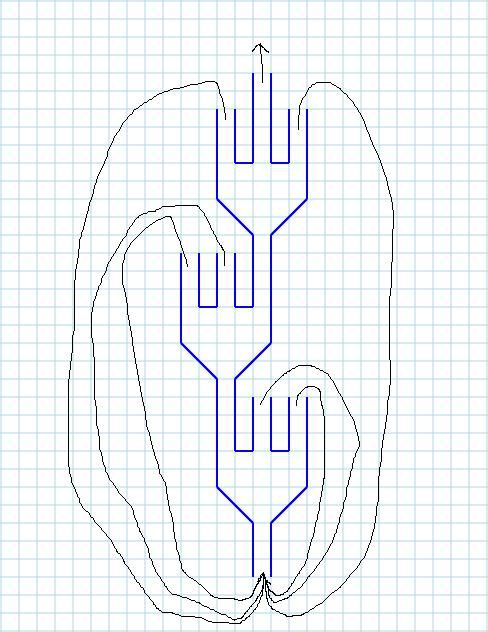
Anyway, back in October 2011, I made some post about a cheesy dungeon trick involving a magic maze.  A tunnel opens into three branches, which must be navigated properly to access whatever dungeon lies within.

See, it starts out like this:

This looks familiar, right?

And loops unless it is navigated in this way:

Oh, yeah.  I'd know those MS Paint arrows anywhere.

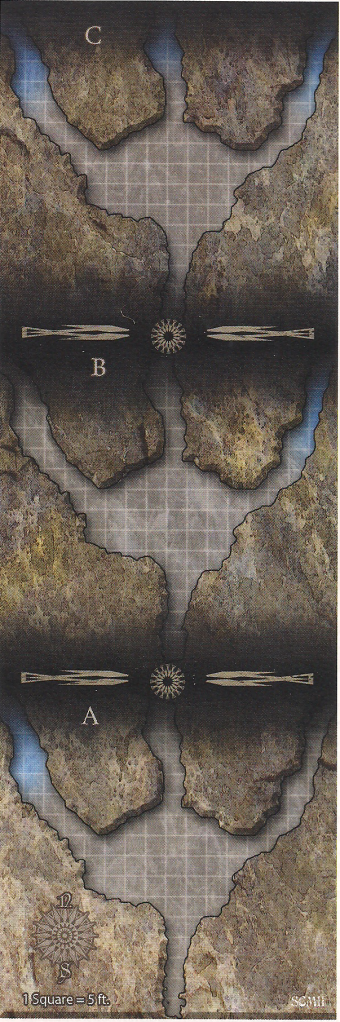
So, I'm reading through "Dead in the Eye" when I come to this on page 8:

Copyright 2012 Wizards of the Coast, from "Dead in the Eye," blah, blah, blah

It's a bit more complicated than my original scheme, but the blue-highlighted route depicts the proper way to navigate the maze (it ends up looping in odd ways to confound interlopers, and travelers don't get any clues before they enter), but you still go left, right, and then continue on towards the dungeon.

It's a fairly classic trick, so I'm assuming it's a coincidence.  If it's not a coincidence, then it would appear that Wizards of the Coast developers and freelancers are reading my blog, which is also cool (go ahead and give a shout in the comments, if you'd like, as I always appreciate feedback).

Tuesday, April 17, 2012

Another Weird Hit

So I previously received one Google hit from some guy searching for "strangling her" porn, but now I have three hits from something that topped that.


The weird part?  I had to know.  I did the Google search.  I got sixteen pages into the results and I still didn't find my blog.  After adding my blog to the search heading, I finally figured out that you can input that phrase and find this post.

I just don't know sometimes.

Friday, March 9, 2012

Tagged

I'm not one for memes, but I was tagged by Jedediah, and you should probably be reading Book Scorpion's Lair (books, role-playing and randomness), Ook, she wrote (an ecology photoblog), and Of Rats and Gangs (the Shadowrun replays noted on Book Scorpion's Lair have their own blog, written as an in-character journal).

If none of those interest you, what in the Hell are you doing reading my blog?

Anyway.

The Rules Are:

1. You must post the rules.
2. post eleven fun facts about yourself on the blog post.
3. Answer the questions the tagger set for you in their post, and create eleven new questions to ask the people you've tagged.
4. Tag eleven bloggers, however, you can break the rules and tag fewer people if you want. Make sure you hyperlink their names/blogs.
5. Let them know you've tagged them - it's good manners ;)
6. Enjoy and have fun with it.


1. If you could choose three people to game with (any at all: fictional, real, famous ect.), who would that be?
Stephen Colbert, Snoop Dogg, and Irene Adler.  Why, you ask?  Stephen Colbert has familiarity with the game, Snoop Dogg would probably have a blast (seriously, Snoop Dogg always projects an aura of having fun), and Irene Adler outwitted Sherlock Holmes.  She would either be the most interesting player or the most annoying; it's difficult to say.

2. What's the most weird thing you have ever eaten?
Everything I've eaten makes sense to me.  I guess I'll go with fried pickles, as my response was typical of the responses I've seen — initial suspicion followed by immediate acceptance.

3. Name the three most important things to have in case of zombie attacks.
It depends on the zombie.  I'll go with clean water, clean food, and plenty of wood — fighting zombies never seems as important as outlasting zombies.

4. Whats top of your bucket list?
I don't have a bucket list.

5. What's the most weird character concept you have ever come across, as a GM or player (feel free to include your own)?
I always get back to the eccentric newspaperman who wanted to disprove religion.  He had a missing eye but frequently wouldn't wear an eyepatch.  Sadly, I never ran that game.

6. Dracula or Frankenstein? Why?
As much as I love Dracula, it's all about Frankenstein's monster.  Shelley's original creation is some alchemical god, super-strong and hyper-intelligent.  He'd be likable if he didn't have all the daddy issues.

7. If you could choose any movie at all to see on the big screen (again or for the first time), which one would that be?
Lawrence of Arabia.  I'd imagine it's impossible to go wrong with a Lean epic.

8. Where did you buy your first dice?
My very first set (Vampire: the Masquerade d10s) was a gift, but I know they came from Colzac Comics.  The first set I bought came from a gaming store a nearby mall; I was out on a random outing and recalled that a friend of mine worked at said store.  I can't remember the name of the store for the life of me.  Both of these stores are now defunct.

9. You're offered a day on a holodeck. What do you create?
I'm running my next Cthulhu LIVE game, obviously.

10. Time travel: what would be your destination of choice?
You know, time travel seems like more of a hassle than an adventure, so I'm not sure I'd want to deal with it.  That having been said, I talked about the Colonial era earlier in the week, so that could be interesting.  For that matter, I've heard a tale about a Man in Black visiting the Continental Congress.  I want to see if that's true.

11. If you had to choose a RPG system to live in, what would that be?
I guess I'll go with Unknown Armies.  It sounds about right.


And now, my turn:
1. You can pick up to five players, living or dead, to populate your gaming group.  What is your dream gaming group?
2. What is your favorite role-playing game?
3. What is your favorite role-playing game you've never had the chance to play/run?
4. Do you prefer to play or GM?
5. What is your favorite novel?
6. What is your favorite author?
7. What is your personal Appendix N?  Give three (quick) examples.
8. What was your first role-playing session like?
9. Do you listen to music while gaming, and if so, what band(s) do you choose?
10. How did you meet your current gaming group?
11. What is your favorite gaming moment to date?


Tagging:
You!  I'm going to do this self-serve: if you like the questionnaire and want to pass the chain, then you're officially tagged.  Answer the questions either on your own blog or in the comments.

Tuesday, December 20, 2011

Review: Carcosa

You should buy this game.

Okay, so, my history with this game is...well, unfortunately short.

I started hearing about it when delving into OSR blogs.  Typically by encountering reviews discussing the controversy surrounded it.  Like this one.  Or this one (also available on RPG.net).

For those who don't know, Supplement V: Carcosa by Geoffrey McKinney was released a few years back.  It was touted as a supplement to the 1974-edition D&D, and was written with that fact in mind.  It was available at Geoffrey McKinney's blog, but by the time I heard about it and went looking for it, that was a dead link (I now suspect that this occurred because he was in talks with James Raggi to get the thing published).

After looking around for it with no luck for a few months, I saw that Lamentations of the Flame Princess was going to publish it.

With my problem solved, this was one of the few products I actually awaited and ordered on release date (strangely, the other was another LotFP product, Vornheim, which I pre-ordered the day pre-orders went live; I've yet to get my hands on Weird Fantasy Role-Playing, but I plan on picking it up, and I expect damn good things).

Anyway, Carcosa details a fantasy setting taking place, well, on the world of Carcosa (you know, where Hastur lives), a setting combining sword-and-sorcery fantasy, Lovecraftian horror, and the typical weirdness of Erich von Däniken and Giorgio A. Tsoukalos (himself a Delta Green friendly).  Horrible entities stalk the empty wastes, and humanity is a cosmic accident (we were actually bred as a slave race for the Snake-Men).

As for player races, there are only humans.  Humans are weird, though; there are thirteen human races, and these aren't ethnicities, these are actual species, although this does not alter their game statistics in any way.  Each race has dark hair, dark eyes, and skin entirely the color for which they are known (Blue Men are as blue as the sky, Green Men are green as grass, Bone Men have transparent skin and hair, Black Men have skin black as pitch, etc.).  In addition to the typical colors, there are three additional colors on Carcosa, and a race of man for each.

There are rumors and superstitions about the different breeds of men.  They do not trust each other as a rule.

The number of classes is reduced to two: Fighting-Men, and a new class called "Sorcerers."  Sorcerers are basically Fighting-Men who can learn spells.  Unlike typical D&D, they start with no spells, instead learning them in their travels.  Also unlike typical D&D, spells are rather unfortunate beasts.  With the exception of dismissal spells, all spells are horrible and should never be cast by anyone.  They take a long time to cast, require exotic components, and will almost uniformly mark the caster as a bad space person.

So, if magic is primarily evil and everything is trying to kill us, how has humanity survived?  Simple: they scrounge the technological detritus of the Space Aliens (basically Greys, by description), using these items to bring the fight to the Old Ones.  These items essentially replace magic items, leading to a setting where loincloth-clad men with bone weapons also have plasma cannons.  As noted in Carcosa, this reliance has stunted humanity's growth; it is far easier to steal advanced technology than invent some.

Ah, well.

The game has some other little neat things that make it worthwhile: tables for random spawn of Shub-Niggurath, random robots, and random alien artifacts.  One of my particular favorites is the random hit dice/damage mechanic.  It slows combat a fraction, but makes combat completely uncertain.  Characters have set numbers of hit dice and set numbers of damage dice.  However, the die type and value is randomly determined.  Those bandits might just have one hit die, but are you facing down d4 bandits or d12 bandits?  Does each one have 1 hp or 12 hp?  Are they swinging with d4s or d12s when they hit?  What about that monster with 10 HD?  Is that 10d12 HD, or 10d8 HD, or 10d4 HD?

Do you want to risk getting into a fight with him to find out?

All-in-all, Carcosa is a fully-detailed sandbox setting, and probably has neat stuff no matter what you play.  For example, you could totally use some of the monsters, spells, artifacts, and random charts in any game (retroclones require the least translation, of course), with some modification.  If you play oD&D, though, this game is truly an inheritor to the title — it combines gonzo, pulp adventure (Conan steals a fusion rifle from the Grays and kicks ass) with pulp horror (sadly, a fusion rifle doesn't protect you from saying, "Hastur") in proportions to do Gygax and Arneson proud.

After all that, I should probably address the controversy about the book.  This is a game of brutal, violent combat, and morally grey people doing morally grey things to other people likely worse than they.

Carcosa is ultraviolent.

People had problems with the graphic violence of the game.  The article at the beginning of this post notes the most egregious example, that of the spell Summon the Amphibious Ones.  The ritual component for the spell involves coitus with an eleven-year-old virginal girl, followed by her murder.

I completely understand why that's offensive.  In fact, if you find that offensive, congratulations, you're not a sociopath.

However, I also think that gaming is probably one of the better places to explore these themes, as the environment is "safe."  (We'll ignore all the horror stories about people with bad roleplaying experiences regarding this sort of thing, and briefly assume that we're roleplaying among people we know and trust.)  Granted, a lot of people don't want to explore heavy themes in RPGs because they don't find that fun.  That's fine (and again probably puts a check somewhere in the "not a sociopath" column of your chart).  But I don't necessarily think it's monstrous to include it, particularly if done with an eye toward the subject matter.

Which leads me to the second point: sorcerers are bad people.  This was a deliberate choice by the author; sword-and-sorcery sorcerers are almost always bad, and if they aren't, they're still somehow wrong (even if Solomon Kane accepted him, N'Longa was still creepy as all hell).  Nobody is stopping a character from playing a sorcerer, but the heights of power are only reserved for those who are willing to sacrifice their humanity.  Sure, you can do this awesome thing, but is it worth it?

The question of character responsibility is always appropriate, in gaming or elsewhere.

Basically, this isn't FATAL.  Horrible things aren't included to indulge in a twisted power fantasy, but instead to balance power with consequences.

So that's that.  If you have anything that really bothers you, you probably shouldn't read it (or look around on the internets to see what people are saying about it, and make a choice based on some other reviews).  If you like your gaming to be light-hearted fun, you likely won't like it (though maybe you'll find something you do like, such as the random robot tables).  If you want some gonzo ridiculousness with a little sanity-blasting horrible, you'd probably like it.

Consider it added to one of the many things I'd love to run someday.

A Word on pdf Layout: While waiting with baited breath for the print version (and the map!), I've been looking at the pdf.  It's a gorgeous beast.  The monsters, spells, and map hexes are all keyed together, so that if Summon Atrocious Beast summons the Atrocious Beast from the Well of Generic Pulp Awfulness in Hex 666, links will take you to all these places.  I typically don't like to read pdfs, but this one is pretty friendly.

A Little 4e Note: I'm currently playing 4e, so my awareness is geared toward 4e.  This RPG.net post asks about porting Carcosa 4e.  For the record, I agree with the author's conclusion: limit characters to Martial types (maybe Psionic types, too?) and only allow magic through the Ritual Caster Feat.  Mess with the rituals to match spells in Carcosa, cutting out the generic component types and replacing them with specific components from Carcosa spells.  I'd be inclined to respond to the post if I didn't have to go through the rigamarole of signing up for RPG.net, so chronoplasm, this one's for you.

Wednesday, December 14, 2011

Wednesday Werk: An Introduction

Here's the deal:

A little while ago, I wrote this post.  In the aforementioned post, I gave 4e statistics for Hereticwerks' brilliant gore-worms.

Well, a conversation happened in the comments, and garrisonjames mentioned doing more Labyrinth Lord to D&D 4e conversions.

So, here it is.  There are a lot of truly inspired ideas over there, and if the oD&D format doesn't float your boat, maybe this will help.

Also, unless otherwise stated, assume that whatever I post hasn't been playtested, so if it murders your entire party, cherish the horror and make new characters?

I guess you can submit feedback if you actually use them before I do.

View the most recent Wednesday Werk entry here.

Table of Contents

1. Gronk Sword, Octoscholar, Synchronocitor

2. Gronk

3. Petrocloptrian, Flytaur, Queen Lobster

4. Bruthem, Glimp-Shell, Xulg

5. Irving the Impressionable Shoggoth

6. Acephali, Almas

7. Candle Head, Grikflit

8. Zaldrim, Scarletscales

9. Walmakash, Urglun

10. Triloo, Rattong

11. Quindra, Hallimox

12. Phorain

13. Ordrang

14. Pseudoblepas, Nerglid

15. Molg

16. Lurm

17. Koponu

18. Drilg

19. Jaladari

20. Illigom

21. Mind-Slime

22. Plodder-Shell

23. Quintapoidal Fungi

24. Necropixies

25. Hagtessa

26. Ractur

27. Sanguinovore

28. Withering Mist

29. Rulak

30. Fantomist

31. Vilg

32. Grobbly-Bonk

33. Miasmagaster

34. Flutter Worm

35. Monoptrian

36. Yirgao

37. Elajess

38. Blatherer

39. Crannit

40. Crudiv

41. Xilmpa

Sunday, October 16, 2011

Some Rambling About System

Today, James Raggi made this post.  I usually warn you about comments, but Jeff Rients writes thusly in the comments:
As far as I can tell the fundamental disconnect between the Forge and what I do is that they seem to expect the rules to do the heavy lifting. I could run the same basic thing in any of several rulesets and get basically the same results. That seems to be the opposite of what they want. I speak tentatively here because I'm not sure I ever understood what was going on at the Forge.
I've been contemplating saying a bit about system for a while and this seems like a good time.

I've heard some arguments for both sides, but I'm one of the guys who thinks that system doesn't matter.  You can run any game in any system.  You might have to make some tweaks, but ultimately, every halfway decent system is viable for whatever you want to do.

The counter-argument is that the Game Master should not have to spend extra time tweaking the rules to make it work for him.  A game should be a toolkit that's ready to use.

(I might counter-counter-argue that with two words: House Rules.)

Anyway, you can run a high-adventure game with World of Darkness, or run gritty horror in D&D (both even have some optional rules to help emphasize these genres, if you're into that sort of thing).  If you take the sanity system out of Call of Cthulhu, then you have the Basic Roleplaying System and you can run whatever you want.  Really, you can break all game engines down and then just use a rules-heavy or rules-lite engine, depending on what you're doing (use Deadlands for that Oregon Trail game you always wanted to run; use Risus for that fast-and-furious Star Wars game you always wanted to run).

Strangely, even though I feel this way, I tend not to do this.  I like the psychology behind different systems — among gaming groups, a system can be a shorthand for the sort of game you want to play.  But I still think that system is hardly a constraint for the sort of game one might like to run.

I would like to play with it, though.  I was contemplating a Star Wars game a while back — I'm rarely intrigued by established settings like Star Wars or Forgotten Realms, but there was a throwaway line somewhere that stuck with me, and I got the idea for a somewhat tragic Star Wars game — and I was going to run it in Saga Edition, but I was toying with (new) World of Darkness or Big Eyes, Small Mouth.  If I ever revisit it, I might still do that.  We'll see.

Tuesday, October 11, 2011

A Little Thing About GNS Theory

I have previously mentioned GNS Theory, and I think noisms's recent post on the subject is fairly accurate.  It's a nice thought exercise, but broad classification tools tend to ignore the weird little idiosyncrasies that people have.

I might be inclined to disagree with his statement about "simulationists," though; it's probably pretty small, but I think there is a base of people who like roleplaying games purely for the world-building aspects rather than the playing-a-game aspects or the telling-a-story aspects.

I might also direct readers to brave the comments, as Zak's comment on GNS ignoring the fact that roleplayers might want different things from day-to-day is also worth considering.

For every comment you read, however, you will spend another month each year in Hades, though, so keep your sojourn a short one.

Print Friendly