Pages

Showing posts with label anecdotes. Show all posts

Monday, August 12, 2024

Advice in Practice: On the Simulacrum Spell

I've talked before about what I think makes for effective games that keep players wanting more (namely listening to the players and establishing real stakes as described in this blog post), but I recently encountered a Reddit thread wherein the original poster was asking about advice for trying to limit the 5e version of the simulacrum spell. The rule for 5e simulacrum is that a given caster can only cast one instance of simulacrum at any given time, but those simulacra could use their one cast of simulacrum on the caster, creating an infinite army of wizards given enough time and powdered rubies. The redditor in question was worried about this "exploit," and was asking for advice.

While a lot of advice in the comments suggests, "go ahead and limit it, you're the GM," I don't find that satisfying, because I tend to think the inflection points of a thing are usually the most interesting part. So in keeping with establishing real stakes, here was my response. A specific example that is potentially broadly applicable; when your players can do something wild and creative that seems like it will upend your carefully crafted world, let them do it! But also, brainstorm the ripple effects this action will have. Nothing happens in a vacuum, and the world keeps moving while the players wait.

(Also, part of the joy of being a powerful wizard in any role-playing game system is doing wild, impossible things. Don't take that from your players!)

I replicate my response below:

As the DM, you are perfectly within your rights to limit aspects of the rules or setting. That's technically the end of the discussion, although I might canvass the entire player group and see what they think.

But personally? I wouldn't limit simulacrum. I'm usually in favor of whatever nonsense my players want to do.

However, there is always a cost.

Each casting of simulacrum costs 1,500gp and takes twelve hours, which means you can functionally only cast it once per day despite your spell slots. (If your characters have folded time or don't need to sleep, then maybe you get two castings if you have the spell slots. Wish obviously changes the calculus of these assumptions, but it does that anyway.)

That means your magic-user's clone army takes weeks to amass. If anything else is happening at the moment, it continues to happen while they're doing this. If the other players don't want to wait, then they get to go have adventures while the wizard sits in their laboratory and makes simulacra all day.

And what about ruby dust? Your player might have plenty of rubies (a single "typical" 5,000gp ruby as described in the treasure portion of the Dungeon Master's Guide yields enough powder for 3 1/3 castings of simulacrum), but will probably have to get more to amass an army over the course of months. That means they have to go delving, or mining, or trading. How many rubies are in a typical settlement, anyway? A typical mine? Is the queen willing to pry every ruby out of her crown to power your simulacra?
All of this to say: the spell is not instantaneous, and it's not without cost. Casting simulacrum takes time and resources, the sort of large-scale project that someone notices and tends to engender strong opinions. What do the NPCs do when they realize a wizard is casting simulacrum over and over again? What do they do when they realize a wizard has 50 rubies on hand? (Worth at least 250,000gp; the GDP of whole city-states.) What do the other player characters do when they realize the wizard is going to spend the next two months blasting through their wealth to build clones?

Are things so quiet in the world that the characters can afford to wait while the wizard performs their Great Work in their ivory tower? Is there no political or religious organization in your setting that would be very interested in these activities? Is the villain merely sitting idly while the players gather a magical army vulnerable to antimagic?

I don't know the parameters of your campaign. But I do know that player decisions don't happen in a vacuum, and in high-level games, they have consequences. Big consequences. What are the consequences of this choice?

Play to find out.

Thursday, November 9, 2023

Doxacon 2023 After-action Report

This past weekend (November 3 and 4, 2023) saw Doxacon X in Arlington, VA. Despite the fact that Nicole and I are still preferentially avoiding large groups in the midst of the ongoing plague, Kenneth Hite posted this three months ago and found it impossible to resist the siren's allure:

So off we went.

But first, a word about personal bias: Assuming you clicked on the above link to learn that Doxacon is sponsored by the Protection of the Holy Mother of God Orthodox Church, and assuming you have read my previous blog posts like this one, you might surmise that Nicole and I are not quite the target audience for this convention. So interpret whatever I write with that in mind.


Also, it appears that Doxacon eventually puts its lectures online, and there was definitely recording equipment present. So whenever that happens, I will endeavor to link to the lectures here.

Doxacon is a small convention: this gathering had somewhere in the neighborhood of 400 attendees, although we hardly saw that number present. Since we were coming for Tim Powers and Kenneth Hite, we missed several of the lectures and didn't participate in the gaming block around lunch on Saturday. (In hindsight, I'm curious to see the full shape of a table-top RPG at a Christian fantasy convention.) I would ultimately estimate that we saw about a third to half of what the convention has to offer.

Having skipped Friday evening, Saturday morning opened with an akathist before Tim Powers' lecture. Tim Powers spoke about writing fantasy fiction as a Catholic, and how having a belief in the supernatural makes one's fantasy writing more authentic. Whether or not you agree with that point, I can find common ground with the idea that you have to believe on some level about the subject of your writing — I have previously said that I think my Unknown Armies campaign The Rule of Beasts suffered because I never quite believed the antagonists' motivations.

In the afternoon, Kenneth Hite's lecture was about traditional morality in Lovecraft's work and in Call of Cthulhu. He argues that while most RPGs are escapist fun (and there's nothing inherently wrong with that), Call of Cthulhu reinforces traditional Christian morals because it posits that player characters are willing to sacrifice themselves for the greater good of their community. Hite also connected this to the Western, and deftly brought these themes into Lovecraft's work by pointing out that most of his stories with "happy endings" occur in his hometown of Providence, RI. Despite his nihilism, Lovecraft clearly also had things he cared about and an eye toward community.

While I'm not the intended audience for this lecture, I'm certainly intrigued by the assertion: he has a point that most games do not start with coalition-building as an explicit goal, and almost none of them encourage personal sacrifice in either tone or mechanics. (That stuff often appears as an emergent property of the group rather than something explicitly coded in the rules.) While noting that there aren't many games that encourage coalition-building as an explicit goal, he referenced Underground and Avery Alder's The Quiet Year as good models in this paradigm.

I idly wonder if we'll see more coalition-building mechanics in the wake of renewed collective bargaining power over the next decade, but then again, who knows what the future holds?

The final lecture was a panel discussion among all authors about their writing process and about the role of fantasy in a secular world. Regarding the latter, Ken Hite's comments resonated the strongest with me: belief never left, as we always need stories and ghosts and fairies and continue to repeat them time and again even as proponents of the Enlightenment claim we have banished them. Regarding the former, Ken Hite contrasted what game designers do with what traditional authors do, noting that RPG designers really only provide setting, leaving plot and character to the individual tables, but that comes with the added difficulty of having to provide lots of setting as one does not know how those individual tables are going to engage with the material.

He also noted that the joy of game design is that nothing is wasted: if you have a concept that seems too niche to achieve mass appeal as a setting book, you inflict it on your home game instead. (His example was Rex of the Old '97, which I know for a fact would be eagerly purchased by tens of Unknown Armies fans.)

With that, we closed the book on Doxacon X, leaving Arlington before vespers.

While there were no grand revelations from the lectures at this Doxacon, it was a fine time and very worthwhile. (I got something out of all of the lectures, and I think it is worthwhile to occasionally immerse myself into wholly alien cultures.) I cannot say that we would return any time soon, although depending on the guestlist in a future year, I would be loath to say we would never return. If you're a faithful Christian in the D.C. area with an interest in science-fiction and fantasy, you'll probably like it. Otherwise, you might feel a little like Dr. Gonzo at a narcotics convention.

Edit (11-09-2023, 11:52 AM): Chaosium's Facebook page shared an article from Catholic news site Aleteia, which posted their own (much more thorough) overview of Doxacon.

Edit (01-11-2023, 10:20 PM): The recordings from Doxacon are live. Tim Powers' lecture is here and Ken Hite's lecture is here. (If by some happenstance you're reading this in the far future, the recordings from Doxacon X should be dated Tuesday, January 9, 2024.)

Thursday, August 3, 2023

All's Well That Ends Well


Another year, another completed long-form campaign.

Last year, one of my player groups wrapped our eleven-year-long Dungeons & Dragons campaign. Last week, we wrapped our seven-year-long Unknown Armies campaign. As always, you can read the entire thing over at Obsidian Portal.

After Crux of Eternity and The Imperial City, it comes in third in terms of number of years. Probably in the number of hours, as well: I would estimate maybe 300 hours, but who can say?

It started humbly, as a playtest of the yet-unpublished third edition. (You'll note there that I call it a mini-campaign, not yet aware that it was going to last over seven years.) We largely stuck to the collaborative setting generation, but as with Crux of Eternity, I started with a handful of inspirations which were woven into the structure as appropriate:

  • There's a rumor in the second edition core rulebook about Jim Morrison still being alive.
    • Being well-acquainted with the old rumors that he faked his own death, I decided a long time ago that he was probably The True King of Los Angeles.
  • I read volume one and volume two of the collected Suppressed Transmission by Ken Hite.
    • Specifically, there was an article about Misrule that got the wheels turning in my head about an avatar of The True King symbolically being deposed in favor of an avatar of The Fool.
  • Years ago, I wrote some notes about a potential game set in Las Vegas, featuring an apocalyptic cult leader in the mold of Tyler Durden from Fight Club.
    • I realized this was an opportunity to tell his backstory, since I knew he was an annihilomancer who got a major charge at some point.

These elements combined to form the basic setup. While the players just knew that Hollywood producer Jasper Fitzroy was acting a little strange of late, the truth is that he was an unconscious avatar of The True King, baptized as a child to be the king of film actors by none other than MGM executive Nick Schenck, attempting to make the ultimate movie star. Magickal shenanigans prevented it from working as planned, but Fitzroy was destined to step into a kingly role no matter where he found himself, so he became a royal movie producer instead of an actor.

However, Jim Morrison, The True King of Los Angeles, never wanted the job, but he also didn't want it to go to someone who might abuse the station. And he certainly didn't think a movie producer could avoid the temptations of a powerful occult position, so he tried to think of a way to rid himself of this rival king without killing him or informing him of the existence of magick.

The answer came in the form of Iggy Williams, an annihilomancer who left Los Angeles in the early 1990s but came back in the late-2000s. Jim Morrison recognized him, but knew that he didn't want him in town, either, so he hatched a plan to rid himself of both simultaneously by convincing Williams to get two major charges by leaving town and convincing Fitzroy to leave as well. This seemed like a pretty hard sell until Fitzroy's wife died, in which case it became easier to insert new people into his life during the upheaval. And that's the very unlikely set of circumstances by which Iggy Williams became Jasper Fitzroy's personal assistant.

Since Iggy Williams had never harvested a major charge before, he didn't know how much symbolic power he needed, so it was his idea to invoke the whole Misrule thing, introducing Fitzroy to an unconscious avatar of The Fool named Pamela Kruse and then slowly making it look like his predecessor cooked the books and Fitzroy would take the blame — but he could save the rest of his family by fleeing to a foreign country.

A convoluted and tenuous plot, but a symbolically resonant one.

Unfortunately, the player characters didn't unravel the plot in time, so Iggy Williams convinced Jasper Fitzroy to flee Los Angeles and put Pam Kruse in charge of his affairs. However, that misfortune kicked off the rest of the game's plot as the characters found themselves tangled in the local occult underground. (And I suspect that failure turned a short campaign into a long one, as they sought to unravel many mysteries and bring order to the city's chaos.)

The Obligatory After-Action Report

While I have run a lot of urban fantasy and horror games previous to this one, this was my first time running Unknown Armies for more than a couple of sessions, and specifically my first time running third edition.

Many of my complaints about the system remain despite the fact that it's a pretty good system, albeit one that feels more like an assemblage of parts than a cohesive whole.

It's a very sandbox-y game, which suits my style, but I think that player-driven goals can sometimes leave the players adrift, especially because of a pattern I've noticed across a couple of games. Having now run two Unknown Armies campaigns, I like to make them grounded and realistic, and the players instantly respond to this. They make backstories, introducing friends and family members and connecting with NPCs. But this also serves to make them play the game very conservatively, as they suddenly have jobs and loved ones they can lose. As such, nobody plays the sort of ruthless obsessives that Unknown Armies seems to really encourage, especially in previous editions, and that means that they approach Objectives with a lot trepidation and very little mayhem. And that limits their options.

Note that this isn't bad — more player buy-in versus more player mayhem is a choice rather than a value judgment — but it does make the Objective process take a long time as players try to determine the safest way to handle a problem. (The recurring joke during this campaign was that we were actually playing a Camarilla campaign, given all the careful politicking.)

I also suspect that has something to do with relative power levels: both of my long-running Unknown Armies campaigns have begun more-or-less at street level. Sure, the characters might start with funky powers and weird experiences, but they don't know that there's an occult subculture out there, and they certainly don't know about things like the Statosphere or Invisible Clergy. And when you're new to the occult community, all you have is the stuff you brought with you: your career, your family, your friends.

Obviously, you don't want to lose that stuff.

But there is something very magical about a slow-burn occult campaign where you see the players go from clueless newbies staggering in the shadows of giants to people who feel comfortable solving their problems with ritual actions and weird artifacts. It's telling that we started the campaign with the player characters trying to unravel the mystery of a film producer's sudden shift in mood, and we ended with a ritual arson designed to assassinate a powerful wizard.

As for "the plot," as befits a sandbox, the campaign ranged all over the place. The campaign lasted long enough for the players to plumb most of the mysteries I plotted at the start, although as one might expect, each question yields half a dozen others. By the end of it, they are movers and shakers, having cut deals and installed their own True King as the symbolic monarch of Los Angeles, so the repercussions of this game will likely reverberate into any future Unknown Armies games I run. (Especially as the charitable foundation they created moves into other cities.)

This was also probably the most romance-heavy game I've run: everybody had some manner of romantic relationship, often forged in the fires of the secret wars of the Los Angeles occult underground. (And some characters had several romances during the game!) As noted in the Crux of Eternity after-action report, I always find that funny as I don't plan romantic subplots, but it often appears in my games, so the players clearly trust the process.

Final Thoughts

As is usually the case, I'm running another campaign on Sunday, so I don't have time to mourn the passing of this one. It always feels a little weird to end things, but there are always more stories to tell, and time marches ever oneward.

Nevertheless, I expect I will continue to think about it for some time, wondering what might happen next in that city of tiny lights by the sea...

Friday, June 9, 2023

Advice Against Quantum Ogres

Meanwhile, on a Facebook D&D group, someone shared this meme:

Accompanying the meme was the question, "What do you do if you are the DM?"

As you might expect, The Dreaded Discourse™ reigns, and there is a long conversation nested in the threads below the post. (And the original post was shared to other groups, themselves with long nested threads of The Dreaded Discourse™, so there are a thousand thousand such responses.)

Contrary to my instincts, I engaged. (I fall firmly on Team Anti-Quantum Ogre.) Most of the rebuttals were something to the effect of, "How do I run an epic game without offering the illusion of choice?" But in the midst of that, I think I gave the best advice I've ever given as a Game Master, and will probably ever give as a Game Master, so I repeat it here for you:

The players are already on your side. You don't have to lie to them to get them to like you.

I'm only being a little hyperbolic when I say that 90% of GM problems could probably be solved by keeping this in mind. Even if you're gaming with total strangers, they're there to game. They want to play a game. It's not a job interview* and it's not going on your permanent record, so you don't need to impress anyone. Just make sure it's fun, and it will be memorable without you doing anything special.

(And obviously, "lying" in this case should be assumed to mean things like illusion of choice, or "protecting" certain NPCs, or other bits of behind-the-scenes chicanery. Most GMs keep hidden information, which falls under typical player expectations for traditional sorts of table-top role-playing games. Determining and calibrating how accepting players are about hidden conspiracies, secret NPC agendas, and the like makes a good Session Zero conversation.)

As for how to run an epic game without offering the illusion of choice, it's hard to fake the actual work. You basically have two choices in that regard:

  • Run a linear adventure path, and be up-front about it. Decide what you do when the players leave the rails before you get to the decision point. (If you don't have a meaningful choice in mind, why give them a choice in the first place?)
  • Run a sandbox, but make sure the players have enough information to make meaningful choices. (With the requisite caveat from The Alexandrian that choosing to not do research, or failing to find information, are also choices that should be honored.)

Outside of those options, be prepared to improvise if they make choices you didn't expect, or just be honest with them. You can get a surprising amount of mileage out of, "This is what I have planned tonight," although you have to be prepared to roll with the punches if you want the world to feel immediate and infinite.

And honestly? Speaking from experience, the most interesting game tidbits tend to happen when the players go completely outside of your expectations and into no-man's land.

But remember: no matter what else happens, the players are already on your side. You don't have to lie to them to get them to like you.

* Okay, so if you're a professional GM, it's a bit like a job interview, but "impressing" those players tends to come more from actual work than shortcuts. And as with a home game, you tend to impress players the most when you validate their choices — when the players see that their choices matter and that their decisions have an impact on the world, that's when they pay close attention to your game.

Friday, March 10, 2023

No Prep Is Wasted

If you run games long enough, higher-order patterns begin to emerge without your direct input. A campaign setting is a thing better divined than made.

I have previously posted about Arctic Death, Infinite Night, my "arctic Ravenloft" campaign. (If you want the basic setup, this post has all the details.)

Well, that section of the campaign has wrapped, and as they say, the slime's coming home. They killed the darklord, did the obligatory bookkeeping, and now the wizard has built a spelljamming helm and they have acquired a vessel in the hopes of returning to the home they fled via the Gardens of Ynn, essentially causing most of the issues in the campaign to date. As for the Domain of Dread of Isiksivik, when they slew the darklord, the whole realm fell back into the world it left centuries ago.

But which world is that?

I've been ruminating on that particular question for months now, but then I remembered What Luck Betide Us. Many years ago, some friends asked me to run a 4e campaign, and I did a lot of work on it before we started. Like, I made a map of a region a million square miles in size and filled in the settlements with procedural generation before the campaign started. (To contrast, the Sorrowfell Plains map for Crux of Eternity is still mostly empty, with landmarks only going on the map as they come up in play.) While a fun exercise, I wouldn't recommend trying to build a campaign setting from the ground-up like in What Luck Betide Us, and I certainly wouldn't have the time to do it now unless someone were paying me.

Well, as with most campaigns where you front-load much of the work, that game died a horrible death after only a couple of sessions. So it goes.

But that just means that there's an unused campaign setting just sitting in my notes, one that I know fairly well because I made it up. Isiksivik can easily sit to the far north of the region from What Luck Betide Us, and what's more, the dwarf's sketchy backstory fits nicely with the overall aesthetics of the dwarven theocracy of the Farhelfik Commonwealth and the elvish magocracy of the Lanirilis Protectorate. She can just as easily be from the same world!

(The characters in Arctic Death, Infinite Night subsequently met the major campaign villain from What Luck Betide Us, because they fit well with her agenda in the service of Chaos.)

Years ago, I also teased The Wizard at the End of the World. I didn't know anything more about this entity than I put into the blog post, but I figured the rest would sort itself out in the fullness of time. In trying to solve this problem, I also solved that problem: The Wizard is indeed the second iteration of a BECMI-style Immortal, originally from the Sorrowfell Plains but now ascended after some time shenanigans, and What Luck Betide Us features the world she made during her first ascension. (I already knew she made a world, I just didn't know that it was clearly this one. But it nicely explains a couple of things I never quite figured out during the course of What Luck Betide Us.)

(The characters in Arctic Death, Infinite Night subsequently met this Immortal in her guise as the elf Archdruid Lueliten. She has ties to the dwarf's backstory and clearly has some future knowledge about what has happened and will yet happen.)

If there's a takeaway from all of this, it's the advice I gave at the start: leave gaps in your campaign creation where interesting things might go. The players don't need reams of epic backstory to jump into a game, so you don't need to make them. However, if during the course of planning or play, you determine interesting connections between your disparate, intriguing details, give them context and make them matter. (Remember: nothing the GM does matters unless it emerges at the table. This is why the other players ultimately have more power than the GM, because every decision they make matters.)

It's the Tim Powers design principle, but applied to one's own writing: in a couple of places (I'm citing this one in particular), he references doing research for his latest book, giving this anecdote, "Half the time, if it's very late at night, I find sometimes when I open some new research book, it'll appear to confirm my fictional theory, and I’ll think, 'Oh my god, Powers, you’re not making this up. You've stumbled on the actual story here.' Except in the morning, I'm sane again." Leave gaps, interrogate those gaps, and then divine your own campaign setting from what you find.

Now the only way to truly recycle all my ancient prep is to find a way to re-use plot points from my aborted Spelljammer campaign from ten years ago...

Thursday, January 5, 2023

RPGs as Art: On Sincerity in Art

"Don't do fashionable science." — Max Delbrück

A mantra for 2023.

Wandering around the lonely corners of the internet in this foul year of our Lord two-thousand twenty-three, there's a repeated piece of advice that feels intensely counter-intuitive to me. Whenever someone is thinking about writing something for publication — often on one of the OneBookShelf community content sites like DM's Guild, Storyteller's Vault, or Statosphere — the most common piece of feedback I see is to write something that the author thinks will be popular. Or I see people soliciting their slice of the community for ideas, putting up a poll or open thread about what sort of thing the community wants to see next.

It doesn't surprise me that lots of those projects never materialize.

I can't speak for anyone else, but I can say that I am way more likely to finish something if I'm passionate about it, and I'm more likely to be passionate about it if it was more-or-less my idea. My idea is a relative concept — it might be a collaboration or even someone else's skeleton that I sketched out — but the key is that it's something that lit my brain on fire and I had to put it somewhere. If I produce it for public consumption, I'd rather produce a weird piece of art beloved by ten people (and perhaps hated by a hundred more) than a milquetoast piece of art that is passively enjoyed by hundreds of thousands of people and then abandoned when the media cycle changes.

(In fact, the most melancholy version of the crowdsourced art trend is seeing someone abandon a passion project because they arbitrarily decided no one was interested in it. I still dream about the guy who was thinking about doing a Statosphere supplement about archery. Archery hasn't appeared in my modern horror games, but if someone is passionate about it, I want to see what they do with it.)

On the consumption side of things, the RPG products I enjoy and get the most use out of are things I never knew I wanted in the first place. Of the Unknown Armies offerings on Statosphere, everyone talks about big, ambitious products like American Dreams or GOAD or RITE, but I've gotten the most direct use out of Three Miles of Bad Road. (I'm not even running a car-centric campaign!) I haven't had a chance to slot The Sun King's Palace into a fantasy campaign yet, but I'm definitely going to do so. I keep returning to it, tasting it in my dreams. I certainly didn't ask for a d100 horror sci-fi game, but Mothership continues to beckon me. (And there's a sentence or two in the beginning of A Pound of Flesh that features some of the best game advice I've ever read.)

All this to say: everyone has a story in them that only they can tell, in a medium of their choosing. Even if it's a lousy story, clumsily told, it will resonate with someone. Make your weird, idiosyncratic art and you will find like-minded people to play with you. Don't try to make the art you think people want to see, and don't try to make art because the topic is trendy. If you find yourself rushing to make something so you can release it while it's still topical, you've already lost.

So when you're staring down the gun barrel of your next RPG project and you don't quite know what to do, don't turn to focus-testing to tell you what to do. Brainstorm, try stuff, put your weird art out into the world. Consider this your permission to get real fuckin' weird with it.

(And astute observers will note that this applies to all art, not just role-playing games. I've watched a lot of mediocre film and television over the past month, things that were clearly focus-tested to death or tried to have Important Things To Say™ rather than honest things to say. Tell a story only you can tell.)

The Obligatory Addendum

Since the above screed largely talks about the individual (-ish) process of making art, let's talk about the uniquely collaborative activity of role-playing games themselves. (As I say repeatedly, RPGs are what happen at the table, and the rest is but smoke.) Even though the above post addresses the individual artist, it also applies to the group as a whole. If you're a Game Master, don't ignore your group's good ideas because they don't jibe with The Very Important Story You Have To Tell™. If you're a fellow player, don't ignore your other players' ideas because they don't fit your conception of this collaborative exercise.

The RPG table is going to be weird, messy, and collaborative. Your job is to enable that collaboration and have fun. (Please don't forget that games are supposed to be fun.) Everyone's favorite moments in a role-playing game are invariably when everything is chaotic and in total freefall. Lean into that, otherwise you could be writing a novel.

Thursday, December 22, 2022

How to Keep Players Returning for a Thousand Hours

As noted elsewhere, I've run a lot of long campaigns. (I don't currently have an ongoing game that has lasted less than three years. My longest campaigns lasted eleven and eight years, respectively; one of my current ongoing games has continued for six-and-a-half years.)

Bearing that in mind, one of the most common complaints I see on the internet is about Game Masters attempting to wrangle players and force them to enjoy the GM's nonsense. To answer those complaints, here's a short list of advice, in many ways a coda and distillation of the advice I gave at the bottom of this post. Enjoy!

  1. Don't cancel. If the players have to cancel, that's one thing. But in my experience, if the GM habitually cancels, everyone assumes the game isn't a priority and their attention wanes. Stay home if you're sick or there's an emergency, but otherwise, do your best to make the game a priority and your players will do the same.
    • If you have to cancel, give as much notice if you can. Otherwise, even if you're feeling unprepared, this might be a great opportunity for a breather session.
    • If you can establish a regular schedule, that's even better. Don't break it unless you absolutely must.
  2. Listen to the players and make their choices matter. Table-top role-playing games have two big selling features: players can try anything they want (as long as they're willing to live with the consequences), and it's the only activity in this cyberpunk hellscape where a participant is guaranteed an actual living human's individual attention (as a reward rather than a punishment). So give it to them: let them try whatever they want and live with the consequences as long as you telegraph the consequences in advance.
    • You don't have to tell them exactly what will happen, but "if you fail this jump you'll fall" and "you don't know what will happen if you mix those potions together" are good starts.
    • Also, let consequences echo throughout the campaign. Players love it when a dangling plot thread from a year ago makes its triumphant return.
    • You can do this even if the characters aren't "important." The cashier at the corner store notices that you haven't been around in a couple of weeks; that establishes the character's place in the world and suggests that someone cares about what they're doing.
  3. Establish real stakes. A series of 300 scripted fights might be fun as a tabletop combat sport, but it makes for a boring longform campaign. Dig into why the characters are doing what they do, and play antagonists as intelligent characters in their own right. Everybody wants something, and has stuff they're willing to do to get it. What does that mean for the NPCs? What does that mean for the PCs? Even if the players are no-backstory dungeoneering chumps engaging in 1974-style fantasy adventuring to get gold to gain XP to build a domain, that's a plot detail that should probably come up before Level 9, right?
    • On a smaller scale, not every encounter with hostile forces should lead to combat, and those that do should feature creative use of equipment, terrain, traps, tactics, and even more ephemeral things like positioning and time limits. A fight even against weaker opponents is more interesting if they have hostages, while C1: The Hidden Shrine of Tamoachan increases the difficulty by giving the players a time limit while delving the dungeon.
    • Even if events become world-shaking, always bring the game back to the player characters' scale. They're not saving the world, They're saving the people in it. They probably even know and like some of them!
That's basically it. You should show your players all the courtesy you want a friend to show you, and they'll keep coming back to find out what happens next.

Thursday, November 3, 2022

Classic-Style Fantasy Elfgames: A Summary

To grossly misappropriate one of my favorite quotes about dungeon-y, dragon-y games, "You play Conan, I play Gandalf. We team up to fight Dracula." In that spirit, I saw this picture on Tumblr which also captures the appropriate vibe:

As always, click the picture for the original artwork

Wednesday, June 15, 2022

The Head of Vecna

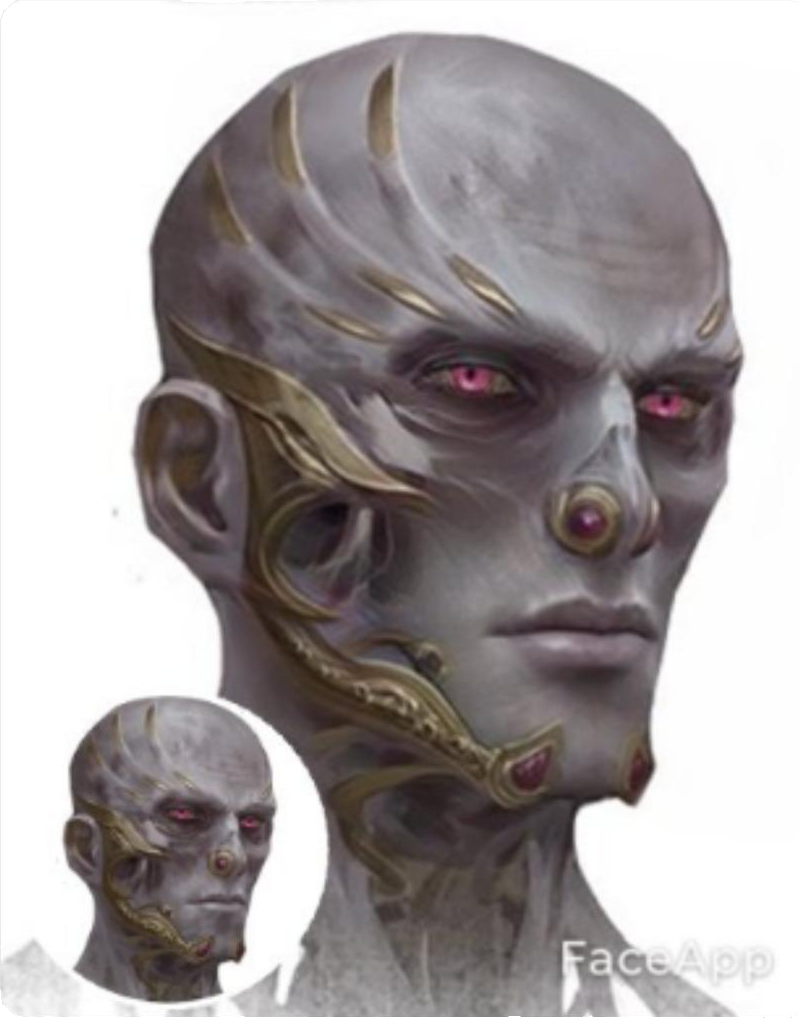
A week or two ago, Wizards of the Coast released a new design for D&D's Archlich Vecna, back before he was betrayed by Kas and still had two eyes. He looks like this:

As you can imagine given the sharp cheekbones and strong chin, the internet-at-large was very normal about it.

Vecna featuring The Book of Erotic Fantasy.

Continuing with that train of thought, when Nicole saw it, her comment was, "They yassified Vecna..."

And her comment led me to create this monstrosity:

I think I met this guy at the club one time.

Which then prompted this edit of Vecna from the classic Die Vecna Die! cover:

A friend said he looks like an Are You Afraid of the Dark? villain.

And of course, since people were confused about Vecna because of Stranger Things, that led to whatever this is:

This anime protagonist needs moisturizer.

A friend also mentioned Acererak. Acererak the demilich or the regular ol' lich sadly doesn't have enough skin for FaceApp to recognize his face, and the one human picture of Acererak I was thinking about is too low-resolution for the filter to make his face look right:

He looks like a Spongmonkey.

To end this very stupid post, I'll leave you with a friend's ultimate comment about the Vecna redesign:

Happy Pride, everyone!

Thursday, May 26, 2022

It Is Finished

It is done.

After eleven years, we finally wrapped the Crux of Eternity campaign last Saturday, May 21, 2022. If you want to read the session reports, you can find the whole thing at Obsidian Portal.

It's certainly the longest campaign I've ever run in terms of the number of years. Even though there were some significant breaks, I would still estimate the whole campaign at around 800 hours, which is probably about how much we would have played if we played regularly for eleven years. (Assuming roughly once every two weeks at three hours a session.) In contrast: my next-longest campaign is the occasionally-mentioned The Imperial City, which lasted about eight years. We played irregularly, but very often — I expect we were gathering roughly twice a week at the height of that game, so in terms of hours, it likely blew Crux of Eternity out of the water. Rounding out the other completed campaigns are Bread and Circuses at just over two years and False in Some Sense at about a year-and-a-half.

I have talked about the origins of this game elsewhere, but the key points are that we started in May of 2011 in fourth edition, updating to fifth edition in December of 2015. The humble seed of this campaign sprawled into my typical nonsense: an elaborate cultic criminal conspiracy corrupts the heart of the largest city in the region, and it is poised to spread if the player characters can't stop it. I didn't know then at the time that we were going to spend eleven years fighting slavery and delving the dangerous wilds of the Sorrowfell Plains, but here we are.

Since then, that game has spawned many others and has ranged across several different systems: in addition to a couple of one-shots and side stories and budding campaigns, we have explored a tale of escaped gladiators trying to find their way in the world, a conspiracy tale about high-level enchanters doing... something, and a tale about poor wanderers trapped in a land of arctic horror. I'd love to run a proper old-school, open-ended hexcrawl with, say, BECMI or Old-School Essentials one of these days, but most of my players respond way better to concrete objectives, so we keep riding the fine line between new-school and old-school.

(Although I can't tell you how badly I want to run a BECMI campaign that runs all the way from level 1 through the Immortals box set twice until the players ascend past the Immortals tier. A massive undertaking, but one that I imagine would be very fun with a dedicated group.)

While I'm always worried that my players aren't enjoying themselves, they kept returning after eleven years, so I suppose we made something we could all enjoy. They certainly seemed to find the final battle against the Khan of Nightmares dramatic; the umbral blot was a terrifying opponent, and the Khan's personal hound turned half the party to stone before they finally managed to defeat the Khan and take over his Coliseum Morpheuon.

And then they fade into the mists of history to fulfill their own agendas and inevitably return as NPCs in some future game...

The Obligatory After-action Report

This was my first time running fantasy in general or Dungeons & Dragons in particular, and since it lasted over a decade and spawned many spin-offs, I have to assume it was a rousing success.

I have to assume the players were engaged if they stayed with this game for so long. For all my uncertainty, they certainly seemed like it; it wasn't as anarchic as The Imperial City, but every month or two, I would get a message in my inbox from someone who wanted to do something on their own time.

Having played both extensively, I vastly prefer fifth edition to fourth, and ultimately think it's a decent game. (As with most things, it's better than the haters claim it is but not as good as the fanatics seem to think.) It's certainly more suited to the sorts of games I like to run than some other editions, and not as focused on combat as third or fourth edition. If I could have run this entire campaign in fifth edition, it definitely would not have been as linear and structured.

However, I also tend to prefer old-school play to new-school play. As noted above, I wish I could have done more what I did with Of Kith and Kin: start the characters in a town, seed a couple of adventures, and see what direction they go. Some players respond better to that than others, but I preferred the sprawling, open-ended game Crux of Eternity became rather than the plot-driven quest it was at the start.

The game went largely as I expected, for better or worse, although we had a couple of side-quests that took me by surprise. (The battle against Kiaransalee and the Khan of Nightmares were both largely or wholly player-driven activities.) We've also done enough world-building that this game will no doubt spawn several others for as long as I care to run fantasy games and my various gaming groups care to play them.

My only regret is that we didn't have a more open table. We had a handful of guest stars over the years, but I like the energy that new people bring to the table. A possible consideration for future games. (Then again, I'm thinking of eventually following this up with a West Marches-style Blade in the Dark game, so then I can accommodate a truly sprawling number of players.)

And Now: Some Advice

This game has been marked by me becoming more active in the RPG internet hobby space, and so I see lots of comments, complaints, and critiques about long-running games. (Or trying to organize games in general.) Mainly, prospective Game Masters seem mystified as to how to get a group together and to keep them interested. I find that getting a group is the hardest part, especially if you live somewhere that's a trifle remote, but keeping them around and engaged isn't especially challenging. Trawl hobby spaces, be active, talk to people: the usual stuff you do to make friends in this wide world of ours. Beyond that, contemplate these tips:

  • Don't get discouraged if your player group isn't interested in playing your favorite RPG. Compromise is part of life, and the rules typically aren't as important as the culture at the table. If you build a rapport with your group, you can eventually convince them to play any game you like. But you have to put in the work first to build trust.
  • Be excited. Even if you're, say, a Monsterhearts GM who is stuck running this vanilla fantasy D&D game, put stuff you like into the game. There's plenty of room for queer romance and interpersonal drama even in the hardest sci-fi dogfighting game. I cut my teeth on World of Darkness and fell in love with Unknown Armies, so my D&D games are full of secret societies, Gothic horror monsters, obsessive wizards, moral ambiguity, and de-emphasized combat. There is a lot of room to explore the sort of stuff you like; traditional games usually have room for all sorts of campaigns in them, so there's room for the stuff that excites you.
  • It's pretty easy to challenge high-level D&D characters: give them real stakes, follow through on your threatened consequences, and put them in impossible (but open-ended) situations. The real magic is when players surprise you. (This is good advice for any game, by the way. Most traditional sorts of pen-and-paper RPGs assume characters become more powerful as they age, so there's likely a "high-level" option for your favorite RPG, as long as it isn't too esoteric.)
    • One of the reasons why good published high-level adventures are so rare is because high-level games seem to grow logically out of the consequences of your players' actions. Also, what might be a suitable challenge for one group might be too easy, too boring, or too difficult for another. The variables are so great that it's difficult to predict that sort of thing.
  • Don't punish the players for good ideas. Throwing a bunch of qualifiers at them or making every outcome negative really hurts player morale. Every character choice is a vote for what players want to do and be good at doing in a game, and you shouldn't invalidate that.
  • The players are the stars of the show, and what they choose to do in the game is a vote for what they want to see. If they fall away from certain challenges or characters, don't force them to interact with them. If they hang out with certain NPCs more than others or gravitate toward certain places, encourage them to do so.
    • As an example, I'm not a romance-heavy GM, but my games often include romance because many of the players seem to enjoy exploring it. Give the people what they want.
  • Make the players' choices matter. Good or bad outcomes are less important than agency, and the players are going to remember the puppy they saved or the tavern that was named after them more than the big, epic set piece battle with the Dawning Lord of the Nine Suns. Saving the world isn't half as cool as when the tavern server remembers your drink order.
    • Although you can make saving the world matter when the world reacts to it. If people tearfully thank your players for saving them, or hide them when they're in trouble, then their choices mattered.

Final Thoughts

As I write this, it still hasn't really hit me that it's over. Admittedly, it's not really over for me: I have a session of Of Kith and Kin on Sunday, so my head is still very much in the Sorrowfell Plains.

In a very real way, this blog only exists because of this campaign, so if you've ever enjoyed anything you have read here, you can thank this sprawling epic and the dedicated players who saw it through to the end. I learned a lot from running it, and those lessons will hopefully inform whatever happens next.

I'll hopefully also have more time to curate the blog and write stuff as some of the existing campaigns wind down. That's always the dream, anyway.

Be seeing you.

Thursday, May 19, 2022

REVEL AT ION

I've learned a lot about myself during this ongoing pandemic of ours. For instance, at the beginning of the pandemic, I was in ten role-playing games, and running six of them.

I've learned that you should never, ever do that.

(These days, I'm at a more reasonable six games, and only running five of them. You should never do that, either. I suspect I'd be happiest running two or maybe three.)

I've also learned that I'm not a big fan of running one-shots. They're fun to play, but I find it takes roughly as much work to craft or prepare a one-off game as it does to start a campaign, and then I might as well just run the campaign. (An endless series of one-shots requires roughly the same effort every time, but campaigns have a break-point where what I get out of them vastly exceeds the work I put into them. Plus, most games are complicated enough and many players are addled enough that there isn't really time for character creation and a game session, meaning a one-shot is two sessions, or I have to make the characters, which adds to my planning load.)

Of course, the track record among my circle of friends probably speaks to that. I have a modest number of completed campaigns under my belt, but to date, I have only played in one campaign to completion, and even then the GM scrambled to wrap everything up before he lost interest. Campaigns otherwise usually fall apart, or the GM gets bored, or the character sheets get lost, or whatever.

I vastly prefer to run RPGs than play them. (But you probably guessed that from the content on this blog.)

Most importantly, I think I've learned what my ultimate, Platonic ideal of a campaign would be.

Serious, Stupid, Spooky

You need the mix of all three in roughly equal proportion. To keep things interesting, the tone needs to drift over time. Perhaps an example will explain what I mean. My ultimate game would go something like this:

The player characters are trapped in a town during a zombie outbreak. (Did they arrive during the outbreak? Were they in town and the dead rose? It probably doesn't matter, although the latter makes more sense.) It's the standard zombie setup familiar to Romero fans and Resident Evil players: the town is under quarantine, zombies are wandering the streets, easy escape is unlikely, and help isn't coming. The zombies are scary: there are a lot of them, they never sleep, and maybe there are a few variants and mutants here and there. Even if the players are hardened horror fans, you can still overawe them through numbers and graphic description. [Spooky]

There are a lot of residents, and they all need help. And you can meaningfully help them, should you choose to do so. (What I mean by this: while choosing to help someone in the middle of a natural disaster is a difficult choice, it shouldn't backfire. You probably only get one guy in the opening act who is secretly nursing a zombie bite, and you don't get any tricks like "the PCs escort the NPCs to the safe haven but it's full of zombies and everyone dies." Your choices should be difficult, but meaningful.) People need food and escort to safe havens, disparate family members want to be reunited. Not everyone is going to survive, and the player characters will likely fumble their plans a couple of times, but the meat of the scenario is the tense character drama as the player characters interact with NPCs and argue with each other. [Serious]

Also, for some reason, there's a talking dog. The dog is helpful, but is mostly there for comic relief and so I can do a silly voice in an otherwise grim scenario. Apart from being able to talk, the dog isn't supernatural in any meaningful way. He can probably do a couple of useful things if asked like find lost objects or sniff out zombies a block away. The PCs probably think the talking dog is weird at first, but they probably grow to love him. [Stupid]

Then we boil the frog. Change the parameters of the test over several sessions until the campaign looks like this:

The player characters are pretty inured to the zombies now, so you tend to play them for dark comedy more than anything else. A zombie wrapped in a chain link fence who can't get free. One pinned under a car, snapping its jaws at the PCs' approach in the most amusing way possible. They don't stop being a threat, exactly, but you start playing up the slapstick elements. Zombies make weird noises designed to disarm the tension. [Stupid]

Of course, zombies aren't the real threat anymore. It's the people. (Maybe it always was.) It's been A Week™ for everyone in town: a week of raw terror and shattered nerves. Nobody has had a hot bath in that time, or a hot meal. Tensions are high. People are starting to get desperate and make bad decisions. And most importantly, the player characters aren't doing enough. As the campaign continues, the townsfolk become angry at them. You're the most capable people here. Why haven't you solved this yet? It probably doesn't take too long before some townsfolk reach the only logical conclusion: the "heroes" engineered this crisis. They're manipulating us. The torches and pitchforks emerge soon thereafter. [Spooky]

Towards the climax of the adventure, the talking dog dies. It's probably very heroic. The dog's body is recoverable. [Serious]

I could never run this as described, of course. Most of the elements I enjoy are things that emerge naturally over the course of a campaign. I like to be surprised.

It's a collaborative medium, and determining too much in advance spoils the fun. Even if I'm running an "adventure path" for real '90s-style traditionalists, the path is just an outline. If the players go somewhere else, that's fine. The surprise keeps me as an engaged player, too.

But the above scenario describes all the things I like in the course of a campaign. There should be something dramatic and sad, a tragedy the player characters can possibly prevent or solve or just watch unfold as they pursue their personal interests. Vampire: The Masquerade drew me into this hobby, and it still represents a lot of the things I like in stories and RPGs. If possible, I like to include a nerve-wracking and horrific threat. (I also lump thrillers in with horror, so sometimes the "spooky" element is simply the hidden: a mysterious serial killer, a lurking mastermind, an "ally" who knows too much.) And finally, I like there to be something a little dumb and fun to act as a release valve when the other elements are too much. Something with a silly voice, or some harmless eccentric as a bit of local color. My Unknown Armies games include a handful of scary wizards among a sea of obsessive (but ultimately friendly) weirdos. My arcane thriller about a secret wizard cabal has a ninja turtle in it.

While I can't usually plan the twist, those sorts of things happen naturally. Characters introduced as bits of color become important, central characters. The mood shifts as the player characters become more competent and their investment in the world changes. Things that were once threatening become mundane as greater or hidden threats emerge.

You know, the usual stuff.

Thursday, December 23, 2021

No, Seriously, Enchanters and Illusionists Rule the World

Over four years ago, I alleged that enchanters and illusionists rule the world.

And finally, there is proof!

My players in the Sunday night game are on the cusp of learning The Awful Truth™: a secret cabal of enchanters has altered their memories to obfuscate the fact that the player characters accidentally stumbled upon their operations a few months ago. (In fact, the cleric has already cast greater restoration to restore his own memories, and so has already learned this secret. He currently plans on doing it to the rest of the party the next time they get to rest.)

They have previously received hints of this conspiracy:

  • They keep finding the same symbol everywhere they go. It usually appears on articles of clothing or jewelry, and on one notable occasion, as a tattoo.
  • They received a picture from an oracular dwarf girl depicting a creature none of them could perceive. (They managed to determine this because the henchmen in the party seemed a little weird when confronted with the picture, so then they started asking everyone they met about it. Once they determined that their description of the picture differed from everyone else's, they started interrogating the problem further.)
  • The campaign's arc words are, "Are you forgetting something?" (In fact, this and other secret messages appear if you Select All on the campaign's front page on Obsidian Portal.)

Currently, we don't know why the characters' memories were altered, but next session, we're going to do a brief flashback to find out the sordid details. (We'll be using a more narrative system for that to cover the fact that they clearly can't die in the flashback. And then we'll return to the present, in the midst of a deeply complicated standoff — roughly half a dozen factions are involved with some trying to enter the Temple of the Frog and others trying to repel them. It's a glorious mess that I am very excited to run.)

The only information the player characters currently have is that one of the cabal's agents is currently attempting to retrieve the Book of Salientian Hours I mentioned in a blog post last month. This artifact has only just been introduced, but the players currently know that it is the Froggies' prayer book and that two other factions also want it: an unknown elf who claims it was stolen from him, and the warlock's patron who has not yet been identified as Graz'zt himself. (While the players are aware of the aforementioned facts, the characters don't yet know this information, because only the warlock knows this as part of his patron's secret agenda. Graz'zt has promised the warlock the staff of a powerful wizard if he can retrieve the book ahead of the other factions.)

I love it when a plan comes together.

Once again, my bog-standard sandbox-y fantasy game turns into a sticky morass with plots and intrigues and secret histories.

As for what this secretive cabal of memory manipulators seeks with the Temple of the Frog's prayer book — not to mention their other nefarious plans — remains a mystery. For now, anyway. (Although readers may take note that Dark, Utopia, and the Southern Reach Trilogy had outsized influences on this thing, even though I watched and read them after the game started heading in this direction. Hopefully this thing will take shape with the fullness of time.)

As for the other games I run in Khaldun, this secretive cabal has only directly interacted with one other group of player characters, although they didn't know it at the time. But there is always the possibility that other groups will follow...

Thursday, November 25, 2021

On Prophecy

A couple of weeks ago, Matt Colville published a new video about prophecies, both talking about the concept and soliciting feedback from the community as to whether anyone has ever successfully included prophecies and visions in their games. (For the record, he hasn't ever gotten it to work.)

I'm not in the habit of spraying my opinion across the internet, so I'm sharing it here.

I don't watch Colville's videos religiously, but I'm always a little surprised by them when I manage to watch them because I usually agree with about fifty percent of his content. (Let's say 40%-70%, probably depending on my mood.) He runs a very different game than I do, and so a lot of his discussion and advice isn't particularly applicable to my table. (He also doesn't seem to play or run terribly often, so I get the impression that his games are way more planned and plotted than mine. I'm embarrassingly running five-ish games right now on a baroque, rotating schedule, so I frequently have to be comfortable with a good answer now rather than a perfect answer derived from five hours' planning.)

Colville tends to see role-playing game scenarios as an alternate form of literature akin to short stories or novels: linear plots with plot points, themes, moods, etc. These things are all knobs that the author (in this case, the GM) sets and constantly tweaks in response to player action. Astute observers will recognize the core of '90s game design, with its metaplots and linear adventures, probably traceable back to Maliszewski's so-called "Hickman Revolution" in the early-to-mid-1980s.

My initial and anarchic foray into RPGs way back in the late 1990s may have started with White Wolf, but I quickly surmised that their Storytelling advice wasn't going to work for me. How can I establish a theme and mood for the game without knowing the energy the players are going to bring to the table on any given night? They have a say in how the game runs, too, and they're probably not going to explicitly tell me what they want.

In retrospect, it's hardly surprising that I fell in love with old-school play. Playing to find out what happens, the "story" of the game is the emergent story at the table, and all that.

Which brings me back around to the point: I think Colville's approach to prophecies and oracles failed because he was still thinking about role-playing game sessions like novels and not as their own genre of art, as I will argue again and again in this corner of digital real estate.

In a novel (for example), a prophecy usually serves two purposes: it acts as exposition and foreshadowing. If a prophecy is somewhat vague, as most of them are, then the audience might get the shape of it — enough to know that something big is coming and maybe even with some idea of what shape that thing is going to take — but readers won't know the outcome until later in the story. The more explicit the prophecy or the more deft the writer, the greater the likelihood that the audience will be "rewarded" by figuring out what the foreshadowing means ahead of time.

Contrast with role-playing games. Prophecies and visions serve a similar purpose, but the audience and the participants are usually the same people, so visions have a very different weight: they're clues. Clues don't have to be planned ahead of time — astute players in an investigative scenario are going to interrogate environmental details that the game master didn't explicitly plan, but can surmise based on what they know of the larger shape of things — but they do need to be deliberate and included with purpose. More importantly, the game is always about what the players do at the table. So, as with any clue, the game can't come to a screeching halt if the players aren't interested or don't understand the prophecy they receive.

What does all this mean? In my experience, prophecies, oracles, and visions all work pretty well, but the game master needs to be deliberate about their placement, and the game has to be able to continue running if the vision is ignored. I'll give you a handful of tips and examples:

  • In the above video, Colville indicates that he included a vision almost as an afterthought: no preamble, no warning that the players were going to receive it, and most tellingly, he probably planned it only a session or two in advance. (Having watched some of his liveplay stuff, he seems to turn the plot on a dime as cool ideas occur to him. Protip: use your cool ideas, but make sure they're well-integrated with your existing game.) Even if a prophecy is about something minor, being able to tell the future is A Big Deal™, and should be both well-telegraphed and thoroughly considered in advance. How will this impact things? What happens if the players interfere? What happens if they ignore it? (Always assume your clues are going to get ignored. What happens next? Usually, ignoring a vision means that things escalate.)
    • As long as we're talking about giving players oracular abilities, there is an alternate method to giving a player a vision. I did it sometimes in my Dungeon World game, and it is one of the recommended methods for some oracular powers in Unknown Armies: give the character an in-game bonus (a reroll or whatever), and then when they use it, ask the player what they saw in their vision earlier in the day. While it is a much more narrative way to solve the problem than giving the players a puzzle to solve every time you give them a vision, it gives them a little more agency when it comes to how they use their oracular abilities. Of course, as with trying to use oracles in the first place, that won't work for every game, either.
  • In my Los Angeles-area Unknown Armies game, things were ramping up, and the player characters heard there was an Oracle in Las Vegas. They talk to the Oracle and receive the following poem. Unsurprisingly, the players didn't understand most of it, but it did reinforce that Something Big is happening, and that the player characters needed to interfere or else something bad is going to happen in Los Angeles. (This was further reinforced by the fact that many members of the occult underground left the city, evidently having divined that some sort of big trouble was on its way.) The core purpose of the prophecy was to let them know they were on a timer; any other clues they could derive from the prophecy were just icing on the cake.
  • My Sunday night D&D game keeps encountering weird signs: a picture they can't perceive properly, a mysterious symbol they've found unobtrusively on at least one person in each town they've entered, various people asking them, "Are you forgetting something?" A merchant once claimed he met the characters before, but when they were insistent they had never encountered him before, he said he must be confused. (He's from the Underdark, so maybe he doesn't have a great memory for the faces of surfacers.) The cleric has received a couple of strange dreams featuring the player characters, his goddess, and a dwarven woman they've never met before. The players still don't know what to make of it, which is perfectly fine: it lets them know that something is happening in the background that they don't fully understand, and each weird clue or creepy vision just informs them that a clock is running down to an unknown revelation.
  • My arctic Ravenloft game has two prophecies: a tarokka reading telling the characters where to find key elements to oppose Khan Yemur (a deliberate homage to Ravenloft's tarokka reading for treasure placement), and a prophecy. (Both the tarokka reading and prophecy may be found here.) They've been dutifully seeking elements from the tarokka reading, but they have a little less information on the prophecy itself. Again, that's perfectly fine: the prophecy is vague, and its main purpose is to let them know that they are important and that their destinies have been "claimed" by the Dark Powers of Ravenloft.

In every case, I fully recognize that the players aren't going to guess all the elements on the first try. Instead, these are sources of tension: each one lets the players know that their actions are important, that there's probably some sort of clock running in the background that they should be considering, and that there is some sort of confrontation coming that will relate to each prophecy. The more clues they uncover ahead of time, the more likely they are to have some warning for the coming event, but they don't need to perform any particular actions to enact the prophecy.

That's probably the key: don't treat prophecies as something you have to force the players to do, instead putting them there as additional sources of clues so the players can figure out what's about to happen. And if the players miss the prophecy date or misinterpret the vision and head in the opposite direction, so much the better! Whatever terrible thing they foresaw and failed to stop now gets to happen in their absence, and they can deal with it in the aftermath. Or not; maybe they decide to flee instead. If the continent is doomed, why is it always their responsibility?

Remember: the game is whatever the players decide to do at the table. Everything else is just fluff.

Thursday, November 11, 2021

The Lost Epoch of Khaldun

One of the original building blocks of Crux of Eternity was the existence of convergences — places where other dimensions leak into the world. (They're always written in bold. I don't know why; it just feels right. A tip for new GMs: not everything you do needs to have a reason.) Although this was a cool, mysterious detail, the real reason for this is to provide a plausible framework for including other people's content without stretching credulity. Your FLAILSNAILS character comes to Khaldun and finds another Tomb of Horrors? Blame convergences. The fungi from Yuggoth show up, even though they're really not from around here? Again, probably convergences.

I can introduce all sorts of hot nonsense, and when the PCs ask why winged cyber-boars are attacking, I just throw my hands in the air and say, "That's convergences, babey!"

(Convergences have steadily been getting worse and more numerous over the past couple of centuries, but that has an easy explanation: Morana the Forsaken has been tearing open convergences, hoping to open the right doorway that will resurrect her dead family while remaining utterly heedless of the cost. Now that she has been destroyed, that problem will probably get better. With the possible complication that a complete list of convergences exists in the Archive Adrift's Codex Canalium... which has already been seen by mortal eyes at least once before to scribe the Book of Salientian Hours for the Bogbeast Fens' Temple of the Frog. Among other blasphemies, it's how the cultists knew where to find The Egg.)

Well, a year or two ago, a player learned about the convergences and the fact that they were getting worse, and idly wondered why that might be. The campaign ended before it became important, but it occurred to me that I didn't know why they existed in the first place. (Once again, kids: world-building is fun, but only useful inasmuch as it gets used at the table or informs your decision-making. If it doesn't need an explanation, don't feel the need to give it one.) The immediate answer my brain conjured was some vaguely-considered idea that reality was damaged when the gods and primordials were fighting, and that damage is still ongoing. It didn't feel 100% satisfying, but if someone dropped a legend lore right then and there, it's something for me to riff on and develop further.

Ultimately, no one asked, and so I neglected the question, instead focusing on other activities.

However, I was recently inspired by a detail introduced into D&D lore by Fizban's Treasury of Dragons. They introduce dragons as consummate creatures of the Material Plane, so much so that they (and things tied to them) tend to recur across various alternate Material Planes in the multiverse. So, there might be a version of Benthosruthsa from Castle Whiterock on dozens of Prime Material Plane worlds — an easy excuse as to why several different GMs have run that adventure in their home campaigns and yet all those campaigns represent different fantasy worlds if taken holistically. (In terms of "things tied to dragons," the book gives the example of the many manifestations of the Tomb of Horrors occurring because Acererak killed a lot of dragons to help make it.) Some especially potent dragons even have dragonsight, allowing them to communicate with these extraplanar manifestations. Those dragons might engage in plans that span multiple worlds simultaneously.

To tie this all together, they introduce a new mythology of "the First World," wherein the dragon gods made one world, something happened to sunder it, and that made the sprawling multiverse in which all fantasy games take place.

(I stick with a Planescape-esque "all myths are true" vibe in my fantasy games, so even though the First World isn't necessarily the truth, it is still potentially true, you dig?)

That spiraled in my head to form a rationale for the convergences: a lost epoch of Khaldun, wherein a potent and despotic draconic emperor attempted to reunite the worlds in a grand ritual. (While this would have greatly amplified said dragon emperor's power, it would have destroyed the cosmos as we know it, collapsing all potentials down to just one.) The ritual failed, but the convergences remain as residual echoes of the attempt, linking various dimensions on a fundamental level. Since the gods weren't especially keen on having anyone attempt to reunite (and destroy) the multiverse again, all records of the world-spanning empire were destroyed, and it now exists only as a series of curious anomalies in the historical record. (And perhaps the occasional artifact for a delving adventurer to find.)

Of course, that assumes we can truly be sure that a nearly-godlike dragon emperor with potent sorceries and a consciousness spanning whole worlds is truly dead and not merely sleeping...

Print Friendly