Pages

Wednesday, April 11, 2012

Carcosa Wacky Races

I doubt I'll find the time to participate, but you bet I'm interested.  This is for the FLAILSNAILS crowd.  Over-the-top Carcosa races.  Motorcycles that run on blood vs. battle vans that run on plutonium vs. dinosaurs that run on your opponents.

Read more, chump.  If I don't have time to jump onto Google+, at least I now have some low-prep option for when I'm down a player and/or drunk.  The charts are what make this entry.

So make sure you read it!

Wednesday Werk: Koponu

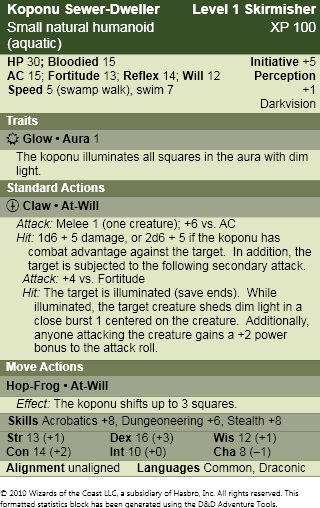
In this week's Wednesday Werk, we'll look at the Koponu.

The Koponu are a race of subterranean, amphibious humanoids.  Koponu are typically found as slaves of other subterranean races, such as troglodytes (the specimen below knows Draconic for this reason).  Some are free-living, however, and are typically found in caverns and subterranean ruins (old aqueducts, cellars, dungeons, and the like).

Free Koponu form their own underworld ecologies, replacing the typically mammalian and avian pets and farm animals of humanoid civilizations with amphibians.  Supposedly, they have even bred and trained creatures such as warfrogs and fighting-newts.

Koponu are most notable for the bioluminescent slime they secrete.  Even stranger, those attacked by Koponu have been occasionally "infected" by this slime, causing the victim to glow like the Koponu.  Although harmless, this can be fairly unfortunate on dungeon delves, as glowing adventurers make better targets.

The following specimen is indicative of a typical sort of Koponu (despite the name, it is not only found in sewers).  Knowledge of Draconic suggests a relationship with troglodytes — either this is a slave, an escaped slave, or a descendant of escaped slaves.  Free Koponu are typically more inclined to run away if a fight begins to go unfavorably, but enslaved Koponu will fight at the whim of their masters, knowing that the penalty for failure is likely death anyway.


At the DM's option, characters successfully attacked by Koponu may be exposed to the affliction known as "The Glows."  At the end of the encounter, the character must make at DC 12 Endurance check (if the Koponu has been altered to be higher than 1st level, the DC should reflect a moderate Endurance check of the Koponu's level).  Failure indicates that the character has caught "The Glows," which lasts until the end of the victim's next extended rest.  While under the effects of "The Glows," the character sheds dim light in a 1-square radius, and while in total darkness, grants a +2 power bonus to any creature attacking her.  This is typically more annoying than debilitating, although stealth tends to be difficult (if not impossible) when one is glowing softly, for example.

Tuesday, April 10, 2012

Some Remarks About Dave Arneson

I've talked about Arneson before, but it bears repeating as this past Saturday marked the second anniversary of his passing.

Presently, my player group is investigating the appearance of monsters in a nearby swamp.  This swamp is known as the Black Moor.

The adventurers were also informed that the weird monsters recently appearing in the swamp have been displacing the bandits that lair there, forcing them to make forays farther south.  They were tasked with, among other things, helping apprehend the bandits.  They were informed that Arneth, the bandit's leader, was to be taken alive.

Upon confronting the bandits, they learned that Arneth was slain by the swamp monsters, but that David, Arneth's son (see what I did there?), has been leading the bandits in his stead.  (Incidentally, this is the same encounter in which the tracker jackers made an appearance.)

Coincidentally, I had neglected the fact that April 7 marked Dave Arneson's passing, so I'm quite pleased that the adventurers made it to the Black Moor on our April 6 session.

Monday, April 9, 2012

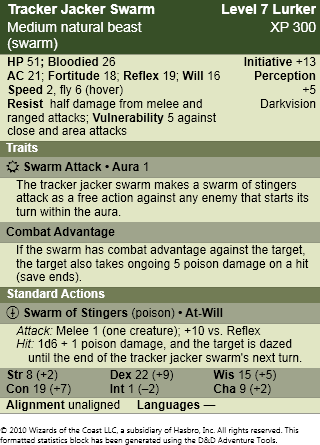
Tracker Jackers

So.  The Hunger Games.  After hearing a ton of hype (including writers and people older and wiser than I), I decided to read it.

I can always explain it away as research, or some such.

Anyway, after reading the first book, I can say it's about as good as all those people say.  Some critics will say that it's just a Young Adult rip-off of Battle Royale or The Running Man, and that's also entirely true.

That also handily ignores the fact that cavemen already told all the stories that will ever be told before we started writing them down, and that new literature comes about because people take old stuff and recombine it in new and exciting ways.

In this case, The Hunger Games has the same basic set-up as Battle Royale or The Running Man with a little post-apocalyptic action and a little bit of The Prisoner and A Clockwork Orange thrown in.  And it's Young Adult so there's a love triangle, because apparently the constant threat of death and the future threat of bloody uprising just isn't enough conflict for adolescents with raging hormones.

Anyway.

I told you that story to tell you this story: I love the tracker jackers from The Hunger Games.  What are tracker jackers?  They're genetically-engineered wasps developed as a bioweapon.  If a nest is disturbed, they will attack the source of the disturbance relentlessly, following it as far as it goes.

Also, their venom is very potent (a few stings can easily be fatal) and hallucinogenic.  As in, one or two stings suddenly turns you into Hunter Thompson.  Just like that.

So what's a guy to do?  Obviously, turn them into a D&D monster.  What follows are some D&D 4e stats for a jacker swarm (and some notes for retroclone versions).

Tracker Jackers (4e version)

If you care about that sort of thing, these guys haven't been playtested.  Their attack pattern is pretty simple: attack the nearest target with swarm of stingers until it dies.  If the target moves, the swarm follows it.  If the primary target is dead, choose another target.  If no more targets are available, return to nest.

Tracker jackers choose targets indiscriminately, which makes a jacker hive an interesting wild card in an encounter.  Maybe one faction or another can use it to their advantage.


For the record, I placed this swarm with a group of bandits.  Both the PCs and the bandits considered shooting at the swarm to activate it, but in the end, nobody did.  Partially because it was a dangerous gambit, and partially because the bandits surrendered really quickly.

But S. P., 4e sucks!

Not to worry.  Labyrinth Lord has an entry for "Insect Swarm" (for that matter, Monsters & Treasure has an entry for individual insects).  Treat tracker jackers are ordinary wasps with a few adjustments:
  • If tracker jackers are disturbed by nearby creatures, typically when they pass too close to a hive (or disturb one), they are always considered "aggravated."
  • Tracker jackers will follow a creature and attack it until that creature is dead.  They cannot be dissuaded by weapons, although other methods may work at DM discretion.  As with mundane bees, they can be subdued by smoke.
  • The sting of a single tracker jacker requires a save vs. poison; on a failed save, the poisonous stinger deals 1 hp damage along with a confusion effect — tracker jacker victims start hallucinating and may lash out, run, or go catatonic without regard to outside stimuli (as such, I'd recommend using the linked chart because it includes an option for running away; many retroclone Confusion spells do not).
  • The above rule considers only a single jacker; whole swarms probably require several such saving throws, or to make a single saving throw at a notable penalty to avoid confusion and injury.  Maybe the victim makes a single save vs. poison to avoid confusion and 1d10 damage, or some similar contrivance.
That should at least get you started.

Wednesday, April 4, 2012

Spell: Baron van Hook's Microcosmic Eye

So, in a couple of Wednesday Werks, I've been referencing a character named Baron Lee van Hook.  He's a minor magus and botanist who also has been researching something he terms "microphytes," which a modern audience would recognize as microorganisms.

Observers might ask the logical question, "How does a fake-medieval fantasy guy see microorganisms anyway?"

The answer: Baron van Hook's Microcosmic Eye.

As part of his plant biology studies, Baron Lee van Hook determined that he needed to be able to see how plants work in miniature.  How do these things fit together?  What action pulls food and water from the soil?

When a magnifying glass wouldn't work, he turned to specialized applications of magic to answer his questions.  It took a lot of research, but Baron Hook finally developed specialized scrying methods to view the microcosmic world around us.

Persistent rumor suggests Baron Hook is researching a refined version of the spell, Baron van Hook's Fundamental Eye.  He suspects there are things even smaller than what he can see with his microcosmic eye.  Modern observers might infer that the fundamental eye would have resolving capabilities similar to electron microscopy.

Baron Hook would likely be willing to teach the spell to others (tell your FLAILSNAILS friends to come to the Sorrowfell Plains!), but no one knows because most people consider his microcosmic investigations to be somewhere bordering on quackery.  It is likely that he has already taught the spell to some of his colleagues or that it has been otherwise archived at the Wizard's Tower.

What follows are three versions of the spell, one for retroclones, one for D&D 3e, and one for D&D 4e.

Retroclone Version:
Magic-User Level 1
Duration: 1 turn/level
Range: 0
This spell augments the caster's sight, allowing him or her to magnify objects.  While focusing on an object, the caster can "zoom in" to a magnification as high as one thousand times, essentially the upper limit of modern light microscopy.  As an added benefit, the spell automatically enhances contrast, replicating some of the utility of microbial staining.

Among the typical components required of magic-user spells, this spell requires a small, finely-crafted lens worth 100 gp.

Third Edition Version:
Divination
Level: Brd 1, Sor/Wiz 1 (the jury's still out as to whether any clerics have channeled this spell, but the Knowledge domain seems like a good bet)
Components: V, S, M, F
Casting Time: 1 standard action
Range: Personal
Target: You
Duration: 10 min./level
You can magnify objects by sight and will alone.  While focusing on an object, you can "zoom in" to a magnification as high as one thousand times, essentially the upper limit of modern light microscopy.  As an added benefit, the spell automatically enhances contrast, replicating some of the utility of microbial staining.

Baron van Hook's microcosmic eye can be made permanent with permanency.  The caster must have a minimum caster level of 9th level and spend 500 XP.

Arcane Material Component
A pinch of crumbled, dead leaf litter.

Focus
A small, finely-crafted lens worth 100 gp.

Fourth Edition Version (Ritual):
As you finish the ritual, you find that a microcosmic world opens for you.
Level: 1
Category: Divination
Time: 10 minutes
Duration: 1 hour
Component Cost: 5 gp, plus a focus worth 20 gp
Market Price: 50 gp
Key Skill: Arcana
For the ritual's duration, you can "zoom in" your sight at will to see microscopic objects and creatures.  At the DM's option, this may allow you to re-roll a failed Perception check — as well as a failed Nature or other knowledge check — when appropriate.
Focus: A finely-crafted magnifying glass you look through as part of the ritual.
Wednesday Werk: Lurm

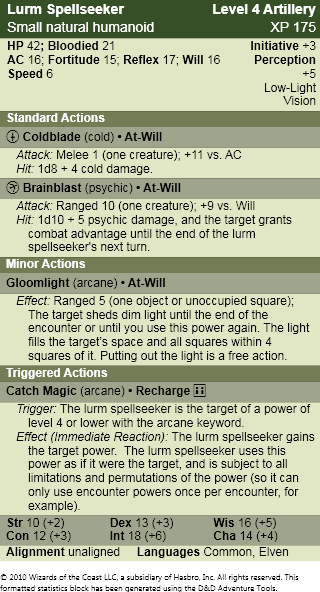
In this week's Wednesday Werk, we'll look at the Lurm.

The Lurm are a diminutive, unpleasant race of magicians and planeswalkers (they originally hail from the distant plane of Jiloth).  The Lurm have a rather unfortunate obstacle when learning magic, however; they are utterly incapable of understanding magic.  Most sapient races have the facility for the weird mnemonic devices and odd symbols used in typical occult writing, but the Lurm are almost completely devoid of this capability.  (The Lurm do innately comprehend exactly one spell, their signature Gloomlight.)

Like most sapient races, the Lurm are resourceful creatures and remain undaunted in the face of adversity.  As such, they have since devised a way to capture errant arcane energies and learn spells from them (rest assured that many have attempted to duplicate this ability without success).  As such, any spell cast at a Lurm can potentially be captured and learned by the Lurm in question (another reason why this ability is hard to duplicate — try learning how to cast a fireball when it's coming at you at high speed).  Once successfully learned, the Lurm can then cast the spell as appropriate.

Lurm can also trade spells and rituals, but expect them to haggle mercilessly.  It is typically more trouble than it's worth.

The following Lurm is a somewhat young specimen, only capable of learning lower level spells.  It already has a couple at its disposal, but is always interested in learning more.  And it is more than happy to initiate magical duels to learn more spells.  Other Lurm may already know different spells of the DM's devising, and may be higher level and thus able to catch higher-level spells.


On the subject of Catch Magic: For example, if targeted with Icy Rays from a Level 4 wizard with Intelligence 18, a +1 Magic Staff, and Staff Expertise, the lurm spellseeker can use Icy Rays once in the encounter with a +8 vs. Reflex and deals 1d10 + 5 cold damage.  Likewise, if the same wizard attacks with Magic Missile, the lurm spellseeker deals 8 force damage.

Tuesday, April 3, 2012

More Fun with Microbiology: Brewer's Bane

So, I've previously noted a love for microbiology, as well as modules in which it is a plot point.

Why?

Well, in addition to my own proclivities, microbiology has driven the world.  Just as early humans had to follow the herds and plants to survive, so were they vulnerable to the vicissitudes of the microscopic world.  There are more bacterial cells in and on you than cells of you.  (Your cells are just bigger.)  If you could scour your system of every microbe, you'd die, either from bacterial infection (the flora on your skin typically out-competes any interlopers), starvation (the flora in your gut helps you digest your food), or some thing I haven't thought of yet.

Apart from that, agriculture created a whole host of challenges.  Since you're not following the plants, you have to avoid leaching too much nitrogen from the soil in your planting cycles (which is easily-remedied by planting legumes, whose symbiotic root nodules help enrich the soil again).  Also, now you have to store food, which gets into the problem of storage and spoilage.  You have to figure out what to do with your corpses and your sick people so they don't infect the whole village.

And so on.

Anyway, forgive my rambling.  Hereticwerks posted a write-up about the myxogastrids, also known as Brewer's Bane.  These are slime molds that like to eat yeasts, thereby ruining bread and beer production.  Since this stuff is important to any fantasy medieval society (scholars tend to think that bread and beer, along with animal husbandry, were among the first examples of biotechnology harnessed by humans — and your typical agricultural society thrives on all three of these things), it's just the sort of thing a group of adventurers might have to worry about.  Maybe your traveling band has the knowledge necessary to stop the infestation, or maybe the Ancients knew how to do it, and the device/spell/aseptic technique lies in a dungeon somewhere.

For a truly unfortunate story hook, what if something your band of murderhobos is carrying has become infested with the slime mold, meaning that you bring it to every town you visit?

Anyway, go read the post, would you?

Print Friendly