Pages

Monday, December 5, 2011

On the Subject of "Legends & Lore"

I haven't really read much of the Legends & Lore column at Wizards of the Coast, but I heard one of my associates complaining about Monte Cook's new articles, so I had to look at it.

Since taking over for Mike Mearls, Monte Cook has primarily written about the things that made D&D great in previous editions, and how to apply those to 4e.

Now, I don't care about system or edition wars.  I'm adapting a couple of AD&D modules for my 4e game.  I mostly follow OSR blogs on here, and I wrote an oD&D adventure for my 4e campaign. That having been said, I agree with my friend.  Monte Cook's articles are a really weird and clunky fit.  There are ways to simplify 4e, and make it run more swiftly, but it doesn't hybridize well with previous editions (which is one of the core complaints about it).

I thought this post (Monte's first, actually) was particularly egregious.  Monte Cook suggests a system to simplify perception — characters ought to have a set perception rank, allowing them to automatically succeed at perception if they're perceptive enough, or force a roll if there's some uncertainty.

The only problem with this system, is that 4e already does this: there is "passive perception" and "active perception," and it works almost exactly as described.

Unlike a lot of people, I don't think this proves Monte Cook is out of touch (although it certainly doesn't preclude the possibility), but rather that Wizards of the Coast is trying to expand their market base.  It's an apologist strategy aimed at OSR guys and 4e haters, because apparently Wizards of the Coast doesn't realize they already lost that audience.  You can find the core AD&D books for 1e and 2e for about ten dollars apiece, and the 3e books are still readily available (or you can just play Pathfinder).  The internet holds pdfs of out-of-print stuff, or you can grab a retroclone, or you never got rid of your old books.

Basically, sell 4e to 4e fans.  If Wizards of the Coast wants to break into the OSR market, Zak Smith gave a suggestion (I'm mostly referring to his first suggestion to "Publish two big hardcover coffee-table books with all the old TSR adventures in them").

Sunday, December 4, 2011

Blood

Ever the attentive archivist, Porky made a bunch of blood-themed resources available.  I'd recommend all the posts — he has his own post on the subject; a link to a post about blood, iron, and magic; and a bunch of stuff about gore-worms and their uses, both culinary and surgical.

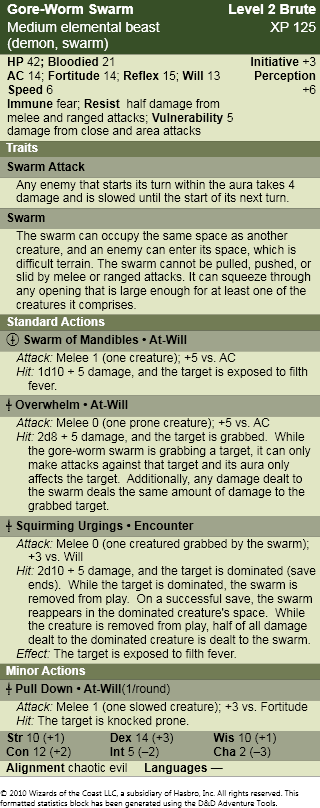
Since gore-worms already have a Labyrinth Lord writeup in the above post, I made 4e stats for them, because that's what I'm currently running, and I really liked them.

This version of gore-worms assumes their proclivities come from demonic influence — maybe they were maggots or rot grubs twisted by the power of the Abyss?

It doesn't really matter.  They're here and they want to eat you.  Stats for Worm Feeders, Writhers, and Wormtongues can easily be cobbled together using existing human and undead statistics.

And now, the gore-worm swarm.  It hasn't been playtested or anything.  Fear it:

Thursday, December 1, 2011

Sharpened Hooks: Oi there, basher! What's the chant?

This one isn't so much a story hook as a story hook delivery system.

I'm sure a lot of gamers do this already — it's practically required for any player-driven, sandbox-style game — but if you haven't tried this, the prospect of in-game rumors is both entertaining and useful.

I started manufacturing rumors in my campaigns after reading Unknown Armies, a game I may have previously mentioned.  Each section of the core rulebook opens with a collection of rumors — some are true, some are false, and some cannot be verified as they might be true in some campaigns and not others.  Basically, they're meant to motivate Player Characters and inspire Game Masters.  Additionally, they're indicative of the sorts of things one might hear on the street, and so can be taken in-character without justification ("Last night, I was messing around on Google and I heard that the seven original varieties of Barbasol correspond to the seven chakras of the body!").  The Unknown Armies website has a collection of fan-generated rumors* that I might recommend; they're really usable in any contemporary occult roleplaying game.

This trend extends beyond Unknown Armies, of course.  In addition to the fact that Game Masters have probably been doing this for years — again, how do you expect get players to muck about in a sandbox if they don't have some idea of what's out there? — I've seen it elsewhere.  A local LARP, SimTerra, has a "rumor mill," which is really just a construct so that players don't have to worry whether they've heard something in-character or out-of-character ("Wait, did Eddie tell me his character stole Vyrkaj's spellbook, or did his character tell me that?  Eh, I'll take it as a rumor, because I heard it somewhere."); manufacturing rumors to further distort things is, of course, perfectly okay.  Likewise, Jeff Rients offers recaps of his ConstantCon Wessex game, which can be taken in-game with the justification, "Well, you heard some folks drunkenly boasting in the tavern."  Of course, some details may be omitted, and some people absolutely keep quiet afterward, so wise adventurers take the information they learn warily.

I also used the rumor system in my long-running Mage: the Ascension game, The Imperial City.  Interested parties can read them here* (the weird editing represents the fact that I originally posted them, as-is, on a forum), though several references don't make sense out of context (they refer to inside jokes or campaign-specific entities, like LINTech and the Brotherhood of Light).  That might just make for weirder rumors, though.

Astute observers might also note the title references Planescape (like I said, I've been playing Planescape: Torment), and "the chant" refers to the collection of current news and rumors.  It can easily be presented to PCs in the form of these rumors.  My PCs in Crux of Eternity will probably get stuff like this before long — and if they don't, I'm contemplating doing an organized crime D&D game as a sequel, and that will definitely have a rumor list.

* These links actually contain rumors suitable for a modern occult conspiracy game.  Modification makes them usable in any game setting.

Wednesday, November 30, 2011

Archival Post

Porky makes my archival posts look stupid.  Read this.  At no charge, How to Succeed in RPGs or Die Trying can send professional mourners to weep for the rest of your lost day.

I only had time to glance at it, but I snatched up the Goblin Market pdf and the shoggoth PC race writeup.

Like I said.  Read it.

Monday, November 28, 2011

Sharpened Hooks: The Brinicle Ice-Finger of Death

Observe:


As noted in the comments (and in this article), this forms in very specific conditions.  Temperatures have to be just right so that a column of air pushes down brine and ice crystals.  The ice crystals follow the salt, creating a corridor that freezes as the salt falls downward.

Of course, magic makes the impossible possible, so it's not unlikely to find this sort of creeping, icy doom in the weird corners of the world.

Sunday, November 27, 2011

Creed of the Broken Chain

The inscrutable cultists and terrorists of the Broken Chain have been known in the Sorrowfell Plains only since the Cackledread War, and yet their presence has been notable.  Their secrets remain, unyielding to scrutiny, as they typically die rather than surrender.

Still, exceptions do take place.  In an attack on the Citadel of Sorgforge a couple of years ago, one member of the Broken Chain was captured alive.  He refused to answer any questions, instead repeating the same creed over and over again.  He died in custody when he willfully inhaled his own water glass, silently drowning to death in his cell.

Still, the creed has been recorded, and is presumed to be a standard creed of the Broken Chain.

I am the dagger poised at the heart of the abyss
I am the key by which the prison is opened
I am the hammer by which the chains are broken
By my hand I do the deed
By my will the world is freed

Scholars do not know whether the creed refers to a metaphorical abyss or the Abyss proper.

Saturday, November 26, 2011

Beer


I recently had the distinct pleasure of editing The Blasphemous Brewery of Pilz, now available at Digital Orc.  The crux of the adventure is a beer shortage, and the PCs are sent to handle the situation.  As I noted in my comments, there is a dearth of beer-themed modules for medieval fantasy settings, which is odd because beer is highly important historically.  Beer is one of the first instances of biotechnology, and many of the premises used in brewing formed the basis of modern biotechnology.  Really, if you want to make, say, human growth hormone, you no longer harvest it from humans, you culture it in a yeast or E. coli vector, grow it in a bioreactor, and harvest.  Those are the basic steps of beer production — throw some stuff in a bioreactor (maybe like a sealed barrel), let the yeast go to work, and obtain alcohol.

As has been noted elsewhere, beer was safer than water for most of human history, and the ancient Egyptians even used beer as a bargaining tool during a labor strike.  If this is your first time on planet Earth, we're humans and we like our beer.

Though the beer isn't emphasized, taverns are ubiquitous in fantasy fiction and roleplaying games, best exemplified by the fantasy trope of meeting in a tavern.  As noted in the link, this makes sense — the tavern hall is really the social heart of the town.  Community leaders who wish to be available might make themselves known there, though they will likely choose, say, Cheers over Chalmun's Cantina (however, note that both bars use the "meeting in a tavern" trope).

As such, it would make a lot of sense that beer would be an important aspect of life.  Merchant caravans and trading houses probably deal in the stuff, monasteries and dwarven brewmasters are probably major suppliers (though plenty of taverns probably brew a house beer), and any interruption in supply would be a major problem, requiring the intervention of government officials and adventuring parties.  Fantasy settings allow for odd varieties of beer (like the mushroom-based brews from the monastery of Pilz in Blasphemous Brewery, or even stranger blends with possible enchantments and other effects), and the ever-present guilds would probably get involved.  The idea of a trading guild based solely around beer is likely — Blasphemous Brewery's dilemma is a crisis for the Tavern Masters Union — and with all these supply lines and monopolies, trouble is probably inevitable.  The rise in crime and other aftereffects of the United States' Noble Experiment are well-documented, and that's before you get into the dangers of a medieval life where beer is likely a major form of recreation and cultural identity.  Riots and uprisings are likely — they certainly happened in Bavaria and Chicago.

For that matter, keeping with the revolutionary theme that has been mentioned on this blog, maybe a party of adventurers will break the Tavern Masters Union's hegemony...

When next you contemplate adventure seeds, maybe you should take a second look at beer.

Print Friendly