Pages

Showing posts with label DnD 4e. Show all posts

Monday, July 31, 2017

On Scandshar, Pt. II

One of the guys on the Unknown Armies Fan Club posted about this Surrealist Ball in 1972.  Although posted because it's pretty clearly somebody's Illuminati conspiracy fantasy, and full of weird pictures, this is a perfect visual reference for the decadent nobility of Scandshar.  I posted an image post about Scandshar a while back (and since Photobucket just changed their policies, all the links are broken, so that's fun), and this is a good addendum to it.  Images are shamelessly ripped from the above article:


Friday, May 8, 2015

The Slender Man for D&D 4e

About three-and-a-half years ago, I wrote an article on the Slender Man, with a focus on using him in fantasy settings.

Well, guess what?  I used him in a fantasy setting.

The Crux of Eternity group suffered a near-TPK at the hands of some giants, and so I wrested an old, forgotten plot thread — another group was attempting to find a fey noble who was lost while seeking a legendary artifact — and had the remnants of one group run into the aftermath of the other.  They allied to continue their separate quests, but the fey noble was being followed by the Slender Man.

He's a difficult fight all by his lonesome, but he showed up with a couple of corrupt druids and their treant allies.  Anyway, without further ado:

Also: The Slender Man on Obsidian Portal
Also, in related news: we may be updating the Crux group to 5e.  I've enjoyed 4e, but the long, slogging combats are beginning to grate.  We'll stick with 4e for at least the next session, but I think we're going to try the switch in a session or two.

Edit: Interested parties may wish to see the Slender Man for 5e.

Saturday, April 18, 2015

Artifact April #18: The Crux of Eternity [Dungeons & Dragons]

[Dungeons & Dragons]

The Crux of Eternity appears as a crystal cross large enough to be held in one hand.  Manufactured by the now-dead god Sorg during the Dawn War, the Crux of Eternity — also known as Ydinikuisuuden — was a masterweapon designed to channel the power of the gods.  (Interested parties may wish to read about the creation of Ydinikuisuuden.)  It was so feared that the primordials forged the Doom of Divinity, Godenschemering, in retaliation, although it was too late; the gods managed to defeat, exile, or imprison the primordials, forming Creation as we know it today.

As the Crux is so potent, it was hidden away somewhere where mortals and primordials could not find it.  (Its resting place is unknown, although most people suspect it resides in Sorg's tomb, wherever that may be.)

The Crux's powers are unknown — no one in living memory has even seen it, much less used it — although there is some speculation as to what it might be able to do:

  • It acts as an implement for channeling holy power.  In D&D 4e, it's almost assuredly a +6 holy implement, usable with Divine powers; it's possible it can be used as an implement for other power sources, as well.  In other editions, it might maximize spells, or make saving throws against spells cast with it more difficult, or possibly even grant additional spell slots or spell uses.  (It doesn't seem out of the question that the Crux might allow its user access to any available spell, for example.)  Whatever it does, it makes spells — particularly divine spells — more efficient.  It probably also acts as a spell catalyst, meaning that spells don't require material components to cast as long as the Crux is involved.
  • Likewise in D&D 4e, it is thought to maximize rituals, amplifying their effects and possibly obviating the material component costs of rituals.  This is related to its "maximizing spell function," above.
  • It seems logical that any attacks channeled through the Crux would deal extra damage to elemental beings, given its pedigree as an artifact designed to slay primordials.
  • Some theorists who think it maximizes magic suspect it doesn't actually affect spell-casting, instead granting wishes, a potent magic long-thought absent from magic items on Khaldun.  (There's a long-standing rumor that a ring of three wishes was buried in the Tomb of Theronna Onyxarm, although no one knows if that's true or not.  For that matter, scholars aren't even entirely certain where her tomb might be.)  If this is true, then the Crux of Eternity's legendary reputation is well-deserved.
Of course, if the Crux were found, it would likely require lifetimes of study to successfully use, as its activation methods are probably just as well-hidden as the Ydinikuisuuden itself.

Tuesday, April 14, 2015

Artifact April #14: The Herald of the Night of Burning Stars [D&D/Carcosa]

[Dungeons & Dragons]

The Herald of the Night of Burning Stars appears to be an astrolabe composed entirely of mummified animal parts — paws, legs, digits, and the like.  It is considered sacred to the mummies of the Radioactive Desert, as well as any who worship Nyarlathotep, as it is believed to be an artifact of the eventual ascendance of the Crawling Chaos.

The Herald requires a short invocation chant to activate (although some claim it can also be activated by destroying it, as well).  When activated, the user can summon a meteor swarm, as per the spell.  The Herald of the Night of Burning Stars only works once, becoming inert thereafter.

(For anybody wanting D&D 4e rules, activating the Herald allows the user to make an area burst within 20 attack at +18 vs. Reflex.  The Herald causes 5d6 fire damage (half on a miss).  This is a consumable object, and only works once.)

Persistent rumor places the Herald of the Night of Burning Stars within the armory of a crashed Space Alien vessel somewhere in hex 1804 on the Carcosa map.  There is another rumor that a party of adventurers from Sigil accidentally activated and destroyed the device, but who knows if either of those rumors are true?

Thursday, November 27, 2014

Happy Thanksgiving from the Wendigo!

In honor of Thanksgiving in the United States, I offer you a Compendium Class for Dungeon World: The Wendigo!  Based on the D&D 4e monster of the same name (detailed in the Demonomicon), the wendigo is a demon that possesses people who become cannibals.  Willing cannibals can channel the power of the demon such that they retain control of their faculties.

It's my first Compendium Class, so feedback is welcome.

So, without further ado, The Wendigo!

Monday, September 15, 2014

The Sorrowfell Plains

I finally made a Hexographer map of the Sorrowfell Plains, the main campaign setting for my Crux of Eternity game.  I haven't yet put the roads on it, but it otherwise includes all locations noted in Crux of Eternity or any of the associated one-shots.

There are, of course, towns, villages, and geographic features not yet noted on the map; they'll get added as they become important.

Bread and Circuses players take note; this is where you live, too.  Scandshar is right in the middle.

And yes, you grognards, one hex is six miles across.  Geographic features are written in Dominican font; settlements are written in Village font (or you can download it from this The Prisoner fansite).

Click to enlarge.

Wednesday, May 14, 2014

BOOOY!

So, I was thumbing through the Chaositech book when I came across statistics for "attack spheres," chaositech spheres that can be used to attack one's enemies.  Unsurprisingly, they sound a lot like Sentinel Spheres from Phantasm, so I was immediately intrigued.

Boooooooooy!
Well, naturally, something like that needs more stats (obviously), so I whipped up a quick D&D 4e stat block.  The things are designed to be quick and dangerous.  Enjoy!

Friday, April 11, 2014

All's Quiet on the Hobby Blog Front

I am, in fact, still alive.

I'm still in the zone of playing more than running, although some friends of mine have persuaded me to run a role-playing heavy D&D 4e game.  Since they apparently want to tackle geopolitics in this game, it will give me the perfect opportunity to run a hexcrawl sandbox.  I'm still developing things for it, but I've started a map:

Click to enlarge.
It's obviously a work in progress — I don't have all the features sketched out yet, and I only have a few cities, but it's 1,000,000 square miles of territory.  I'll likely start the PCs at the inn in hex 04.04.

As for the geopolitics side, I have five kingdoms and one city in the borderlands.  Two of the kingdoms are demihuman kingdoms and the other three kingdoms are kingdoms of men.  The elf kingdom of the Lanirilis Protectorate is a magocracy ruled by the Istyatár or Istyatári ("philosopher-king/queen" in Tolkien Elvish), and the dwarf kingdom of the Farhelfik Commonwealth (totally a reference to the English Commonwealth, by the way) is a theocracy ruled by the Bofmorndin ("great peak" in D&D Dwarven, a title for the priest-king of the dwarves).  As for the three human kingdoms, they're predominantly based off historical kingdoms.  Ardhiyawata is based on several of the old African empires — Ghana, Mali, and Zimbabwe — with the monarch title "Mwene" being a derivative of old Zimbabwean title for "prince."  Hörundsflúr remixes Camelot, the Carolingian Empire, and the Iceni tribe; it calls its monarch a king or queen.  The Gallic Region of Khem emulates the brief Napoleonic rule of Egypt with a heavy dose of the Ottoman Empire and a burgeoning Arab Revolt no doubt in the works; Khem calls its monarch the Empress-Regent (or Emperor-Regent), as the true "Emperor" of Gallia resides in a distant land.

The lone city (so far) I've developed for the borderlands is a place called Khajanarata, the City of 10,000 Pleasures.  A major trading center, it has the feel of medieval and early modern India, and the Persian Empire, although the initial design seed was totally the Swar from Wraith: The Oblivion.  Sprawling, decadent, sword-and-sorcery cities such as Lankhmar, Xuchotl, Mos Eisley, and their ilk also serve as inspirations.  The inhabitants call their leader a Rajpandit ("priest-king").

Interested parties can see the six monarchs in the document, The Rulers of the Five Great Kingdoms of Khemenelda.

Wednesday, March 5, 2014

The Carcosa Sessions

My D&D 4e group is just about finished in Carcosa, so I might as well post the encounters.  All told, there are fourteen encounters, most of which are with different groups of monsters (four encounters include Space Aliens, and two encounters include Green Men; the others are unique).  Some of these are homebrewed, some of them are reskinned 4e monsters, and some are from the 4e version of Gamma World.  You can direct any questions to the comments section of this post.

Check out the Encounters here.

Friday, January 17, 2014

ADVICE FROM CHAATHS-NEB

BEHOLD THE ETERNAL PHARAOH, CHAATHS-NEB
So I've been running two 4e groups through the first level of my Carcosa megadungeon in preparation for finalizing it and running it on Google+ (probably in Labyrinth Lord), and one of the adventuring parties encountered a bombastic mummy brain called Chaaths-Neb.

Despite the fact that they killed him, he lives on eternally — because I think he's going to start an advice column:

IMPUDENT MORTALS, BOW BEFORE THE MIGHT AND COLLECTED WISDOM OF CHAATHS-NEB, THE ETERNAL PHARAOH OF THE RADIOACTIVE DESERT.  THE HERALD OF NYARLATHOTEP AND THE OMNISCIENT SEER OF FALLEN STARS AND BARREN WASTES CALLS UPON MILLENNIA OF FORBIDDEN WISDOM AND LORE.  BRING YOUR PATHETIC QUERIES BEFORE THE MIGHT OF THE ETERNAL PHARAOH, AND PERHAPS HE SHALL MERCIFULLY GIFT YOU WITH SOME OF HIS BOUNDLESS KNOWLEDGE.

(If you ask for advice in the comments, Chaaths-Neb will respond over time.  If I get enough of a response, this might become a regular feature.  Feel free to submit your queries in "Dear Abbey" fashion, signed with a descriptive anonymous tag.)

Monday, December 23, 2013

The Cenobites of the Pleasure in Pain, the Hierophants of the Order of the Gash

Unsurprisingly, this was inspired by too many recent conversations about Hellraiser.  I decided I wanted a faction comparable to the Cenobites (also at The Other Wiki) in my D&D 4e game.  Here's what happened:

The Cenobites of the Pleasure in Pain, also known as the Hierophants of the Order of the Gash, is a shadar-kai cult of personality gathered around an entity known as the Architect of Pleasure and Pain, or alternately, the Engineer of Pleasure and Pain.  (Occasionally, this entity is called "Leviathan" for unknown reasons.)

The origins of this group are unknown.  Anyone's best guess is that the Cenobites (or Surgeons, as they are also known — they seem to be quite enamored of epithets) form from a confluence of three factors.  The first, is the shadar-kai themselves — when the shadar-kai first arrived in the Shadowfell, they found that they would fade away without strong emotions.  As such, they took to the extremes of living to maintain their own identities.

The second factor is a now-disbanded Sigil faction called the Society of Sensation.  Before they disbanded after the Faction War, the Sensates believed in experiencing all things to achieve enlightenment.  Despite their reputation as hedonists, they sought to experience all available experiences — positive and negative.  Although the Sensates as a group disbanded after the Lady of Pain's decree, some keep their traditions alive.  It is not precisely clear how a group of shadar-kai came across the beliefs of the Sensates, but the shadar-kai would easily take to their worldview of empirical thought and experiential enlightenment.

The third factor is the Architect itself.  This entity is apparently a somewhat potent baatezu, as those shadar-kai pledged to it are almost universally warlocks.  The Architect appears as a striking, sensual male humanoid with pale skin and leather clothing.  This figure appears to be constantly in a mixture of ecstasy and agony from the various hooks, pins, and piercings worked through its flesh.

Whatever their origins, the Cenobites typically keep to themselves in their own demiplane forged partially from the Shadowfell and partially from the Nine Hells.  However, they sometimes emerge to explore the boundaries of experience, and to proselytize their experiences to others.  While they consider themselves evangelists and explorers, most communities encountering the Cenobites consider them to be invaders and fiends of the worst sort, arcane torturers who typically leave their victims dead or worse.  The Marquis d'Ennui of Sorgtomb has a standing bounty on any Cenobites found in his domain.

The Cenobites usually travel between realms through the use of arcane puzzle boxes provided by the Architect.

Unbeknownst to the Cenobites, the Architect is actually an aspect of Belial, Lord of the Fourth and Lord of Pain and Sufferings.  Belial is using the Cenobites as a cult to further his goals, and also as a militant order in case he needs to counteract any plans of his scheming daughter, Fierna.  It is possible that Fierna controls a group similar to the Cenobites.

Playing a Cenobite

Cenobites are universally shadar-kai (Dragon 372, page 5) and almost always have the Sensate theme (Dragon 414).  They are usually of the warlock class (Player's Handbook), although some may not be directly bound to the Architect by contract.  Some Cenobites learn how to use a spiked chain; those who do take the Spiked Chain Training Feat (Dragon 372, page 11) and may take the associated Novice, Expert, and Specialist Feats as well.

Cenobites' warlock powers usually manifest as barbed chains appearing from their bodies or nearby shadows.

It is, of course, possible to play a former Cenobite (much like the typical repentant warlock character).  In such a case, the character is likely being hunted by his or her former comrades.

NPC shadar-kai appear, among other places, in Monster Manual and Monster Manual 2.

Enterprising DMs could use probably adapt the Cenobites for use in other editions of D&D.  The shadar-kai appear in the 3e Fiend Folio, while warlocks appear in Complete Arcane.  It is also possible that they could created using the rules for magic-users, clerics, elves, and suchlike in earlier editions.

Monday, August 26, 2013

Inaugural

Earlier this month, my 4e group had the opportunity to become the first adventurers to enter Skyfall delve, my Carcosa megadungeon.

For interested parties, the Shields of the Sorrowfell from Khaldun and the Mourners of Saerun Road from Eberron entered the Skyfall delve with the intention of clearing the top level to make the first floor habitable, allowing the Planar Trade Consortium to create a settlement for future adventurers to mount expeditions into the depths.

So far, the Shields of the Sorrowfell have retrieved a golden statuette of Cthulhu.  No word yet on what the Mourners of Saerun Road found.

She of the Dying Light told the Shields and the Mourners that one of their number, Iathacl the Storyteller, obtained a suit of powered armor and disappeared into Skyfall delve.  Whether he went exploring and died or pulled a Colonel Kurtz and went up river is unclear.

Interested parties may read more details here.

Once both parties clear the top level, the goal is to open up the dungeon to ConstantCon, probably using Labyrinth Lord.  Any updates or relevant information about the megadungeon of Skyfall delve can be found on this blog by way of the #fourthworldproblems tag.  I will also try to whip the Obsidian Portal page into shape relatively soon.

Monday, July 15, 2013

Pulp Era Kickstarters

I've come across two current campaigns to start kicks, and I bring them to your attention.

Exile Game Studio's Revelations of Mars is an expansion to the award-winning Hollow Earth Expedition role-playing game.  For those not in the know, Hollow Earth Expedition is a 1930s pulp adventure game wherein characters are adventurers and explorers in the Hollow Earth.  Previous expansions added further detail to Hollow Earth and also detailed the pulp weirdness happening on earth's surface; Revelations of Mars expands the action to encompass Mars, providing rules for a not-quite-Barsoom world of weird science fantasy.  Revelations of Mars has already hit its funding, but it's a good opportunity to pre-order the book or round out your Hollow Earth Expedition collection.  The Revelation of Mars Kickstarter ends on July 31.

Sasquatch Game Studio's Primeval Thule is a savage sword-and-sorcery pulp fantasy setting for Pathfinder, D&D 4e, and 13th Age.  It's a little Robert E. Howard, a little H. P. Lovecraft, and a little Edgar Rice Burroughs.  (On the H. P. Lovecraft front, they're also going to provide a conversion document for Call of Cthulhu, and one of the adventures is designed to be used with the miniatures from Cthulhu Wars.)  With an awesome horror pulp setting (like Dark Sun but with more than one biome) and industry veterans like Rich Baker and Todd Lockwood, I'm particularly excited about this project.  It has not yet reached its funding, but is nearly halfway there with roughly 17 days to go.  (Basically, support the project, because I want to get a copy.)  The Primeval Thule Kickstarter ends on August 1.

Monday, February 18, 2013

The Life and Death of Large LeFarge

Well, this past weekend, my Crux of Eternity players killed notorious gang leader, Large LeFarge.  I previously mentioned Large LeFarge a while back, as well as giving him a shout-out on the Fantomist entry.

I'm particularly proud of him.  He came out of a desire to match the awesomeness of Bill the Butcher, but with a D&D twist.

So I made him a very, very angry pixie.

My favorite attack is his ability to throw pixie dust at people, causing them to float away.  The party's fighter ended up falling victim to this attack, floating around the room for several rounds before he finally saved against the effect and fell to the floor.

Without further ado, here's Large LeFarge (4e stats):

Pour out a little for our fallen homies.

Level 12 Encounter (XP 3500)
  • Large Lefarge (level 10 solo soldier)
  • 4 streetwise thugs (level 9 minion, Dungeon 161, pg. 32)
  • 2 Waterdeep street thugs (level 7 soldier, Dungeon 171, pg. 96)

Friday, January 25, 2013

Jamming Spells in the Nine Hells

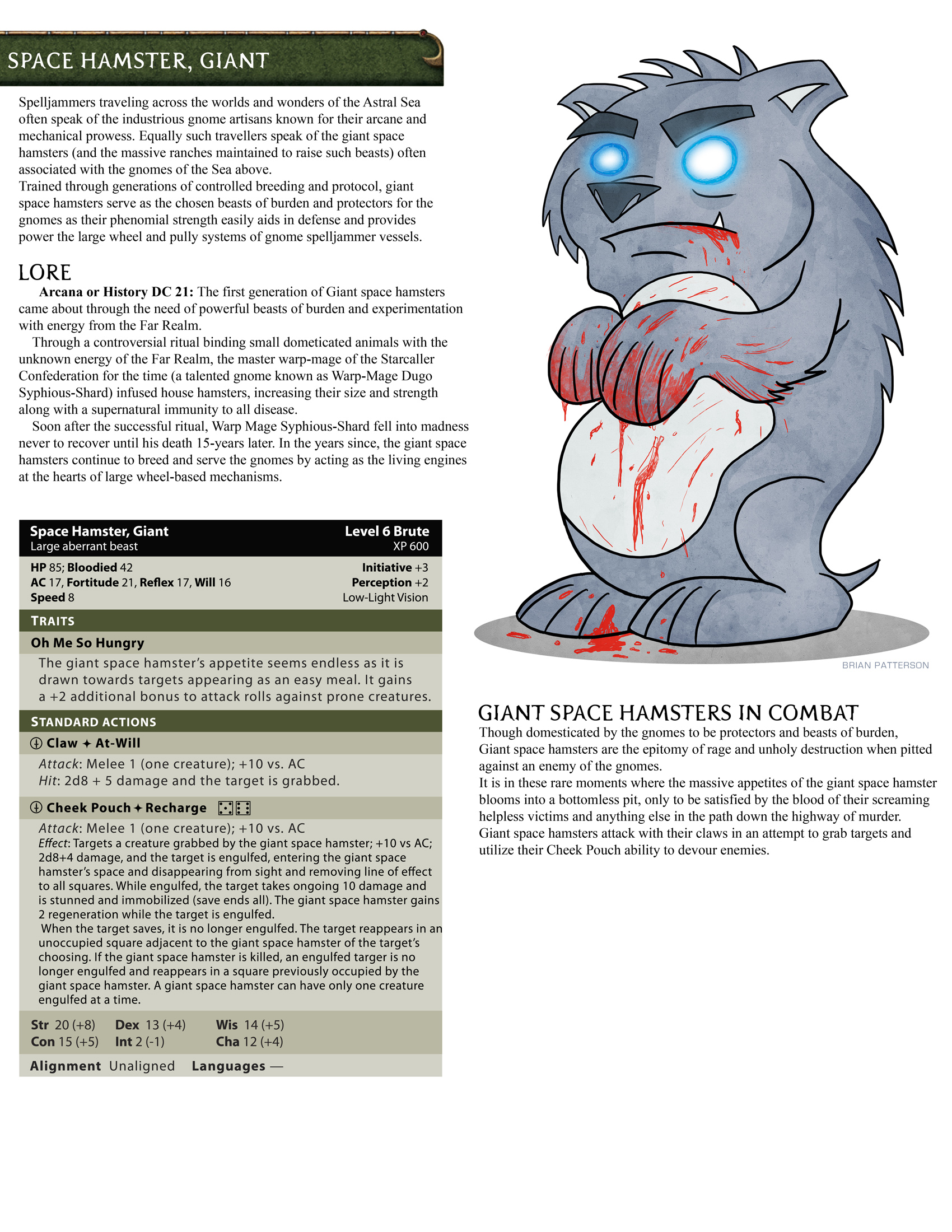
Another random update lacking in substance.  This time, I happened to find a couple of fourth edition treatments of the much beloved/reviled Giant Space Hamster from Spelljammer.

Here's one from d20 Monkey as part of an article on people playing D&D BadWrongFun:


And here's another from David Flor (this time in pdf).

Friday, December 14, 2012

Crux of Eternity replay

Two replays for the price of one today: Crux of Eternity on Obsidian Portal is relatively up-to-date.  Read about it if you want.

The PCs are currently wandering the mean streets of Scandshar, attempting to learn about the fate of a missing abolitionist agent.  Also, by the sound of his voice, the most powerful crime lord in the city might be an undisputed champion of freestyle.

Also, I stuffed a Marx Brothers reference in my game in the person of Lydia the Tattooed Lady.  Naturally, you should probably hear the original song to add some culture to your bacterial culture:

Wednesday, October 3, 2012

Wednesday Werk: The End?

I've skipped around a little, but I've been doing Wednesday Werk entries more-or-less in order, skipping creatures only found in Mutant Future.  So, when I looked for the entry for this week, I found Gore-Worms.

I'd been debating how to end the weekly feature for a while, and since that's where I started, and I have recently become stupidly busy (I haven't posted in a week? Madness!), it seems like a good stopping point for the moment.  I may revisit Wednesday Werk at some future point, but we're stopping the feature for now.

So, What Did We Learn?

I was inspired to do this by garrisonjames in the comments on my Gore-Worms post, and there's a lot of creative stuff over at Hereticwerks.  I encourage you to continue checking it out for your own games.

When I started Wednesday Werk, I was neck-deep in my D&D 4e game, but I was still running a couple of modules for my group.  I had not yet gotten into modifying and creating creatures with any frequency.

Creating creatures for 4e is pretty simple, but can be incredibly time-consuming.  All-in-all, it falls somewhere between 3e and earlier editions; 4e creatures lack the detail of 3e entries, but are way more detailed than 2e and earlier creatures.

In the end, it all comes down to game balance.  Creatures in 4e are a collection of formulas with a certain narrative hook — it looks like an elf, or it hunts like an intellect devourer, or whatever.  On the one hand, scanning other monsters of similar level and sticking to the formulas ensures a creature that is "fair" by the rules (if game balance is a concern, of course).  On the other hand, determining number of hit dice, AC, and any special attacks is way more simple.

This process is rather time-consuming.  The best way to go about it is to reference the monster math (which scales with level and "creature role" — is it a meaty sack of hit points which dishes out damage, or does it strike from the shadows every couple of rounds or so?), and then compare other creatures of the chosen level.  Again, this is to ensure "game balance" — 4e adventurers are assumed a certain level of competence, and tend to encounter challenges they can survive.

At the beginning of Wednesday Werk, this could take a couple of hours.  Now, it only takes me about an hour to crank out a creature, including brainstorming, research, and writing its write-up.

Additionally, I found the things that make 4e monsters unique are not the same as the things that make early edition monsters unique and memorable.  Many of Hereticwerks' creatures are planar travelers with spells or spell-like abilities.  In 4e, these creatures have a tendency to be fairly similar, with only the "fluff" differentiating them from one another.  Unique, memorable creatures in 4e are typically molded by strange tactics and odd powers; the story surrounding a creature helps differentiate it to the players, but makes it feel similar in play.  In early edition games, monsters have few statistics, so the fluff is absolutely necessary to differentiate them.  In 4e, powers and tactics serve to differentiate monsters.

(As an aside, the 4e DM has a role in differentiating monsters — there is absolutely nothing wrong with taking a monster and using it with a different description to make a "new" monster; describing those orcs as barbarians will change the encounter for the players, although it will still probably feel familiar to the DM.)

Basically, 4e is fun, and making monsters for 4e is fun, but the simpler approach of earlier editions is easier when planning and playing.

If you want to see everything, here's the backlog of Wednesday Werk posts:

0. Gore-Worms


1. Gronk Sword, Octoscholar, Synchronocitor

2. Gronk

3. Petrocloptrian, Flytaur, Queen Lobster

4. Bruthem, Glimp-Shell, Xulg

5. Irving the Impressionable Shoggoth

6. Acephali, Almas

7. Candle Head, Grikflit

8. Zaldrim, Scarletscales

9. Walmakash, Urglun

10. Triloo, Rattong

11. Quindra, Hallimox

12. Phorain

13. Ordrang

14. Pseudoblepas, Nerglid

15. Molg

16. Lurm

17. Koponu

18. Drilg

19. Jaladari

20. Illigom

21. Mind-Slime

22. Plodder-Shell

23. Quintapoidal Fungi

24. Necropixies

25. Hagtessa

26. Ractur

27. Sanguinovore

28. Withering Mist

29. Rulak

30. Fantomist

31. Vilg

32. Grobbly-Bonk

33. Miasmagaster

34. Flutter Worm

35. Monoptrian

36. Yirgao

37. Elajess

38. Blatherer

39. Crannit

40. Crudiv

41. Xilmpa

Wednesday, September 26, 2012

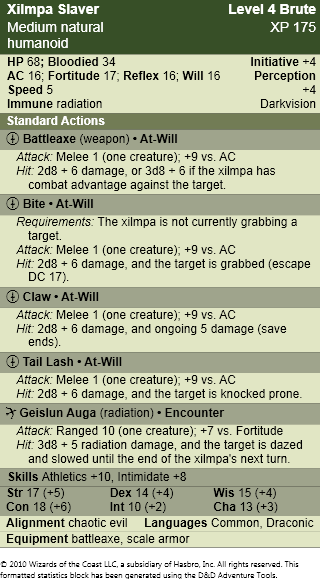
Wednesday Werk: Xilmpa

In this week's Wednesday Werk, we'll look at the Xilmpa.

The Xilmpa are a conquering, warrior race of crocodilian humanoids.  Horror, disease, and destruction follow in their wake, but the reasons are unclear.  Some scholars seem to think they are cursed, while others believe they are infected with the raw soulstuff of the Elemental Chaos.

Partial credit.  The Xilmpa are known to enslave those they conquer for use in their mining operations, as their desire for rare minerals is insatiable.  Oddly, reports suggest they eat these materials.  For strength.

In fact, reports filter back from blasted wastes and ancient mines that the creatures ignore silver and gold, instead mining and eating a silvery-grey metal sometimes called the Dross of the Sun God, but also known as the Excrement of Pelor.

(If you clicked the second link, you'd know the stuff as uranium.)

Some claim the strange metal gives the creatures their strength.  Others suggest they're addicted to it.  Still others say they need it to survive.  Some say all these things are true.

Supposedly, a group of Xilmpa are mobilizing.  Even now, those in the know have offered a large bounty for any who can stop their quest, for the creatures supposedly seek an ancient holy site known as the Sun's Kingdom on Earth.  If they find it, they may be unstoppable.

(These creatures may also be found on Gamma Terra.  Assume they go looking for uranium deposits and other sources of radiation to feed.  At the DM's discretion, they might be cannibalistic, devouring other mutants for the high background radiation in their blood.  On second thought, you might just want to assume they eat people anyway, just to make them more unpleasant.)

In combat, the Xilmpa are efficient hunters.  They typically open with Geislun Auga, attempting to irradiate and weaken opponents before wading into melee.  They attack efficiently and make optimal use of group tactics; if several can surround one opponent, they will typically try to stack as many status effects as possible on that opponent to deal maximum damage.  If that is not possible, Claw is a favored attack as it deals a little extra damage.


DMs without access to Gamma World should assume that radiation damage is a unique damage keyword only found on things that are, well, radioactive.  Radiation damage is probably only a hazard in uranium mines, natural nuclear fission reactors, and the like (I recently updated Expedition to the Barrier Peaks to 4e, and included radiation damage there, too).  It is best described as a combination of disease, necrotic, poison, and radiant, but it is truthfully none of these.  Adventurers are only likely to encounter it with regard to the Xilmpa, and so probably will not have resistances or vulnerabilities to radiation, nor will they deal radiation damage; it simply allows the Xilmpa to persist in toxic environments of the DM's devising.

Additionally, enterprising DMs can create mutant Xilmpa strains in the same method as mutant Almas strains, as described in this Wednesday Werk post.  Simply swap out Geilsun Auga (actually a reskinned Das Gamma Auge Alpha Mutation) for another Alpha Mutation and you're ready to go.

Monday, September 24, 2012

Epic Destiny: Planeswalker

I just created the most unholy abomination, and for that, I am truly sorry.

So, many moons ago, I got my first booster pack of Magic: the Gathering in 1995 because I thought it looked neat.  (In a rather telling anecdote, I was not entirely aware of the nature of the game and thought the cards to be something resembling Tarot cardsWheel of Fortune was even among the first cards I obtained, further cementing the connection in my mind.)

I was never terribly good, and rarely had the opportunity to play, but I knew enough of the setting to think it was rather neat.  (We'll pretend I didn't read any of the comic books or novels and move on.)  Nigh-godlike planeswalkers go plane-hopping through various alien environments, making power plays — it's a lot like Planescape if the main characters were all arrogant, near-omnipotent dicks.

Well, that having been said, among my many casual assumptions lies the one that the multiverse of Domina and the multiverse of D&D are the same place.  Or could be the same place.

As such, why aren't there Planeswalkers in D&D?

In general, the reason why every D&D setting isn't a magic-ravaged wasteland is because they're all too backwater for Planeswalkers to care.  Important stuff is happening elsewhere in the multiverse, and they've got better things to do than slum in worlds of dying magic when they could go into magic-rich worlds and bask in the Mana.  However, that doesn't mean that the occasional Planeswalker doesn't wander through from time to time.

More importantly, it doesn't preclude arcane adventuring types from awakening their Sparks and someday ascending into the ranks of the arcane elite.

As such, I've prepared a D&D 4e Epic Destiny path for Planeswalkers.  Let's hope that this doesn't unleash a Vancian spell card system and D&D/Vanguard crossovers aplenty from Wizards.

Unless you're into that, of course, in which case, maybe that's what you want.

Download the document here.

Wednesday, September 19, 2012

Wednesday Werk: Crudiv

In this week's Wednesday Werk, we'll look at the Crudiv.

The Crudiv is a fungal stalker possessed of extrasensory perception.  The creatures are typically drawn into conflict because their spores only germinate in dead tissue, and because attacking is the best way to infect a creature with their spores.

The Baron Lee van Hook has attempted to study the creatures, but thus far, has only encountered the dead remains of sporelings.  Evidently, mature specimens are canny enough to flee combat.  He has made precious little headway from dead sporeling remains other than determining that they are likely further examples of his "carnophytes."

If Crudiv suspect the presence of nearby creatures, they will attempt to hide and attack from ambush.  They always open with Tendril Lash and then typically use a found weapon for the rest of combat; this specimen fights with a Scavenged Battleaxe.  Crudiv will attempt to make effective use of cover and flanking, as well as attacking from hidden positions if possible.  If pressed or otherwise boxed in, they will attempt to use Sporic Rebuke to attack and escape.  Crudiv only fight to the death if escape is impossible; otherwise, they attempt to flee if one of their number is bloodied or killed, or if combat takes more than a couple of rounds.


Any creature that is exposed to Crudiv spores must make a saving throw at the end of the encounter.  Failure indicates the target contracts Crudiv Spores at stage 1.

Crudiv Spores, Level 2 Disease
Fungal filaments grow inside your body.
Stage 0: The target recovers from the disease.
Stage 1: The target loses a healing surge.  If the target is reduced to 0 hit points, place four Crudiv Sporelings in unoccupied squares adjacent to the target, and the target moves to stage 0.
Stage 2: If the target is reduced to 0 hit points, place four Crudiv Sporelings in unoccupied squares adjacent to the target, and the target moves to stage 0.
Stage 3: If the target is reduced to 0 hit points, place four Crudiv Sporelings in unoccupied squares adjacent to the target, and the target moves to stage 0.
9 or lower: The stage of the disease increases by one.
10-12: No change.
13 or higher: The stage of the disease decreases by one.

Astute observers might note the insidiousness of this disease; once at stage 2 or 3, the target no longer realizes that he or she is still infected.  Devious GMs might make the Endurance/Heal check for the target in secret, so that the player never truly knows whether the infection is gone or not.

And now, Crudiv Sporelings:

Print Friendly