Pages

Showing posts with label Artifact April. Show all posts

Thursday, April 28, 2022

Artifact April 2022

Seven years ago, I posted Artifact April, a month of theme posts whereby I posted one magical item every day in April across various RPG systems. I was hoping to do that again this year, but it never materialized.

However, some Artifact April is better than none Artifact April, so here's a selection of seven magic items. I'm running a lot of fifth edition D&D these days, so stats (where available) will primarily reference that edition, but I'll provide some notes on other editions because I convert material with abandon. Anything here should be easy to convert to your game system of choice.

(But just to make everything more confusing, Hekanhoda's Bane and Straight Razor are both made for Dungeon Crawl Classics.)

Cage
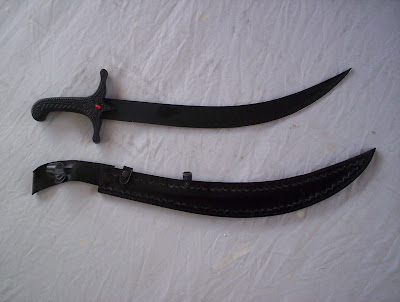
It probably looks something like this.

This sapient blade is a greatsword, appearing as a scimitar sized for a giant (or an efreeti, in this case). It is always warm to the touch. The black iron blade bears glowing runes in the language of fire elementals, while the shagreen wrap on the handle bears binding spells in the language of dragons. The pommel is a small, black iron cage in which a single red ember floats.

That red ember is the efreeti noble Padishah Nurhan Solak, bound in the blade. (He bestowed that title on himself, so he's likely not as powerful as you think he is.) When he speaks — and he often makes demands in imperious whispers — his voice emanates from the ember as it glows and crackles. The ember flares when he is angry.

Trapped in his own sword by a vengeful wizard, the sword now has the statistics of a luck blade. (Interested parties can also find 3.x statistics. The AD&D version of a luck blade gives +1 to saving throws and contains 1d4+1 wishes according to the Encyclopedia Magica.) This particular blade contains 3 wishes, powered by the bound efreeti. When the last wish is cast and the blade loses the Wishes property, the efreeti is released. He almost assuredly returns to the elemental planes and begins plotting his revenge against every previous owner of the blade, whom he has perceived as exploiting and wronging him in some way. (However, he may be gracious to an owner who uses their first wish to release him from the blade, possibly even offering them a free wish. As a lawful evil entity, however, any wishes he offers are of dubious quality.)

In true It Follows fashion, Nurhan probably works his way backwards, starting from the most recent owner until he eventually plots his epic revenge against the wizard who bound him in the first place.

Unlike most sapient swords, Cage cannot initiate an ego battle as the sword is the genie's prison. However, nothing prevents the Padishah from talking, constantly trying to convince the sword's wielder of the benefits of using a wish in this particular situation. Since he wants to escape the sword, he's even less capricious than a typical genie, fulfilling the spirit and letter of any wishes he grants. (At least for the first two wishes. He probably perverts the intent of wish number three as a final "fuck you" to his wielder before he leaves and plots his vengeance.)

If this sounds a bit like recommended Shadowguiding techniques from Wraith: The Oblivion, then you know exactly how to play the Padishah.

In addition to the standard properties of a luck blade, the sword's wielder can speak and understand the language of fire elementals while they carry the sword, and they are unaffected by extreme heat. (Up to 120 degrees Fahrenheit. That's about 49 degrees Celsius if you use metric.) The user can use a bonus action to cause the ember in the pommel to brighten, shedding bright light in a ten-foot-radius and dim light in a further ten-foot-radius.

The sword loses these properties if the genie is released, although it keeps the bonus to saving throws (and to-hit and damage for 3e and 5e versions and the Luck property in 5e).

Although it can't initiate conflicts, the sword's statistics might still be useful. It is lawful evil; has an Intelligence of 16, a Wisdom of 15, and a Charisma of 16; can hear and see (with darkvision) out to 120 feet; and can speak, read, and understand Common and Ignan.

If you're using 5e, Cage is a legendary magic item that requires attunement.

Dunce Cap
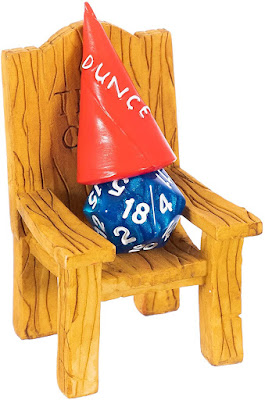
Nobody makes kids wear these anymore, right?

A standard paper dunce cap, albeit decorated with strange writing on the inside. While worn, it makes it hard to think but also makes the wearer less noticeable as a threat: people tend to ignore the wearer, and enemies target them less often.

For fifth edition, I'd probably give advantage on Charisma (Deception) checks to seem unobtrusive and Dexterity (Stealth) checks to remain hidden. The downside is that this item grants disadvantage on Intelligence checks, attacks, and saving throws.

This is likely a rare item that probably requires attunement. Assuming it requires attunement, it grants disadvantage on Intelligence rolls while it's attuned, but only grants the bonuses while it's being worn. Tricky, eh?

It's paper, so it folds away easily but is also easily damaged. If you'd like, maybe it's made out of something more durable, like leather.

Green Sash
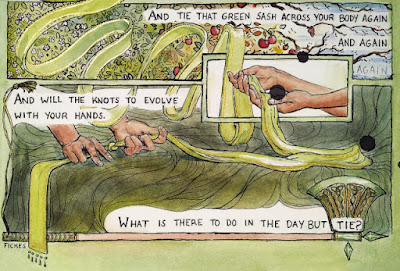
A gift from the Fair Folk always comes with strings attached.

You probably know this one already. Lady Bertilak gifts such a sash to Sir Gawain for his confrontation with the Green Knight.

There aren't any tricks with this one: the wearer gains immunity to slashing damage, but a critical hit from a slashing weapon cuts the sash, dealing full damage and rendering it useless. (If your system of choice doesn't include critical hits, assume it is cut on a natural 20. You might also decide a called shot can sever the sash, but you should make that decision based on your system of choice.)

While there aren't any tricks with the item itself, it is a sash of fairy make. There is a possibility that having the sash itself causes trouble, such as in the case of Sir Gawain.

For the fifth edition crowd, this is another legendary item requiring attunement, although I think it's a more interesting item if it doesn't require attunement.

Hekanhoda's Bane
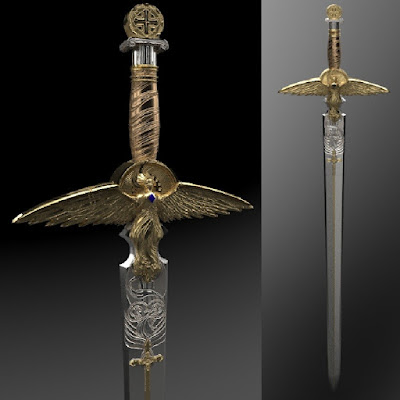
It looks a little something like this.

If you've read Intrigue at the Court of Chaos, you already know Hekanhoda, Lord of Grotesques. (I believe Hekanhoda also appears as a patron in the DCC Annual.)

Hekanhoda's Bane is a powerful sword of Law dedicated to slaying Hekanhoda. However, this sword has great ambitions, as it has plenty to do before killing the Chaos Lord.

This Lawful +1 long sword has Intelligence 11, and can speak and communicate telepathically. In addition to killing Hekanhoda, the sword also wants its wielder to uphold the Law. It has several banes:

  • Thieves: the wielder gets a +1 bonus to attacks and damage against thieves.
  • Wizards: any wizard successfully struck by the sword is banished. The wizard must make a Will save against the sword's roll of 1d20+10 or else be banished back to its native plane or lair.
  • Earth Elementals: the sword detects any earth elementals within 100 feet, even if they are invisible or concealed. The sword can overcome magical defenses with an effective Will or spell check of +10.
  • Dragons: as with thieves, the wielder gets a +1 bonus to attacks and damage against dragons.
  • Sphinxes: the sword acts as a spotter, making it easier for allies to attack. Allies can fire into melee between wielder and bane at no penalty and with no chance of hitting the wielder, and allies attacking bane with missile fire within 100 feet of the sword receive a +1 attack bonus.

In addition, the sword has several powers. It can detect gold within 1d8 × 10 feet, it can locate object twice a day, it can shed light in a 20-foot-radius at will, it drains 1d4 XP with every blow in addition to its other damage, and the wielder heals 3 points of spellburn each night without rest, or 6 points each night with rest.

The Princess' Ring
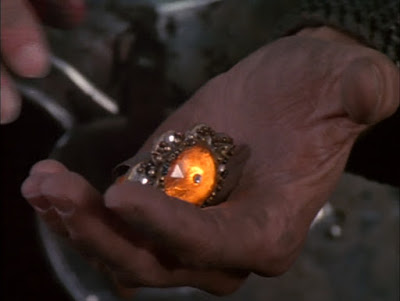
Using magic from lost kingdoms is like unearthing uranium.
It could power or destroy a city, and there's only one way to find out.

While the origins of this ring are lost, the story attached to it is that the princess of a lost kingdom owned this ring, which she used to sneak around the castle and even beyond its walls. This is often told as a cautionary tale, as she was executed or exiled for witnessing something she ought not to have seen. Others say that the magic in her ring somehow destroyed the kingdom. Some even say her ghost haunts the ring, providing an unpleasant surprise for anybody who uses the ring's magic.

This item is simply an ornate ring that, when completely covered by the hands, transfers the user to the Ethereal Plane as per the etherealness spell. Depending on the tales, you can either use it three times per day or as often as desired, but it does require the user have both hands free. As such, it probably takes at least an action to use it.

If you're doing the full 5e thing, this probably works as a very rare item, although it likely doesn't require attunement. Watch out for thieves! (You might want to make it legendary if the wearer can use it at-will. Then again, you might feel that being able to do nothing other than hold the ring is balancing enough. It's ultimately your choice; I'm a blog post, not a cop.)

Straight Razor
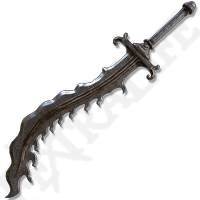
It looks similarly impractical.

Diametrically opposed to the monument of Law that is Hekanhoda's BaneStraight Razor would see civilization reduced to rubble and ash. This Chaotic +1 long sword has Intelligence 10 but only communicates through simple urges. It seeks to build a monument to Chaos from the rubble of civilization and to punish interlopers and those who interfere.

The sword hates water elementals, sending its wielder into a berserker fury against them. When facing water elementals in combat, the wielder must succeed on an Ego check against the sword or else gain +4 Strength and Stamina for 2d6 rounds, and then become exhausted at -4 Strength and Stamina for 1d6 turns thereafter.

On the other hand, Straight Razor grants its wielder the ability to speak and understand thieves' cant, and it can shoot out a tongue of flame once per day. The flame jet is shaped like a cone, 40’ long and 10’ wide at end. All within take 2d6 fire damage and may catch on fire. They can avoid this damage with a Reflex save against the sword's roll of 1d10+10.

The Widow's Ring
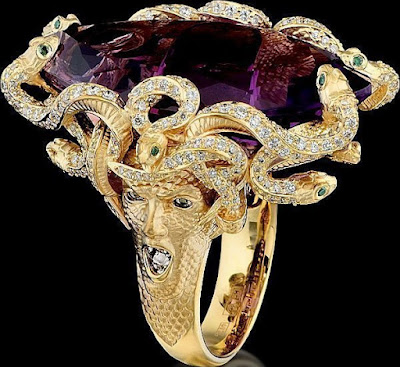
Just what I always wanted: a ring that hates me!

Old tales speak of the maedar, the male versions of medusae. One particular tale speaks of a maedar who found a mate very late in life, but was as devoted to her as any other maedar is to his wife. In fact, he was so devoted to her that he ensured he would never leave her.

When he felt his life coming to an end, he undertook the ritual that maedars sometimes undertake to become a glyptar, a maedar's consciousness remaining in stone. Maedars are said to go mad if they become trapped in gemstones, but this particular maedar willingly projected his consciousness into amethyst so that he could remain with his wife until the end of her days, and could continue to guide and protect future generations of their family. Before death, he made arrangements to have the amethyst fitted into a ring, delivered to his wife, so that they could spend eternity together.

And so the glyptar spent generations with his descendants, at least until some group of adventurers murdered them and took the ring.

As you might imagine, the glyptar is very displeased with this state of affairs.

Any medusa can use the widow's ring to gain a burrow speed equal to her walking speed, even allowing her to move through solid stone. Three times per day, she can turn stone to flesh, either ending the petrified condition on a creature or turning an area of stone as large as a 10' cube into meat. (If you're using an older edition with a proper stone to flesh spell, just use that instead. If you want the classic glyptar experience, old-school maedars can technically use their stone to flesh power every 30 minutes. In AD&D, the spell mentions turning stone golems into flesh golems, but since 5e stone golems cannot be altered in such a way, we'll skip that particular detail.)

Humanoids and other folk might be able to use the ring's powers as discussed above, but they have to convince it of their intentions first. The original adventurers who stole the ring probably won't get it to cooperate, nor will any adventurer who kills a medusa and lets the ring know about it. (Even hearing a rumor that the wearer killed a medusa might be enough to prevent the widow's ring from cooperating.) In fact, such users find the ring is basically cursed: the glyptar will attempt to take control, leading the wearer into suicidal situations. However, wearers who seem sympathetic to medusae and are willing to help local medusa populations will likely receive the ring's aid. (Although it might just ask for them to deliver it to a proper medusa, unless it thinks it can better aid medusakind by staying with the current wearer.)

The widow's ring is lawful evil; has an Intelligence of 12, a Wisdom of 13, and a Charisma of 15; can hear and see (with darkvision) out to 120 feet; and can speak, read, and understand Common. (If you're using an old-school system, the ring can also speak the languages of medusae. It also has the equivalent of a Labyrinth Lord psyche around 15 or so, to give you an idea of what sort of Ego rating you should give it in whatever system you're using.)

For 5e, this ring is probably legendary and definitely requires attunement.

Thursday, April 30, 2015

Artifact April #30: The Comb of Youth and Vitality [systemless]

The Comb of Youth and Vitality is an ivory comb with an opal set in the handle.  It always feels unnaturally cold to the touch, and its presence sets one's teeth on edge, like drinking a cold drink with sensitive teeth.

The first person to use the Comb of Youth and Vitality removes one year of age for every brush stroke.  This person instantly feels themselves getting younger and more energetic, and so can usually determine what is happening and stop before, say, becoming a child.

You're going to want to write down how many years the first person removes, though.

All subsequent users of the comb age that many years for each brush stroke.  So, if the first person removed twenty years of age, all subsequent users become twenty years older for each brush stroke.  Brush your hair in four strokes, and you're now eighty years older (and likely dead, if you're a normal human).  If your players like to tinker, it's likely at least a couple of them will try the comb, hoping that the effect will somehow skip a person or whatever.

After the initial use, the enervation effect lasts for a number of years equal to the years of age stolen.  So, if you lost twenty years of age, all subsequent users will gain twenty years per stroke for the next twenty years.  Then the comb "resets" — probably after a group of concerned do-gooders locked it away somewhere and it has been forgotten.

Just in time for another to use the comb.

Wednesday, April 29, 2015

Artifact April #29: The Sammas [Dungeons & Dragons]

[Dungeons & Dragons]

(With all apologies to the Finns, as the Sammas is another name for the Sampo.)

According to the legends, the Sammas is a large, ornate, ivory drinking horn, carved with magical runes, which is always full of water.  The legends are exceedingly hazy on its pedigree, although must suggest it was made by an unnamed craftsman to purify the River of Tears, grown corrupted by the blood of dead primordials, or that it was made to provide enough water for the craftsman's village.  (A few legends claim the Sorrowfell Plains used to be desert, and the Sammas is the vessel that made them the verdant plains they are today.  These tales also tend to claim that the dead god Sorg made the vessel.)

The important, common element is that a craftsman needed a lot of pure water, and so made the artifact.

The Sammas is similar to a decanter of endless water, in that it produces limitless water.  However, there is no variance to the amount of water — if poured out, it always pours at a rate of one gallon every six to ten seconds or so.  (One gallon per round, like the "stream" setting of the decanter.)  Unlike a decanter, though, this water is pure (and should likely be treated as holy water).  So pure, in fact, that it purifies things it touches.  Water from the Sammas will decontaminate food, drink, people, and objects as per the spells purify food and drink, neutralize poison, or remove disease (or their local equivalent in whatever game system you happen to be running).  It will also purify areas and people of various types of corruption, and possibly even throw off haunting or possessing spirits.

The main problem with the Sammas is its location.  It has been lost for centuries, and no one has yet determined its location.  It is commonly thought the be hidden somewhere in the Hoarfrost Ridge, far to the north, but it could legitimately be anywhere.  (It is thought that some shrines advertise a connection to the Sammas either as an attraction to bring pilgrims or as a trap for the unwary.)

The last person to seek the Sammas was the fey noble, Lady Graunwen, who departed with a retinue of elves to seek the artifact in the autumn.  Since her final message last winter, two search parties have gone to find her.  Neither has returned.

Tuesday, April 28, 2015

Artifact April #28: The Excision Shears [systemless]

The Excision Shears look like a rusty old pair of scissors — big scissors, like your grandmother would use to cut fabric.  They cut things, as well they should.

The fact is, they cut things really well.

Anything that can reasonably fit between the blades will get cut.  If it's too big, you can't get enough leverage to get started, but anything smaller than that is fair game.  As a rule of thumb, if you have to open the blades more than 90°, you're not cutting it.  You could cut a high-tension wire, but you couldn't get enough leverage to cut a car in half.

The weird thing about the shears, though, is the fact that they cut things that aren't supposed to be cut.  Like emotions.  If you cut your hair with them, you'll always feel better about the new haircut, because you simply won't have an emotional connection to the old one anymore.  Cutting that high-tension wire will always feel cathartic, because it never should have been together in the first place.  The new state always seems more natural than the old one.

That's not the only thing, though.  If you cut up a book, the new book seems more pleasing than the old one.  Nobody knows how far this effect spreads, although if you decide to play William Burroughs and use the cut-up pieces to make a new work, it'll probably be well-received.  (Maybe it's possible to drive a popular book back into obscurity this way.  Or maybe only the person holding the scissors will think the new version is superior.  Or maybe only the author loses the emotional connection.  Who's to say?)

The most disturbing usage of the scissors, though, is with modern photographs.  Cut up a photograph the right way, and you can make someone uncomfortable in their own skin, because they no longer feel the same connection to how they look at they used to.  Or maybe they think one of their features is now extraneous.  Maybe you'll drive them to self-harm, because that part needs to leave.  Or maybe they just grow lethargic and apathetic about it, they just don't care.

And of course, if you cut between people in a photograph, they'll lose their emotional connection with each other.  Maybe someone will use this to make enemies not hate each other so much, but it's always more likely that some vindictive sort will make lovers drift apart.  It's never a sure thing, and some people can resist it, but it's still going to make for a rough time in your life when those whom you hold dearest now seem distant and alien.

Monday, April 27, 2015

Artifact April #27: The Conveyance Mirrors [Mage: the Ascension]

[Mage: the Ascension]

(8-pt Artifact)

The Conveyance Mirrors are a set of objects created by Adeptus Astrum, the leader of a small, research-oriented cabal called "Gibil Esagil" in the town of Brady's Glade, NE.  (He hoped to use them to coordinate actions with another, larger cabal, although he was rebuffed.  It is, of course, entirely possible that he might try to contact another cabal to assist in Gibil Esagil's research.)  Consisting of two floor-length mirrors with Enochian glyphs carved around the frame, each mirror has a small panel on the right side of the frame, right about where a doorknob would go on a door.  This panel is marked with a crown, and if it is flipped open, causes the mirror to immediately transform to a portal connecting to the opposite mirror if and only if the other mirror's panel is also flipped open (this is a safety precaution to help prevent unauthorized travel).  Through this portal, one can travel across any distance to the opposite mirror.

(The mirrors are enchanted with a variation of the Correspondence 4 rote, Hermes Portal, although they are enchanted such that the rote is permanently in effect.  This is fairly vulgar, and so the mirrors should probably be stored in a sanctum, lest Disbelief and Paradox rear their ugly heads.)

If the panels are closed, the mirrors will not function.  If a mirror is placed facing a solid object, the object will block the portal, although a sufficiently strong character can certainly attempt to break the barrier to traverse the portal.

If a mirror is broken, both mirrors break and become inert, leaving behind eight pawns of Tass in the form of mirror shards.

Sunday, April 26, 2015

Artifact April #26: The Lentic Helm of Lordship [Dungeons & Dragons]

[Dungeons & Dragons]

The Lentic Helm of Lordship is a strange and grotesque object.  Meant to be worn on the head, the Lentic Helm is a domed structure made of some manner of transparent gelatinous substance, rather like the flesh of a jellyfish, and held together by surface tension or some strange cohesion of molecules.  The back of the "helm," such as it is, bears several clear, writhing tendrils; these are purely decorative, but tend to unnerve viewers and wearers alike.

The Lentic Helm allows the wearer to issue short commands (maybe five words or so) that must be obeyed, rather like the suggestion spell.  Unlike suggestion, these commands can be harmful to the listener — "Strike yourself!" is just as acceptable as "Sleep!" or "Flee this place!"

Victims must make a saving throw vs. spells/magic/Will (with a +1 bonus for every victim beyond the first to be affected) or else carry out the instruction for one minute.

The origin of the Lentic Helm of Lordship is unknown, although Far Realm influence is suspected.  Some scholars even think that the Lentic Helm might be the work of the aboleths — as much a tool of control as a trap for the unwary who dare use it.  A few dark rumors even suggest that the thing is alive, and part of the aboleth lifecycle.

Saturday, April 25, 2015

Artifact April #25: The Thief in the Night [new World of Darkness]

[new World of Darkness]

4-dot Relic

Durability 2, Size 0, Structure 2

Description: This small ring looks to be made of some dull, grey metal.  It is shaped like a crocodile looped over the finger, with the snout pointing outward slightly.  At the bottom of the ring are two seams, and it has a faint, powdery, green sheen to it.

Background: The Thief has changed hands many times over the centuries, but it is apparent that it is a copper ring shaped like a crocodile.  Some aspects of its design and history suggest that it may have come from Egypt, though it is just as likely that someone was trying to copy the design.

Some scholars suspect that the ring's history has something to do with the worship of Set, as it aids with travel, while others think it invokes Sobek to protect the wearer from watchful eyes.  Of course, it's just as possible that someone used the design because it looked pretty.  No one knows.

Effects

Forgettable (••••): The ring makes the user easily overlooked.  By twisting the ring once and rolling Wits + Stealth, the user becomes invisible — not to sight, but to the minds of others.  So long as the person does not draw attention to herself (by stealing objects larger than her Size or committing violence on others), then she continues to be invisible.  If she does draw attention, the invisibility ends.  Note that, unlike the typical power, she does not risk being forgotten or forgetting herself.

Unnatural Travel (••••): By using the ring's exposed edge to etch a mark into a substance, the user can make that mark into a portal.  The user can create two such marks and travel between them freely by spending 2 Willpower and rolling Wits + Manipulation.  On a success, she disappears from one location and reappears at another one minute later.  An exceptional success reduces this time to one turn; a dramatic failure causes the user to reappear at her point of origin one hour later covered in scratches and bruises (having taken four points of bashing damage).

(Curse) Derangement: The user finds it easier to avoid problems rather than facing them.  Using this ring, the user gains the Avoidance derangement until the next day or until she sleeps for eight hours, whichever comes first.

(Curse) Vulnerable: For four days after using the ring, the user is susceptible to magic.  Any supernatural powers used against her add +2 dice during this time.

Friday, April 24, 2015

Artifact April #24: Reading Glasses [new World of Darkness]

[new World of Darkness]

2-dot Relic

Durability 3, Size 0, Structure 3

Description: This looks like a pair of antique reading glasses.  The frames are tarnished, but the spectacles are otherwise unremarkable.

Background: The origin of these glasses is not immediately apparent.  The age suggests sometime in the mid- to late-nineteenth century, although the manufacturer, if any, is not apparent.  They are probably worth a little on their own, and definitely worth more to the right buyer who understands their mystic properties.

Effects

Knowledge Seeker (•): By spending 1 Willpower point, the character's next Research extended action task will be reduced from 30 minutes per roll to 5 minutes per roll.  If the time interval is not 30 minutes, assume it is reduced a comparable amount (roughly by a sixth).

Potent Success, Attribute (•••): By spending 2 Willpower points, the character's Academics rolls all gain the 9-Again quality for the rest of the scene.  This power may only be used once per 24 hour period.

(Curse) Vulnerable: However, meddling with alien forces does have its dangers.  After using the Potent Success power (above), the character becomes vulnerable to supernatural or magical powers.  For the next three days, any creature using such an ability on the character gains +2 dice to its roll.

Thursday, April 23, 2015

Artifact April #23: The ChAOS Bomb [Mage: the Ascension]

[Mage: the Ascension]

(12-pt Invention)

The Chemical Acceleration, Orgone Separator Bomb, the masterwork of rogue Son of Ether Professor Vapor in tandem with fellow rogue Etherite Doctor Ferric, is a highly destructive superweapon.  The ChAOS Bomb is a stationary device which disrupts natural orgone flows through living organisms, reducing them to their base components.  The Bomb must be primed by charging the generator, which may be charged with a combination of mechanical, electrical, and bioetheric means.  In layman's terms, this device sends out a black wave of energy which disintegrates all living matter in its path.  This has the eerie effect of leaving behind small piles of dust surrounded by clothes and other personal effects of the deceased.  After unleashing its destructive wave, the Invention remains behind to be reused again and again (although it must be primed once again).

In game terms, the ChAOS Bomb uses Entropy 4, Forces 1, Prime 3, and Time 4 to produce its effect.  Entropy 4 and Prime 3 uses a variant of the Wither Life Effect to attack living organisms, dealing aggravated Pattern damage.  Time 4 allows the user to set a timer to delay the Effect; otherwise, she'll be caught in her own explosion!  Forces 1, if combined with Time 4, allows the user to set the device to blow if it receives a strong kinetic shock (such as being dropped from an airplane onto an unsuspecting city, let's say).  Use the damage and duration chart to determine damage as normal, spending extra successes for the area to be affected.  To completely vapourise a city the size of, let's say, New York City, the ChAOS Bomb would need to be primed with somewhere in the neighborhood of a whopping 35 successes at difficulty 9 on an Arete roll from the user, giving plenty of opportunity for enterprising do-gooders to intervene or for Paradox to engage in its natural state.  Paradox, in this instance, usually strikes as direct damage as the device malfunctions or explodes (or even if it detonates prematurely).  Unsurprisingly, the ChAOS Bomb is pretty vulgar, although it's just far enough within the realm of action movie science that a determined mage might be able to explain it away to a frightened populace and make it coincidental.  ("And just so you know I am serious, permit me a demonstration of the awesome destructive potential of the ChAOS Bomb!")

By the way, for those of you playing at home, in The Imperial City, the Order of Portoblax hoped to goad Doctor Ferric into using this weapon so that they could use the sacrifice of New York City to power their Portoblax summoning ritual from The Book of Summonings.  Fortunately, an alliance of Technocrats and Traditionalists stopped them from enacting that plan.

Wednesday, April 22, 2015

Artifact April #22: "Vienna in Wintertime," 1909 [systemless]

This watercolor painting is 50 cm wide by 64 cm tall.  It is a relatively pleasing, albeit unremarkable, work in the impressionist style depicting a relatively empty city street in downtown Vienna, Austria.  The sky is grey and everything is covered in snow.  A mother and child may be seen on the street, hurriedly walking in an attempt to get out of the cold.

Two things make this painting interesting.

The first is the painter's signature.  Handwriting analysis confirms that it is not a forgery; it reads "Adolf Hitler."  No such painting is known to exist; indeed, the 1909 date coincides with the period in which Hitler had been rejected from art school and was nearly penniless on the streets of Vienna.  It is exceedingly doubtful he would have had the resources to afford a canvas and painting supplies.

The second notable characteristic is a small, metallic, blinking box on the back of the painting, attached to the backing board on the frame.  This box appears to project the electromagnetic field surrounding the painting, extending from the box in all directions to a radius of 40 cm.  This force field is incredibly sophisticated, and has yet to be disrupted by any known means.  Contacting the force field with bare flesh produces a numbing, tingling sensation that disappears as soon as contact is broken.  The painting levitates in the center of this force field, and anybody wishing to move it will probably find rolling it to be the best option.

It is likely for the best that the energy field around the painting cannot be disrupted, as it is the only thing separating our atmosphere from the antimatter air bubble and painting within.  Contact between the molecules of our universe and the antimatter molecules inside the energy field would prompt an immediate and violent reaction, probably somewhere on the magnitude of the 50-megaton Tsar Bomba detonation, if not more.

Tuesday, April 21, 2015

Artifact April #21: SYNTHESYS.ARC [systemless]

The SYNTHESYS program is found on a series of twenty 5.25" double-density floppy disks with 360 KB storage capacity each.  Each one is marked with a piece of masking tape, and written in Sharpie, labeled "SYNTHESYS #" followed by a number between one and twenty.  None of the disks are missing.

Nobody has enough records to determine the origin of SYNTHESYS, but all evidence suggests that the program would have been created sometime in the mid-1980s, most likely as artificial intelligence experiments regarding expert systems.  The storage medium suggests an old IBM PC.  However, nobody has been able to determine a specific creator, whether that might be an academic institution, a company, or an individual.

When SYNTHESYS #1 is inserted into a floppy disk drive connected to a computer (a difficult proposition these days, although certainly not impossible), and if someone runs SYNTHESYS.ARC, the program will attempt to install on the computer's hard disk (or possibly the RAM if it's one of the older computers without internal storage).  It will prompt the operator to insert the disks in sequence, until all twenty have been installed.

Installing this program irretrievably crashes the hard disk; any time the computer attempts to boot, it will attempt to run SYNTHESYS and crash again.  (If the program is forced to install itself into RAM to execute, it will be deleted when the computer is shut down, just like anything else.)  Unfortunately, the data on the computer is now irretrievable: any attempt to connect the hard drive to another computer and read it will activate the SYNTHESYS program, which will install on the new system and crash it.

Strangely, attempts to load the pieces of SYNTHESYS without installing or inflating them seems to have the same effect — if all twenty SYNTHESYS.ARC files are found on the same system, the first somehow forces the computer to decompress them and crash in the process.

Programmers who have had the opportunity to look at pieces of the program, or have tried to run it in some sort of controlled, virtual environment, have noted that it appears to unpack an extremely sophisticated artificial intelligence program, which crashes any computer onto which it is installed because it is simply too big for the computer to handle.  Nobody knows how the program operates given a rough storage capacity of 7 MB — especially given that it appears to expand to fit the storage capacity of any computer onto which it is placed — but there it is.

SYNTHESYS typically also crashes computers too quickly to upload to any networks — the partitioning of network architecture is enough that the program crashes the first computer before spreading anywhere else.  (It's entirely possible that people have uploaded pieces of the program to their home systems or to cloud storage, but if the whole program ever exists on a single system somewhere, it runs and crashes that system.)

For now, it's just a curiosity, and an excellent sabotage tool if you can get into direct contact with the system you want to render unreadable.  (You'll also need to connect a 5.25" floppy drive to the system you want to sabotage, although that's doable.)  Of course, that's just because nobody has ever tried to load SYNTHESYS.ARC on any of the arrays with more than 1 PB of storage space — if somebody takes it over to one of the big data installations like Google or Facebook, or IBM Almaden's 120 PB storage array, or Cray's Blue Waters Supercomputer whenever that one's done, then the program will have enough space to finally run...

Monday, April 20, 2015

Artifact April #20: Shakespeare's The Tempest (rough draft) [Unknown Armies]

[Unknown Armies]

There was a buzz going around Europe's occult underground in the early- to mid-seventeenth century that somebody uncovered an early draft of Shakespeare's The Tempest before it was edited for publication.  (Although the references to it occur right around the time scholars think he wrote it, so it's entirely possible that the early draft started circulating in the occult underground before the play came out.  Then again, it's not like these things are exact.)

Dukes who claim this story is true claim that the original play was less an allegory and more an occult history — the original Duke Prospero was a thinly-veiled Lodovico Lazzarelli, who instead of dying in 1500, retired to some weird island Otherspace that was supposed to be Avalon.  (In this scheme, Sycorax was an immortal Morgan le Fay, served by a legion of Romani hardcases.)

Nobody knows what became of Lazzarelli or Morgan or anybody else — although some of the stories in Europe at that time suspect the House of Renunciation got to them first — but the crux of The Tempest is that Lazzarelli renounced magick and then left the island, leaving his library and artifacts (and Ariel, for that matter) behind.

Now I'll admit this whole thing sounds pretty sketchy, and maybe it's even a more recent hoax, but there's a little corroborating evidence — apparently somebody found some old plans written by Fausto Veranzio and commissioned by Louis XIII for a clockworker device to find the island.  (Apparently, one of the plans was to incorporate Durandal in the design, operating on the belief that it's Excalibur and would sympathetically point to the place where it was forged.)

If we can find those plans, I bet we could hire Knezevic to build 'em.  What do you think the odds are that the island is still there?

Sunday, April 19, 2015

Artifact April #19: Durandal [Unknown Armies]

[Unknown Armies]

Power: Significant
Effect: The sword is one-handed, but deals +9 damage.  Furthermore, it deals firearms-style damage (the number on the dice, not the sum) to anybody who is a foe of the Catholic Church.  (Or at least, it did back in the 17th century.  Who knows what would count as a foe of the Church these days?)
Description: The sword is a rusty old Frankish-style one-handed sword that looks like its been knocking around Europe for the better part of a millennium.  (It has.)  A gold inlay in the hilt supposedly contains saints' relics, although it's apparent that nobody has ever had the guts to check.  (Either you risk the wrath of God or you risk ruining the artifact, neither of which sounds like a good idea.)
What you hear: Old rumor suggests that this is the no-shit Durandal, sword of Roland.  (Dukes in the modern occult underground think that's probably a load of horseshit, but who knows?)  Rumor has it that the sword belonged to some long-dead cabal called "The Footmen" back in the 17th century — specifically to their mystical leader called "the Last King."  Of course, all references to the The Footmen disappear before the Thirty Years' War, and nobody knows what they were trying to do.  Occasionally, Durandal shows up in a private collection or at the Swap Meet, but nobody pays a lot of attention to it because how do you authenticate something like that, anyway?

Saturday, April 18, 2015

Artifact April #18: The Crux of Eternity [Dungeons & Dragons]

[Dungeons & Dragons]

The Crux of Eternity appears as a crystal cross large enough to be held in one hand.  Manufactured by the now-dead god Sorg during the Dawn War, the Crux of Eternity — also known as Ydinikuisuuden — was a masterweapon designed to channel the power of the gods.  (Interested parties may wish to read about the creation of Ydinikuisuuden.)  It was so feared that the primordials forged the Doom of Divinity, Godenschemering, in retaliation, although it was too late; the gods managed to defeat, exile, or imprison the primordials, forming Creation as we know it today.

As the Crux is so potent, it was hidden away somewhere where mortals and primordials could not find it.  (Its resting place is unknown, although most people suspect it resides in Sorg's tomb, wherever that may be.)

The Crux's powers are unknown — no one in living memory has even seen it, much less used it — although there is some speculation as to what it might be able to do:

  • It acts as an implement for channeling holy power.  In D&D 4e, it's almost assuredly a +6 holy implement, usable with Divine powers; it's possible it can be used as an implement for other power sources, as well.  In other editions, it might maximize spells, or make saving throws against spells cast with it more difficult, or possibly even grant additional spell slots or spell uses.  (It doesn't seem out of the question that the Crux might allow its user access to any available spell, for example.)  Whatever it does, it makes spells — particularly divine spells — more efficient.  It probably also acts as a spell catalyst, meaning that spells don't require material components to cast as long as the Crux is involved.
  • Likewise in D&D 4e, it is thought to maximize rituals, amplifying their effects and possibly obviating the material component costs of rituals.  This is related to its "maximizing spell function," above.
  • It seems logical that any attacks channeled through the Crux would deal extra damage to elemental beings, given its pedigree as an artifact designed to slay primordials.
  • Some theorists who think it maximizes magic suspect it doesn't actually affect spell-casting, instead granting wishes, a potent magic long-thought absent from magic items on Khaldun.  (There's a long-standing rumor that a ring of three wishes was buried in the Tomb of Theronna Onyxarm, although no one knows if that's true or not.  For that matter, scholars aren't even entirely certain where her tomb might be.)  If this is true, then the Crux of Eternity's legendary reputation is well-deserved.
Of course, if the Crux were found, it would likely require lifetimes of study to successfully use, as its activation methods are probably just as well-hidden as the Ydinikuisuuden itself.

Friday, April 17, 2015

Artifact April #17: The Book of Summonings [Mage: the Ascension]

[Mage: the Ascension]

The Book of Summonings is a treatise on Qlippothic magic detailing the summoning rituals required to summon Portoblax and Its various spirit servitors.  It appears as a leather-bound volume entitled in Arabic.  The pages are hand-written, with several diagrams and pictures to aid comprehension to the admittedly obtuse rambling grimoire.  The first portion of the book is more archaic than the second, detailing how to summon the demonic lord Portoblax.  This portion of the book acts as a tome which teaches the reader how to summon (though not bind or dismiss) Portoblax.  The second portion is more recent, written by Fadi ibn Hept-seshet ibn Set-ab al-Naar, and detailing how to summon, bind, and dismiss various spirit servitors of Portoblax.

The Book of Summonings also acts as a great reference material, allowing those who reference it a +1 Occult (specialty: infernalism) bonus.  Furthermore, those who spend the proper experience points may learn Nephandi Lore 2, Portoblax Lore 3, Spirit Names +1 (specialty: demons).

Part One

This portion of The Book of Summonings is a tome which details the most dreaded of all the Order of Portoblax's rituals, which is the summoning of Portoblax.  Those with the proper knowledge may learn to breach the gap between dimensions and bring this particular Dark Lord to our space-time (the fact that the rift opened will bring the other Dark Lords through is, of course, a mild oversight).

Minimum Arete: 3
Minimum Spheres: Learning the ritual in this book requires Life 4, Prime 4, Spirit 4.
Actual Spheres: Life 5, Prime 5, Spirit 5, optional Time 4.  If the creation of the Wonder is performed communally, it is possible for four different mages to contribute one of these Spheres to the ceremony.

The tome appears as the first half of a leather-bound volume written in Arabic.  This first section appears to be the older of the two sections, and predates the current binding by some time (proper analysis indicates that the book was bound within the past few months; this first portion was written sometime during the Renaissance, and only recently bound into this volume).  The tome details a long and involved process which will open the Gate to Portoblax's domain and bring It to our world.

Included within the text is a calendar, of sorts, detailing times of astrological significance to the Order of Portoblax (such as when summonings may occur).  Dates of note include both solstices, Halloween, and various days when planetary and solar alignments converge.  Also included within the text are images, diagrams, and suchlike to aid reader comprehension and to fully convey that which is necessary for this ritual.  A full list of components required also helps, including legions of sacrifices and similar rites; the centerpiece includes the sacrifices of those innocent lambs who truly believe in the Order of Portoblax (to use for the Prime 3 rote Lambs to the Slaughter).  However, the list of sacrifices tallies to somewhere around the level of an entire city, and requires orgies, desecration of holy items, and suchlike to permit Portoblax's essence to enter this plane.

If these things are all completed, however, according to the proper rites, the Gates to the Realm shall open and Portoblax's rightful place shall be reclaimed.  Bwa, ha, ha, ha.

Quaintly enough, knowledge of summoning Portoblax might also aid someone seeking to dismiss Portoblax, though this is a tricky proposition (if It comes to our dimension, it is probably already too late).

Skimming the book takes two hours; reading the book takes between two and 20 weeks.

The Ritual: This tome teaches the user how to summon Portoblax to our world whereupon It may reside at will.  This ritual is a massive undertaking, and should have plenty of time in which to work.  Spirit rips apart spiritual barriers while Life and Prime provide infusions of Quintessence and help build a body.  The ritemaster needs to roll Arete, difficulty 10, and needs to garner at least 30 successes.  Each roll represents an hour of chants and orgiastic rites.  "Innocent lambs," or children raised in the Nephandic paradigm as sacrifices, must be sacrificed and their Quintessence offered as a gift to Portoblax.  An entire city's worth of sacrifices must be made.  This should be performed in a prepared location with the proper Resonance (that is, the major Node in the throne room of the Cor Obscuritatis Labyrinth itself).  If successful, a vacuum will allow Portoblax to appear on this plane, thusly ushering in the Nephandic Dark Lords.  Paradox backlashes, on the other hand, will incur the full wrath of reality and the Dark Lords, as spiritual surges destroy the proceedings, likely killing those involved or shunting them into Hells and Paradox Realms.  Failing this spell will probably kill and Gilgul the ritemaster.

Part Two

This portion of The Book of Summonings acts as an Artifact which allows the user to summon many spirit servitors of Portoblax including Enforcers of the Pit, Eudociae, and Servitor Imps.  Furthermore, the second section also has magics for rituals to create Shamblers and Unem-ab.

This part of the book appears much more recent than the first portion; the first part was created in the Renaissance, while the binding and second part were created within the past few months.  Like the first portion, the second portion contains detailed instructions, complete with notes and diagrams, on how to summon many servitors of Portoblax.  Unlike the first section, however, the instructions are written in such a way that anyone with the proper knowledge (read: an Arete rating) can follow the instructions in the book to summon these things.

[This book is simple; the prime component is Spirit 4 to allow for summoning and binding.  All these rituals are cast at difficulty 7 if in an area where they may be concidered coincidental, difficulty 8 if not, and difficulty 9 if performed where unbelieving Sleepers may witness.  Frequently, this is vulgar without witnesses, making the difficulty 8.  A successful roll of the caster's Arete, usually requiring about five to ten successes, depending upon the creature, allows the caster to summon Enforcers of the Pit, Eudociae, and Servitor Imps.  If the person also has available corpses with which to house the proper spirits, they may create shamblers (zombies) and Unem-ab.]

Thursday, April 16, 2015

Artifact April #16: Iron Phylactory [Mage: the Ascension]

[Mage: the Ascension]

4-pt Talisman — Background Cost 17

Arete 4, Quintessence 20

The Iron Phylactory is a metallic suit of armour created by Kabbalic magics, allowing a spirit to possess it and use it as a body.  The Iron Phylactory activates with the expenditure of a point of Quintessence (though, due to Effects on the suit, petitioning spirits may spend Essence or Pathos, as appropriate) and a roll of the suit's Arete, difficulty 7.  Three successes are required.  Once activated, the suit becomes an extension of the wearer's body, thereby allowing the wearer to manifest physically without the need for the Materialize Charm or Embody Arcanos (or the Shroud-Rending Arcanos, for spectres attempting to perceive past the Shroud).  The suit has eight health levels and does not take wound penalties.  Furthermore, a character in the suit has Strength 5, Dexterity 3, Stamina 5 as well as three extra soak dice, claws dealing Strength +1 lethal damage, and the ability to soak bashing and lethal damage with equal facility (they may soak aggravated damage with their three dice of armour, as per usual).  While in the suit, characters take half bashing damage after soak, and also take bashing damage from firearms (just as undead do).  Characters in the suit are also highly resistant to temperature extremes (particularly cold) and immune to poison, disease, and similar maladies that would not affect an object.  If the suit is destroyed while a spirit is inside, the spirit is dispelled, but otherwise takes no other damage.

The suit appears as a rather imposing suit of armour with talons tipping the fingers and toes.  The face is comprised mostly of two wickedly curved eye holes.  When the suit is invested with a spirit, the eye holes glow red.  The Hebrew word for "Truth" is covertly inscribed inside the helmet of the suit; if the writing is altered, it is possible to destroy the suit without overt attacks.  The suit is also cloaked in black fabric, making it occasionally difficult to tell that the person is only a metallic suit (and not, say, someone wearing a strange suit of armour).  Wearers invested in the suit have an effective Appearance 1.

The suit also has a version of the Seven-League Stride rote called the Kefitzat ha-Derekh; this allows the character to teleport through the use of Correspondence 3.  Roll the suit's Arete to initiate the Effect.

While invested in the suit, the wearer may use the suit's Quintessence as an Essence/Pathos supply, as necessary.

Wednesday, April 15, 2015

Artifact April #15: Pendant of the Maelstrom [Mage: the Ascension]

[Mage: the Ascension]

5-pt Talisman — Background Cost 20

Arete 5, Quintessence 25

This appears as a piece of amber held about the neck by a silver chain.  Upon closer inspection, one may find the piece of amber to contain a black stone that looks suspiciously like the bone in one's fingertip.  In truth, this is a piece of spectral plasm which allows the wearer to command corpses to rise.  When one yells at the corpse, a face rises from the amber and shouts the same commands at the shambling cadavers.  Its voice is a low whisper that can be heard above the loudest din.

[This pendant uses a Life 4/Matter 3/Prime 3 Effect to raise corpses and a Mind Effect to control them.  Roll the pendant's Arete, difficulty 8, to raise a corpse.  Seven successes are required (+1 for every corpse beyond the first to be raised).  Corpses thusly raised are under the command of the pendant's wearer.  This is usually highly Paradoxical, save in places where the Nephandic paradigm reigns supreme.

[Corpses animated by the Pendant have Strength 3, Dexterity 2, Stamina 4, Brawl 2, and always act last in a turn (unless there are mitigating circumstances).  They have zero Willpower points to spend, but resist mental attacks as if they have Willpower ratings of 10.  All Mental and Social ratings are zero for a reanimated corpse, and zombies never attempt to dodge.  Zombies' dice pools are not affected by damage, except that caused by fire or the claws and teeth of supernatural creatures.  Most zombies have 10 health levels, but they are incapable of healing any damage they suffer.]

Tuesday, April 14, 2015

Artifact April #14: The Herald of the Night of Burning Stars [D&D/Carcosa]

[Dungeons & Dragons]

The Herald of the Night of Burning Stars appears to be an astrolabe composed entirely of mummified animal parts — paws, legs, digits, and the like.  It is considered sacred to the mummies of the Radioactive Desert, as well as any who worship Nyarlathotep, as it is believed to be an artifact of the eventual ascendance of the Crawling Chaos.

The Herald requires a short invocation chant to activate (although some claim it can also be activated by destroying it, as well).  When activated, the user can summon a meteor swarm, as per the spell.  The Herald of the Night of Burning Stars only works once, becoming inert thereafter.

(For anybody wanting D&D 4e rules, activating the Herald allows the user to make an area burst within 20 attack at +18 vs. Reflex.  The Herald causes 5d6 fire damage (half on a miss).  This is a consumable object, and only works once.)

Persistent rumor places the Herald of the Night of Burning Stars within the armory of a crashed Space Alien vessel somewhere in hex 1804 on the Carcosa map.  There is another rumor that a party of adventurers from Sigil accidentally activated and destroyed the device, but who knows if either of those rumors are true?

Monday, April 13, 2015

Artifact April #13: The Sickening Blade [Dungeon World]

[Dungeon World]

Close, Reach, Ignores armor, +1 damage, 2 weight

The Sickening Blade appears to be a long sword made of some pale material roughly the consistency of metal but warm to the touch.  (Proper analysis would reveal it is some manner of strange bone melded with starmetal.)  In truth, the Sickening Blade is actually some extraplanar protuberance of some Far Realm creature.  At will, the blade can elongate into an ivory tentacle, striking foes up to ten feet away.  Wounds inflicted by the Sickening Blade tend to abscess, requiring healing or surgery lest the victim gain debilities before dying horribly.

It is believed that the Illustrious Menagerie of Peacocks holds the Sickening Blade in their gladiator barracks for special bouts against creatures immune to normal weapons.  How they obtained the blasphemous blade is unknown.

Print Friendly