Pages

Showing posts with label dungeon crawling. Show all posts

Friday, June 14, 2024

A Lone Dungeon Room

Back in the spring of 2020, I was involved in an abortive project to present an Exquisite Corpse dungeon. As often happens in the world of table-top role-playing games, the organizer disappeared from the internet, a bunch of people left Facebook, and that appears to be the end of that.

Since I assume that project will never see the light of day, here's the room I contributed. (I present it as originally written, resisting the urge to edit the thing for length and clarity.) Stats are vaguely B/X-ish — if you're converting to another system, the most important thing to know is that a turn is ten minutes long. You can probably figure out the rest.

You could theoretically drop this room into any dungeon in a dead-end room containing a pool.

Chamber #8

Hallway: From Chamber 3, this is a stone archway wrapped with vines that leads into a relatively low-ceilinged arched hall with a bone motif cut into the stonework. The stones closer to Chamber 3 are mossy, with the occasional vine entwined among the carved bones. The stone door leading into Chamber 8 appears to be more recent than the surrounding stone. The door bears a flaking fresco of an androgynous blue-skinned being, clad in river grasses and pulling a dark-skinned man from a river. The man's right side is submerged while the being's left hand grips his left arm. The door (which opens into Chamber 8 so the hinges are not accessible from the hallway) bears two doorknobs. The doorknob on the right is false and trapped with magic; manipulating it requires a save vs. Spells, or else the victim begins drowning as brackish water generates in the lungs. The victim makes a save vs. Paralysis each round or dies from drowning. The doorknob on the left is locked, the key long since missing.

Room: This chamber bears frescoes depicting scenes of daily life in a village by a life-giving river. The two alcoves to the left and right of the stairs are stuffed with offerings of cordgrass and mangrove fruits, long since desiccated and rotted. The stairs lead down into a pool in which reclines an ethereal, androgynous humanoid with greenish-blue skin, clad in river grasses and muddy silt. This being is Streenadi, once a minor deity worshiped by the now-extinct River-People. Clerics conveyed the deity here for safe-keeping after the river was dammed and the riverbed dried, but the loyal priests died before their god could be safely retrieved. Streenadi will implore travelers to find a way to transport them from their prison. They must be at least half-submerged in brackish water (roughly 10 - 20 ppt salinity) at all times. If separated from brackish water for more than a turn, Streenadi will sicken and die. If the travelers can safely transport the deity to a suitable habitat (preferably an estuary, although any appropriately saline body of water will do), Streenadi will grant them a wish.
If the characters deliberately kill Streenadi for some reason, the murderers find water and fish salty and inconsumable thereafter, even if treated with purify food and water. (Alcohol is safer than water anyway.) A suitably sketchy magic-user might pay 3d6 × 100 gp for the river-god's corpse.

Streenadi: AC 5, HD 2 (7 hp), Move 120' (40'), Swimming 240' (80'), 1 claw attack: 1d8 damage (2d8 if the victim is in water), Save As: Fighter 4, Morale: 10, Alignment: Neutral.
Streenadi cannot be damaged so long as they are standing in water. They take double damage from fire. They can perform many minor magical workings related to their sphere of influence, such as rendering water potable or brackish and summoning nearby fish from connected waterways to themself. Once per year, Streenadi can grant a single wish.

Tuesday, January 3, 2023

The Obligatory Dungeon23 Post

In case you haven't heard the good word, there's a community project this year. (Already in progress!)

Sean McCoy posted about this on Twitter and his Substack, but the gist is that you make a megadungeon by writing one dungeon room per day. At the end of the year, you'll have a twelve-level megadungeon with 365 rooms.

I've seen a lot of folks doing a bunch of pre-planning for this project, but as Sean himself says in another post, keep it simple. Divine your megadungeon via random tables and free association. (And in my personal experience, front-loading too much of the work makes it seem unattainable.) This is a brainstorming exercise more than anything else, so get ready to get weird with it.

Personally, I'm excited to see what develops. Hopefully everybody takes this opportunity to figure out how a megadungeon is put together and what they like to see in dungeons.

I don't plan on writing about my own #dungeon23 project too much on the ol' hobby blog, but I plan on keeping up with it. My dungeon is tentatively called The Crucible, although I don't know what it will become with the fullness of time. For starters, I don't think "The Crucible" is what the locals call it; they don't know that the nearby cave systems are actually connected into a megadungeon complex. (In fact, I'm not even sure anyone — including the inhabitants — has ever discovered the main entrance!)

In the meantime, here are a handful of additional community discussions around dungeon23:

Ben L.'s dungeon23 tag on the Mazirian's Garden blog

Better Legends' #dungeon23 tag on Tumblr

Zedeck Siew's #dungeon23 tag on Tumblr

Monday, July 8, 2013

Fiend Folio World: Llurb Tdunon


(Apart from any errant travelers who may happen upon the world, Llurb Tdunon is entirely made of Fiend Folio creatures.  Feel free to check out the Fiend Folio-only encounter tables that accompany this world.)

Set in the same star system as Rockulon Prime, Llurb Tdunon is an enormous world (albeit with Earth-strength gravity), hundreds of thousands of miles in diameter.  (In Spelljammer terms, it's a Size H, Type E spherical world.)  Llurb Tdunon is a savage land of tundra, desert, forest, and jungle.  Like Rockulon Prime, Llurb Tdunon's development was also influenced by the coming of the Space-God.  Unlike Rockulon Prime, Llurb Tdunon did not play host to the dead-but-undying deity's corpus, but rather, the planet was infused with large quantities of the Space-God's blood (so much so that it has a somewhat ruddy hue, and even has a series of red rings, formed by frozen blood droplets).  The quantity of deific blood prompted both strange evolutionary lineages as well as the proliferation of extraplanar portals.  Various outsiders — such as githzerai and githyankislaads, and even the occasional devil — roam the landscape.  It is said that the Princes of Elemental Evil even roam the landscape in material forms.

The natives, largely ignorant of the mythos of the Space-God, instead worship the strange outsiders that have come to be known on this world.  In addition to the Princes of Elemental Evil, the planet's inhabitants are also known to worship Ssendam, Lord of Insanity, and Ygorl, Lord of Entropy.  While many of the planet's drow worship the Princes of Elemental Evil, some have turned to the heretical worship of Lolth, Demon Queen of Spiders.  (Oddly, apart from retrievers, there aren't really any spider-like creatures on Llurb Tdunon.  Scholars think the local populace either treat the spiders as mythological creatures, or that some of the drow originate off-world and brought spider lore with them.)

Note that the good races typically also worship these deities, although their prayers and sacrifices are largely rituals of placation, and they tend to worship different aspects of the deities.  The Princes of Elemental Evil, for example, are venerated simply for their connection to natural forces, while some clerics refer to healing spells as "The Closing of Lord Ygorl's Eye," referring to the idea that the Lord of Entropy's ignorance allows growth and healing to happen.

All-in-all, Llurb Tdunon is a savage land populated by monstrous humanoids and weird creatures.  Barring visitors from other worlds and planes, native sapient races include creatures such as aarakocrabullywugs, dakon, drow, flinds, githzerai, kenkusvirfneblin, and the like.  With no native unifying race, the races tend to be insular and largely keep to themselves.  (Adventuring parties composed of humanoids, however, occasionally occur.)  As such, cities tend to have lots of untamed land between them, and they tend to organize along racial lines.

(Parties interested in the background of Llurb Tdunon may wish to read about the development of Fiend Folio encounter tables.)

Fiend Folio World: Fiend Folio Encounter Tables

(If you just came here for the Fiend Folio wandering monster tables, click the following link: View: Fiend Folio Wandering Monster Tables.)

Long before I started blogging, Jeff Rients mentioned the idea of "proscriptive campaign creation," referring to a campaign with certain intentional limits.  In the linked post, he discusses using Booklet 2: Monsters and Magical Items of S4 The Lost Caverns of Tsojcanth as the starting point of a campaign setting, but he also mentions the prospect of using 1981's Fiend Folio as the basis of a campaign setting.

While adventuring through the OSR blogosphere, I feel like I've heard this concept a couple of times, and decided that since I'm working on a Spelljammer game for my associates, now would be as good a time as any to work on the concept.  (For that matter, the Spelljammer core box set notes the possibility of using obscure Fiend Folio creatures to populate a world on pages 11 and 12 of Lorebook of the Void.)

As such, I decided to make a Fiend Folio-only campaign setting.

I'm really just here for the Fiend Folio stuff

Before I bore you with a ton of design notes, here are the Fiend Folio-only wandering monster tables in Google Drive spreadsheet format.  If that's all you want, just follow that link and you're good to go.  They're not terribly pretty, and they're not in a good format for printing, but they're readable.

When I decided to make a Folian setting, I discovered (to my surprise) that it had not yet been done publicly.  Jeff Rients has been compiling any data people post regarding the Fiend Folio, but there isn't much apart from a few musings on the subject.  In terms of AD&D-style data points, there were only two: Rients' own post on the Folian mythos, detailing the bleak gods of the Fiend Folio, and  Chris Hogan's Fiend Folio-only wandering monster tables, showing only the Dungeon Level wandering monster tables.  (Special thanks to Chris Hogan of Vaults of Nagoh for compiling those tables, because that jumping-off point was exceedingly helpful.)

So, over the course of a few days, I converted all of Hogan's tables to d100, removed any errant non-Fiend Folio results (his tables include humans, rival adventuring parties, demon princes, and groaning spirits), and reduced the "DM's Option" results (which I interpret as either DM's choice or special encounter tables or whatever) to 3% of the chart.

I also proceeded to convert all of the wilderness tables to D100 and remove all the Monster Manual results.

Here are more relevant notes:
  • These tables assume access to TSR's 1981 Fiend Folio for AD&D 1e.  Several of the creatures have been reprinted elsewhere, so it's not totally necessary, but everything makes more sense if you have it.
  • As per the original Fiend Folio, the aleax, denzelian, hound of ill omen, terithran, and trilloch are omitted (although the terithran appears on the Ethereal Encounter Table).  The creatures typically only appear in specific circumstances.
  • All percentages are kept as originally on the random encounter charts.  I make the same assumption as Chris Hogan and assume creature frequency is the same in a Folian world.
  • DM's Option is whatever the DM chooses.  You can throw a rival adventuring party into the mix, use a special encounter table, pick a creature you want to use, or whatever.  (If you're stuck for ideas, you can always just re-roll.)
  • As in the original text, the wilderness charts feature several italicized creature names.  These creatures have a 75% likelihood to be encountered airborne.
  • I replaced the number appearing distributions with dice ranges.
If I made any glaring errors on the charts, feel free to leave feedback in the comments.  And make sure you check out the tables.

(Also, interested parties may wish to check out the sample world of Llurb Tdunon.)

Friday, May 4, 2012

Legend of Grimrock

So I have limited time in which to play video games anymore, but I had to grab this one.  It's called Legend of Grimrock, and it hearkens back to to the old dungeon crawlers like Arcana, Dungeon MasterEye of the Beholder, Shadowgate, and suchlike.

The premise?  The four PCs are criminals.  They are taken atop Mount Grimrock to a dungeon so remote it must be reached by airship.  They are absolved of their crimes as soon as the guards throw them into the pit that leads into the ancient dungeons underneath Mount Grimrock.  As such, they are free if they escape, but since no one has ever survived the deathtrap that is Mount Grimrock, their odds of survival seem slim.

That's it.  They start with no equipment, and have to stagger their way through the dungeon.

Personally, that's what drew me — I fell in love with the premise, and love the idea of a megadungeon used as an actual prison (despite the name, fantasy dungeons tend to have another connotation rather than historical dungeons).  It'd be a neat premise for something such as, say, a World's Largest Dungeon campaign.

Anyway, the Legend of Grimrock has a website, or you can just buy it off GOG.com or Steam, or you can read about it on Wikipedia (plot spoilers ahoy!), or you can read a review on Something Awful.

Tuesday, March 6, 2012

The Tomb of Theronna Onyxarm

So I did a series of posts on running an oD&D game (here's Part 1, Part 2, and Part 3).  In that game, the players played college students attempting to escape from the Tomb of Theronna Onyxarm, a long-forgotten dwarf folk hero.

Well, I finally put up the Tomb.

I removed a lot of my extraneous notes, and now the document only details the tomb.  All D&D-specific references (read: Product Identity) have been removed and replaced with Labyrinth Lord references.  However, astute observers will note that this tomb can be used with any old-school ruleset with minimal fuss.

In addition to the tomb itself, The Tomb of Theronna Onyxarm also details a new creature: the hive lizard.

Download it here.

Colonial D&D

I'm not going to lie: a couple of months ago, I read this article at the Tao of D&D.  Since that fateful reading, the idea of Colonial-era D&D has been in my head.  Admittedly, it doesn't help that I have friends who consider this stuff a current event, or that I'm inundated with fourth graders studying Colonial history, or that my friends have been discussing this trailer:


(It further doesn't help that delving back into Unknown Armies, with its clockworkers and ritualists, tends to bring up modernism, and as noted in the Constitution article linked above, modernism falls outside the scope of most role-playing games.)

Will I ever run this?  Will I ever have time?  Who knows?

But like the Carcosa ConstantCon game I'd like to run, I might throw down some notes.  Maybe I'll use them, or maybe they'll inspire somebody else?
  • It's the American Colonial era.  Maybe it's skewed like Jeff Rients' Caves of Myrddin, or maybe it's relatively true to the source material, but it doesn't matter.
  • I'd probably use Lamentations of the Flame Princess: Weird Fantasy Role-Playing.  I still haven't decided if I'd use non-human classes or not, but if I did, they'd probably be really rare.  Like, you're the only elf in the Colonies rare.
  • The thing I find the most interesting is the prospect of being caught between two mythologies: the colonists certainly brought their old mythologies with them, but the wilderness has all the old American Indian stuff in it, too.  That way, you could fight a pack of vampires in old Philadelphia but then encounter a spearfinger out in the wilds of Virginia.
  • Dungeon-delving would be American Indian-themed.  This is the weird, exotic flavor of the setting — as a European settler, you really don't know what to expect when you find an old Indian ruin.
  • The whole shebang could also be tied into the Revolutionary War — the gold and treasures gathered from dungeon delving are what help fund the war effort.
Really, the setting seems rife for the Weird.  You can have mundane politics (or even spy plots!) in the cities, or you can have weird European legendry.  You can have mundane wilderness encounters in the forests, or you can have weird Indian legendry.

Plus, Deist mad scientists with their alchemical and clockwork constructions seems like a necessary component.

Addendum: Mr. Robertson on Google+ posted this story about Mayan ruins in North Georgia.  It seems relevant.  Then again, this article suggests the first is bunk.  Nothing is ever clear-cut in science, although those gaps are good places to throw Weirdness.  Just ask Tim Powers.

Tuesday, February 21, 2012

Gaming with Mike Mornard

So Rushputin of Warpstone Pile fame informed me of an article that I had to read.

I was not disappointed.

Blog of Holding has a seven-part series on gaming with Mike Mornard.  That links to the first part, and you can proceed from there.

In addition to some thoughts on old-school gaming, the series talks about Mornard's memories of gaming with Gygax and Arneson, but most importantly, it has this little gem I'd never heard before:
Mike gave a fascinating account of a typical early D&D game, with a peculiar detail that I'd never heard before. Gary never used maps or minis: maps and minis were Dave Arneson's thing. Gary ran games in his office, which was provided with chairs, a couch, and file cabinets. While playing, Gary would open the drawers of the file cabinet and sit behind them so that the players COULD NOT SEE HIM. They only experienced the Dungeon Master as a disembodied voice.
Rushputin and I are all for trying this; I don't know if it's something any of us would do frequently, but the idea of the Game Master as a disembodied voice is intriguing.

Also, it better explains the role and necessity of the party caller.  A caller is helpful in old-school gaming just to keep everybody organized (particularly with a large party), but if the DM can't see the players, a caller is essential to avoid confusion.

Anyway, go read the series, would you please?

Wednesday, February 8, 2012

Adventures in oD&D, Part 3: Death in the Tomb of Theronna Onyxarm

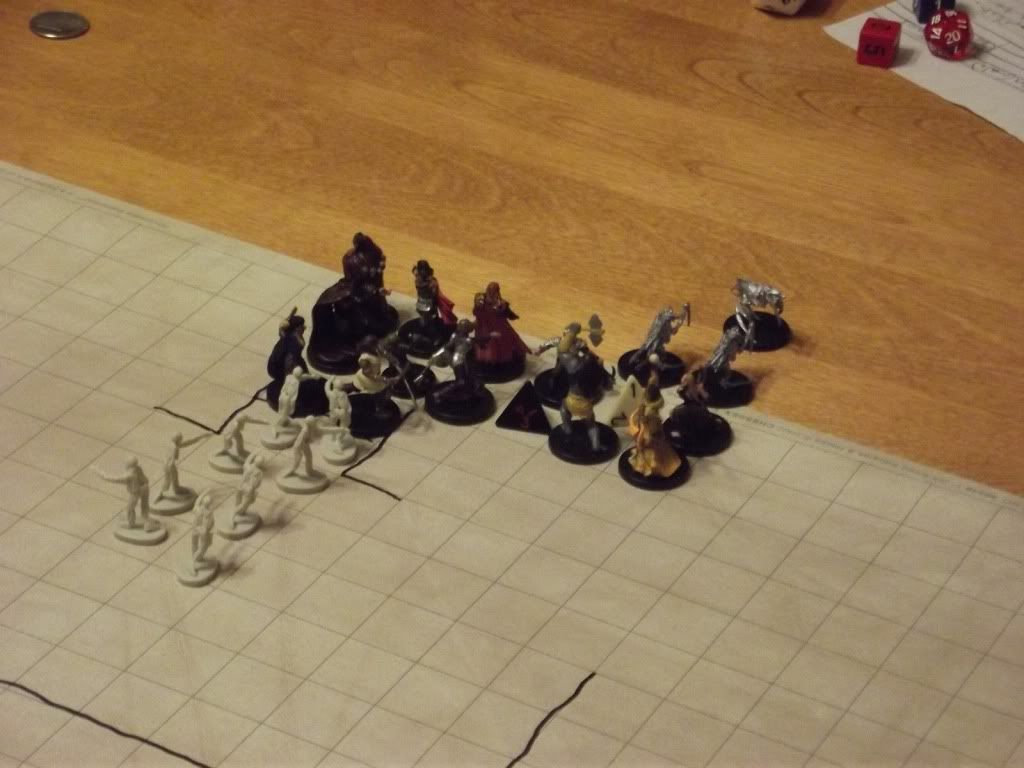
I ran a game of oD&D on August 7.  After the failure of that, I made a few tweaks and ran the game again on November 5, this time for my regular D&D 4e group.

The second run went much better.  Of the twenty humanoids, five chickens, and one goat who entered the dungeon, nine humanoids and one goat remained.

We continued the game recently, and it didn't go so well.

Everyone died.

What happened?  Foul luck, really.  If you want the official account of events, you can read Escape from the Tomb of Theronna Onyxarm, Part 2.  Some notes after the jump.

***********************************

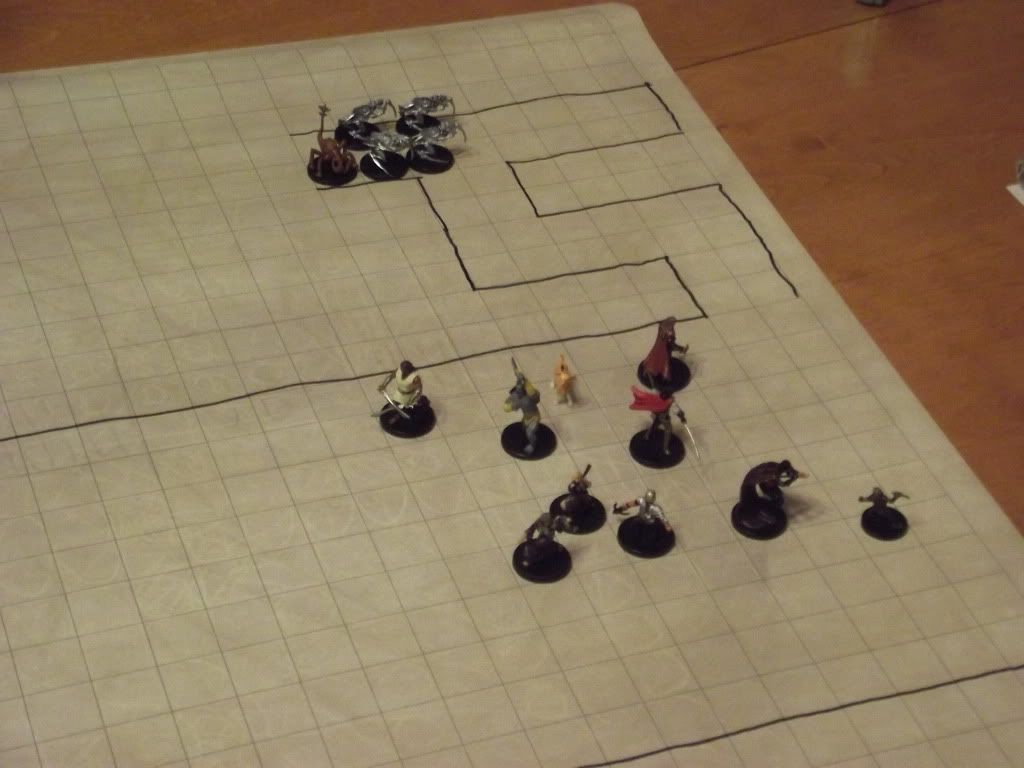
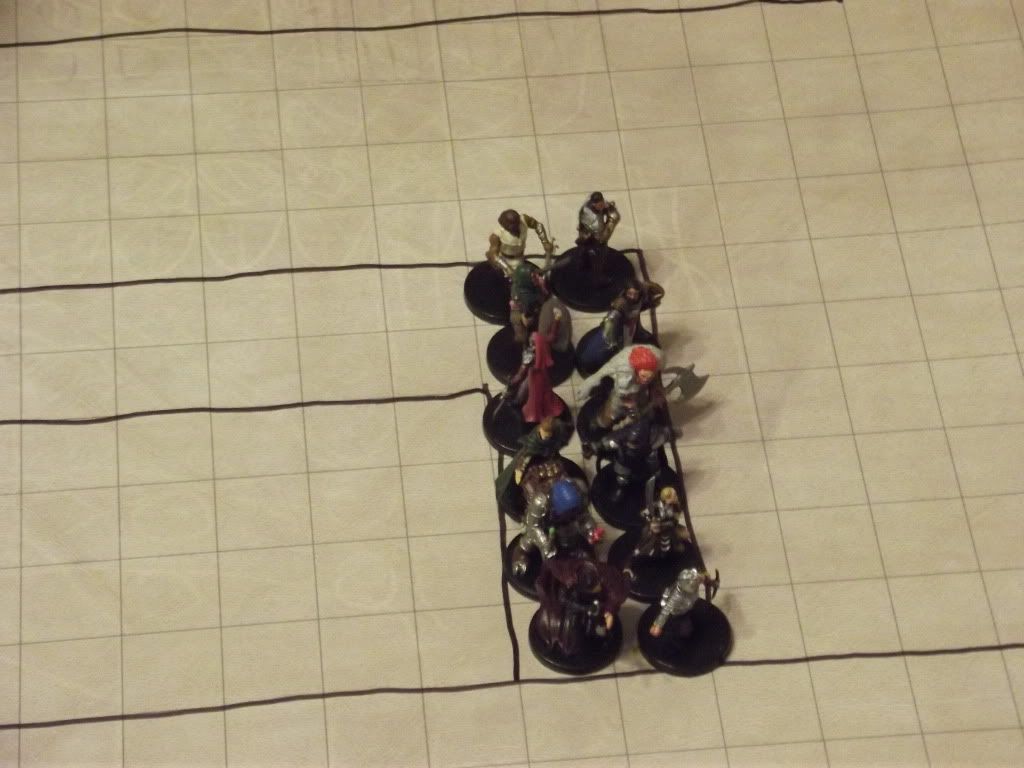
The group was smart.  They didn't split, conforming to something more like a phalanx.  They didn't have mapping tools (and that's intentional; if you haven't read the other entries, the PCs are just college students who aren't prepared for this dungeon), but they used some chalk to mark their way.

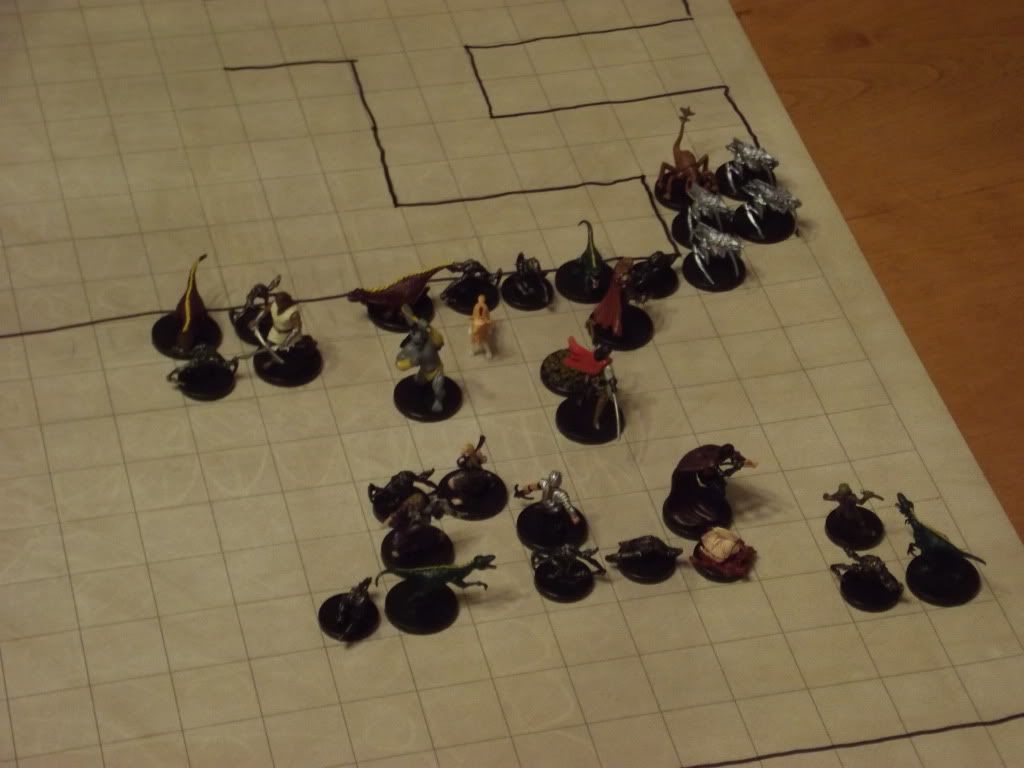
When they doubled back to a room with a score of kruthiks, they wisely decided to avoid it.  The next door, however, led into the room.  As did the secret passage they found — and that's exactly when the random number gods conjured a pack of shadows to close off the only escape route.

It's just five shadows.  That's not so bad.

The group has to run, and when they do, kruthiks boil from the tunnels in the walls.

That's a lot of kruthiks.  We're boned.

The group loses about half its number, but manages to get through the door and close it behind them.

SHITSHITSHITSHITSHI—!

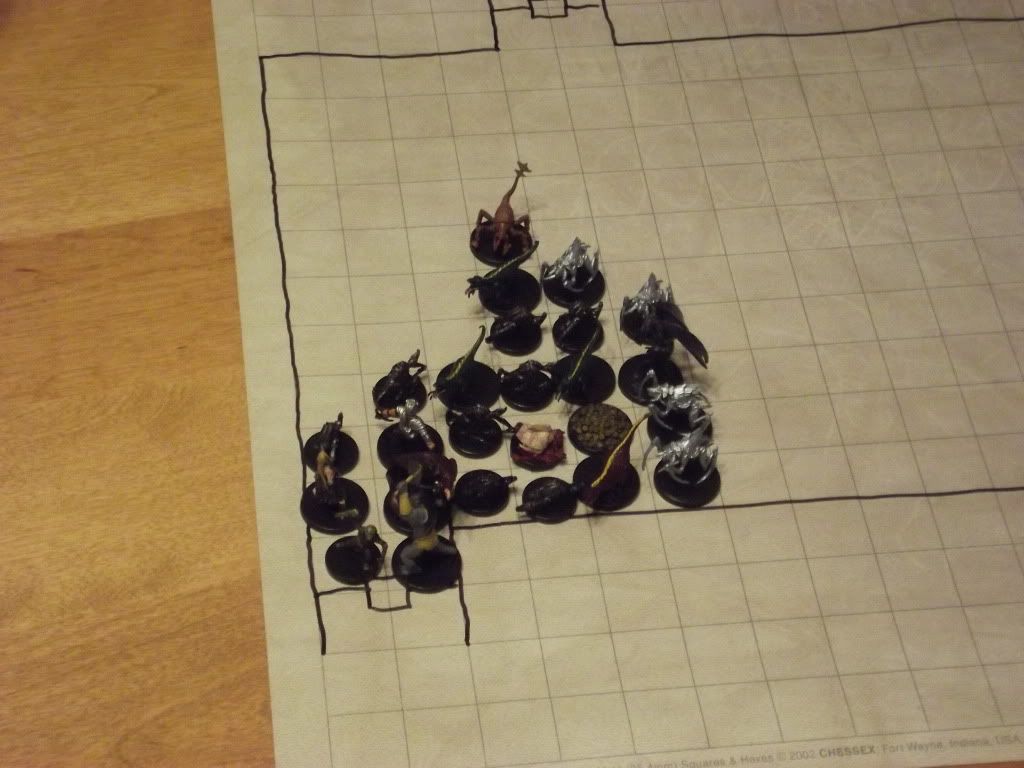
...and then they wander into a dead end, and get cut off by a horde of dwarf zombies.

"Tonight we dine in Hell!"

In an amazing twist of fate, Paul O'Trieadies, running around with 1 HP and at the front of every line, was the last man standing.

"I must not fear.  Fear is the mind-killer.  Fear is the little-death..."

But eventually, entropy takes us all.


Expect the Tomb of Theronna Onyxarm to be posted shortly, likely after I'm done editing.  I'll probably convert the business to Labyrinth Lord for ease of reference.  Among other reasons, Labyrinth Lord is more readily available than the LBBs.

Tuesday, January 31, 2012

Return to Remnant

Remnant survives.

A group of twelve entered the Fungoid Gardens, and four returned, converting the town to the worship of the Old Ones.  After the celebratory orgies and revels of the new Remnant (wherein Kra-deera and Uthak learned that Kra-deera's nails can cause unconsciousness), everyone returned to the business of running the town.  Three more travelers came to town the following day: Lilimuth Yogthoth (1st-level Jale Sorcerer), Shako of the Wastes (1st-level Black Specialist), his lizardwolf pups and his two Red child-slaves, and Vebok Barth (1st-level Red/Brown Sorcerer).

That night, all in the village had a dream, prompting them to dig.

Shothothor and most of the villagers took to digging, while Lilimuth, Shako, and Vebok wanted to investigate these "Fungoid Gardens" about which they had heard tales.  A relative newcomer (having only been in the village a few weeks), Shub Shiggashoth (1st-level Brown Fighter) joins them.  Uthak (1st-level Jale Fighter), having previously survived an expedition to the Fungoid Gardens, joins them and decides to act as a guide.

On the way, they meet and destroy a dolm ooze.  It pits and rusts Uthak's new plate armor and destroys Vebok's short sword, although Vebok scoops up a sample of the goop with one of his glass jars.

Continuing to the Fungoid Gardens, the group tries to investigate paths they have not previously taken.  They find a filthy area with bedrolls and more of the slack-jawed Yellow Men.  Leaving them alone, they go down a side-tunnel to find an alchemy lab with a black-clad figure inside.  Uthak recognizes one of the Gardens' inhabitants, and they talk.  He agrees to give them a tour of the upper levels, although he will not descend into the deep one-ridden lower levels.

He gets the group past the Amphibious Ones and they descend into the lower levels.  They wander, fight another dolm ooze (which results in more plate armor corrosion), and investigate the runes that keep a hive of deep ones trapped in these caves.  Deciding that they don't want to investigate too heavily, they ascend.  Before they help the alchemist move to Remnant, offering their protection in exchange for his services, they decide to investigate the nearby chamber devoid of fungus, as the alchemist says he's always had a funny feeling about that place.  Uthak finds that a section of wall is actually an opening blocked by a boulder.  They determine it to be over 100' deep.  Uthak removes her plate armor and decides to climb down.  She slips and falls, plummeting several hundred feet to her death.  The sound of something in the pit suggests that she landed on it and either injured or killed it.

The group helps the alchemist move to Remnant.  Shako tries to fashion the plate into shovels, but breaks it in the process.

The group decides to enslave any wanderers they can find.  They decide to make hunting forays into the Blighted Lands by night.  The first night, they happen across an Ulfire Woman bearing sword and shield, clad in leather and a loincloth.  Strangely, rather than legs, she has tentacles with which she slithers across the rocky ground.  Vebok reveres her, and rather than enslave her, they make introductions.  She is Kakotug Narthok (1st-level Ulfire Specialist), and she agrees to accompany them.

Their foray only finds a carapaced white arachnoid with two orange eyes and covered with small, fanged mouths.  Kakotug gravely injures it and Vebok finishes the job, killing it.

The next several nights are uneventful, as the group finds nothing in the wastes.

When they return on the fifth day, they find that the hole has been completed, and it leads down into a series of caves.  Before they go to sleep, they decide to investigate.

The caverns are covered with a fluffy, dolm fungus.  They find a sack of coins, which they hoist back up to the village.  Then they continue deeper.

They find nothing, but as they continue deeper, they find a tunnel.  As they walk, they hear several feet behind them, and they turn to find a group of ten to twenty stunted, dwarfish, reptile people with snake-like faces.  After murdering five of them, Vebok addresses them and frightens the remaining group off.

They continue until they find a metal door.  They pry it open and find themselves in an obviously artificial facility with walls of metal and stone.

Traveling with "left hand on the wall" or "wall-follower" method, they wander through the lightless tunnels until they find an intersection.  Shako wants to go to the right door, and opens it to find a smooth green hexapod with two eyes and a sharp beak.  The group leaps into the fray and savagely attacks the beast, killing it in seconds.  A pile of coins also sits in this room, and the group grabs it before returning to the surface.

All told, the group finds 900 silver coins and 500 gold coins in the depths, along with the five spears they grabbed off the snake-things.

Update: Incidentally, while Kakotug, Lilimuth, Shako, Shub, and Vebok were sleeping, Nyu-an, the Black alchemist from the Fungoid Gardens, took a few of the villagers and made a brief expedition into the well, just to investigate this fungus.  He has determined that it is harmless and edible; if the caverns could be cleared, the fungi could be used as a food source and possibly even cultivated.

Further Information Is Available: E. M. Lamb also made a post about the session.  He's currently playing Shako of the Wastes (1st-level Black Specialist), for those of you following at home.

*************************************

Statistical Data: The town started at 45 men led by the Savior of the Prodigals (third-level Fighter).  After the first delve into the Fungoid Gardens, the town was at 35 men led by Shothothor (first-level Sorcerer).  The town has lost an old resident and gained a few new ones, bringing the total number of residents to 38 (39 if one includes Shothothor).

Demographic Breakdown:

Shothothor (1st-level Sorcerer)

38 Men:
  • 3 1st-level Sorcerers
  • 2 1st-level Specialists
  • 2 1st-level Fighters
  • 31 Normal Men
Among the Normal Men, there are:
  • 1 alchemist
  • 1 craftsman (stonework)

Friday, January 27, 2012

More Money, More Problems

Another interesting thing about old school gaming: money is the driving force for the characters, but money almost causes more trouble than it's worth.

I'm making some dungeons, and I realize that using the oD&D tables from Monsters & Treasure and Underworld & Wilderness Adventures generates stupid amounts of treasure.  Any given haul can easily cause the PCs to generate stupid amounts of money.

We're talking retirement amounts of money.  If you consider that being a peasant costs a few silver a day, then the haul I mention below (16,666 gold pieces) will last you past your natural lifespan, assuming you're human.  Even if you are a little more of a big spender and average a gold piece a day to live in comparative luxury, you still won't run out of your first haul for about forty-five years.

But.  There's a snag.  You're a transient, so you don't really need much, but you're on the road hoping to get rich quickly, a life which serfdom won't allow.

Once you get money, though, several logistical problems emerge.

Let's say, for example, that there are 100,000 gold pieces worth of treasure in a dungeon.  Maybe there are six adventurers, so that's about 16,666 gold pieces per party member.

Good luck carrying that out of the dungeon.

If you're going oD&D, that's ten times more than a character can feasibly carry while moving at a quarter of his movement rate (any sane DM will say you can't move, and even the insane ones say that you'll be moving so slowly that you'll probably be attacked half a million times before you actually get out of the damn dungeon).  If you're playing Weird Fantasy Role-Playing, you're eating into your 167th equipment slot, meaning you're at something like 32 encumbrance points, and that your skeleton probably collapsed under the weight of your loot 11,000 coins ago.

This also assumes that you're totally naked, somehow carrying all these coins in your hands.  This further assumes that you lack enough common sense to know that thousands of coins are heavy.

Well, you think, I'll just make some return trips.  This dungeon isn't going anywhere, so what hurry do I have?  But each return trip to the dungeon is a risk, increasing the likelihood of your horrific and messy death.  If it's among your first delves, you may not have enough equipment to grab all that treasure at first, so you'll have have to make return trips.  To minimize those trips, you're either buying carts and livestock (good luck getting those in the dungeon), or hirelings (better pay well, or else they might just take the money and run, assuming they don't knife you in the back before doing so).

Then, once you've obtained your pilfered tomb gold, are you just going to drop it in a cave and stay there all the time?  No?  Then you need to buy property.  And since you're out and about, you'll need people (or objects or whatever) to guard that property.  And people to manage it.

It's fairly realistic, but at the same time, it almost makes you wonder why you'd risk your life to get it.

It also dampens that initial shock when you think, Wait, how much money did I put in this dungeon?

When you're wondering what in the hell happens when somebody has that much loot, the real answer is that the adventurers will be investing it into future dungeon delves.  So it all balances out.

Anyway, enough rambling.  Referring back to the title of this post, take us out Biggie Smalls:

Player Agency, Revisited

After playing The Grinding Gear and running Fungoid Gardens of the Bone Sorcerer, I've learned something important about player agency.

Player agency is the ability to cut your losses and leave the dungeon to go anywhere else.

Most modern variants assume you'll leave the dungeon (or the adventure, or whatever) to sleep and return.  Old school gaming lets you leave the dungeon, and assumes nothing.

Maybe you'll return someday, maybe you won't.

Tuesday, January 17, 2012

Carcosa: The Aftermath 2: The Aftermathening

How could I forget the most important part?

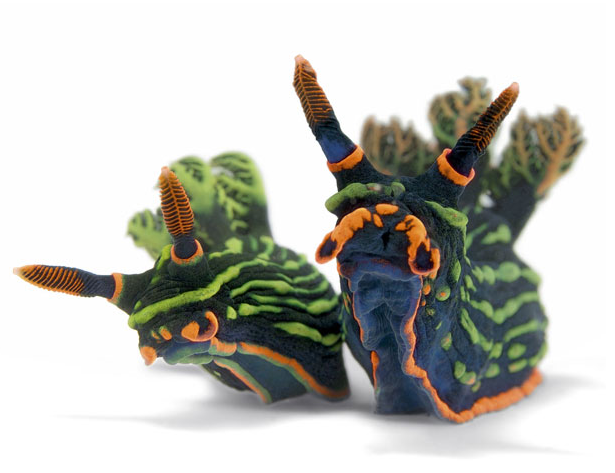
Imagine this in dog size.
The party encountered giant slugs in the Fungoid Gardens, and Kra-deera totally licked one.

I'm already looking at the Fearful Fungi chart on page 222, so I roll with that.

Bam!  Mutation.  Within minutes, her fingernails harden and turn the color of these slugs.

She probably learns that she now has poisoned fingernails when she returns to Remnant and has some time alone with Uthak.  Roll to save vs. poison!

Fortunately, it just causes unconsciousness.  Still, passing out totally ruins the mood.

Carcosa: The Aftermath

So.  Carcosa.  It happened.

I've talked about Carcosa before, but here are a few more thoughts.

Carcosa is like Dark Sun meets Gamma World.

Carcosa is great.  It's the only game I can think of where a young caveman can steal Grey technology, grow up to be Iron Man, and fight the Great Old Ones.

Finally, if you haven't read it, Jim Stutz has a review of Carcosa on RPG.net.  He didn't care for the game, but he gives us this completely accurate gem: "What we end up with are dinosaur-riding sorcerous cavemen exploring ancient ruins and pursuing the Greys for their nifty rocket launchers while being pursued in turn by Nyarlathotep and some undead mummies.

"Why?  Fuck you, that's why."

(For the record, I'll comment on one of Jim Stutz's criticisms when he says, "we're told that 'on a lifeless island of black stone stands the alien city of Carcosa.' So, 'unkowable to Me' serpent-man alien? Non-Euclidean Cthulhu-style alien? Invaders-from-Space alien? We don't know, because that one line is all we get about the city of Carcosa. One could say that the beauty of the setting is that it allows me to answer these questions for myself. One could also say that that's what I paid the writer $21 to do for me."  The answer likely has something to do with redundancy, as there is already all this stuff that references Carcosa.)

So, I ran Fungoid Gardens of the Bone Sorcerer, included in the Carcosa book.  I think people had fun.

E. M. Lamb already catalogued the session if you want to read it, so I'll only provide a few thoughts here.

I made six pregenerated characters, five using the standard Weird Fantasy Role-Playing rules and one using Jeff Rients' "What Went Wrong" supplement (that's a direct link; you can see the original post and some reactions here).  The six players were given the choice, and all chose the "What Went Wrong" supplement.  So there are five characters of guaranteed competence and seven characters of varying degrees of competence.

Also, some of the players wanted to keep with the random theme and rolled 1d100 for their ages.  Three characters ended up over sixty, allowing me the opportunity to test Weird Fantasy Role-Playing's aging rules.  Bonus!

Also, for the record, Uthak and Kra-deera are lesbian lovers, as both were around the same age and both were lesbians.  Thank you, Jeff Rients.  And I didn't even have to use his romance chart!

That would make for a disturbing Carcosa game.  Love in Carcosa, like A Midsummer Night's Dream but with more Lovecraftian monsters and horrific rituals.

That can only lead to tentacle hentai, so I think we're going to skip it.  Moving on.

So, here's the interesting part (and a spoiler alert, though you knew that already).  Reading through the adventure, I felt that the first few rooms of Fungoid Gardens hold nothing suggesting that combat will happen.  The white lotus thralls are picking flowers.  The sorcerer is wandering around, doing experiments.  His acolytes and the alchemist are hanging out.

The adventurers could have had a relatively easy time of it.

As it was, combat only starts when the adventurers are in the white lotus gardens, and the phrase "kill the sorcerer" is uttered.  Pretty much by accident, as they're discussing what they want to do within earshot of the white lotus zombies.

Poor Pheebo.
Pheebo, Uthak's loyal retainer, was the first to die.  Although he totally broke a lackey's neck with a solid right hook.

Kra-deera's loyal lizardwolf took some punishment but held its ground.  Yaan-krok had Boy the slave and some sort of spider-dog thing (he was one of the WFRP guys, so he actually bought those with starting money).  They survived, too.

When the party split, I would later learn the chaotic types were plotting to let the other party members deal with the Bone Sorcerer, and if he killed them all, they were just going to plead ignorance and pledge allegiance.

The Bone Sorcerer would have been a little more frightening if he weren't overwhelmed by about ten dudes, and if the Mind Blast didn't weaken him considerably.  Then again, the fact that a lone man held off about ten armed people for about half a minute is a fairly impressive feat.

But really, that's about it.  The characters were murderhobos and went around murdering everything (including a Spawn of Shub-Niggurath that was completely immobile).  The backstabbing PCs were actually the ones who didn't kill anybody, instead hanging back.

You know.  To murder everyone later.

Shothothor and Yaan-krok were the ones who arrived before the others and slew the Savior of the Prodigals.  Shothothor turned the town to the worship of the Old Ones almost single-handedly.

I hope to play again, and I suspect future games will involve the adventurers trying to get stuff together so that they can make Remnant autonomous.

We shall see.

Addendum: I totally forgot about Kra-deera's toxic fingernails.  Read about it here.

Also, I'll repeat the fact that E. M. Lamb recorded the plot of the game session with more detail than these vague notes about running the game.  You should check it out.

Wednesday, January 4, 2012

It Begins

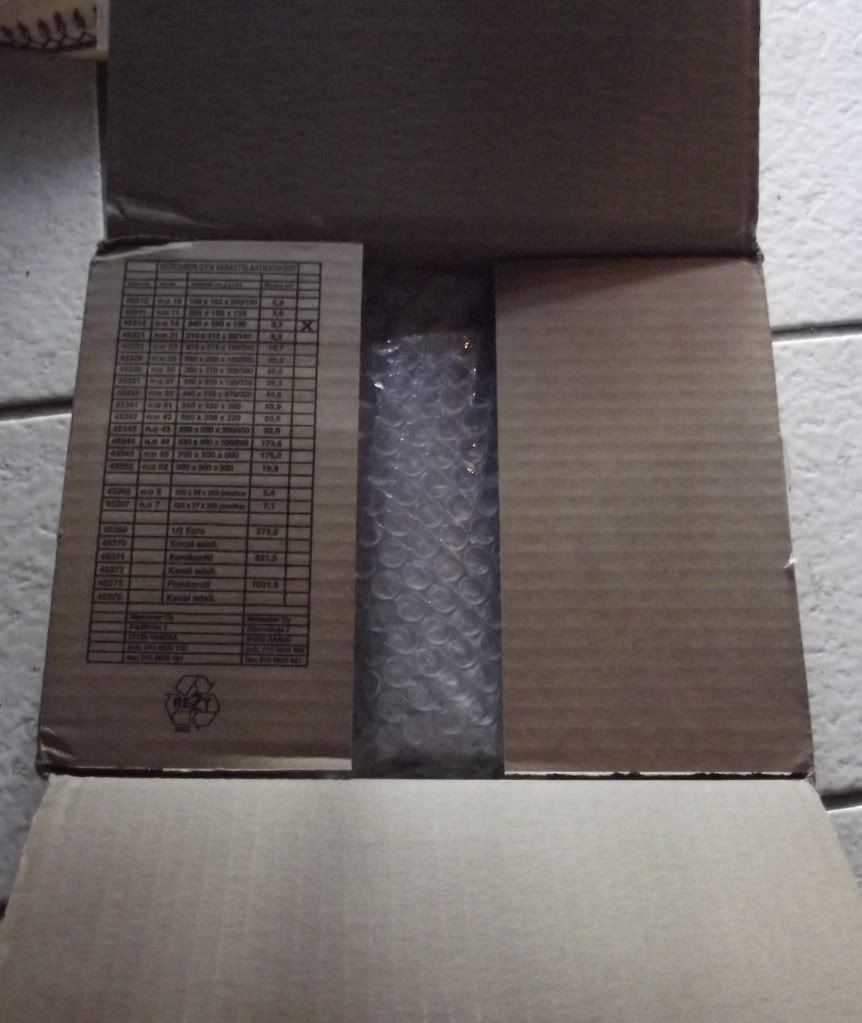
Well, what's this?  What showed up at my house yesterday?


Something from Lamentations of the Flame Princess, you say?  Well, let's take a look.


Oh yeah.  That looks like a Carcosa.


Easy...


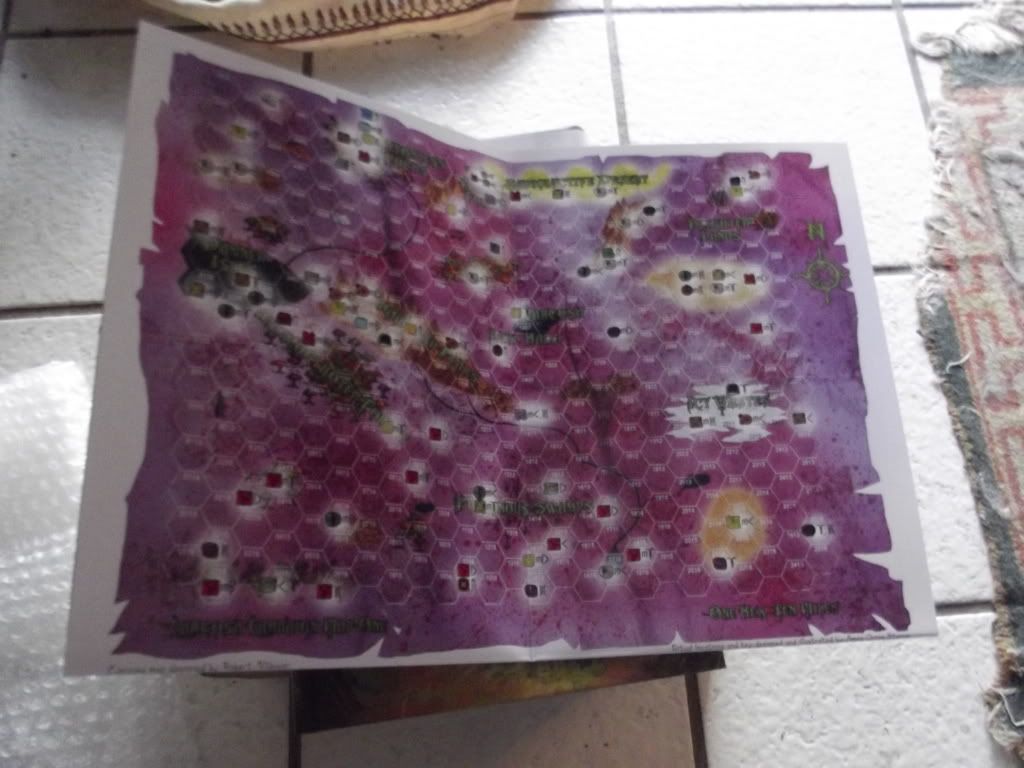
It's wrapped in the canvas map that you got for an extra five euros.  I was planning on getting the map to actually use it, but I'll probably frame the bastard.  It's a good-looking map.


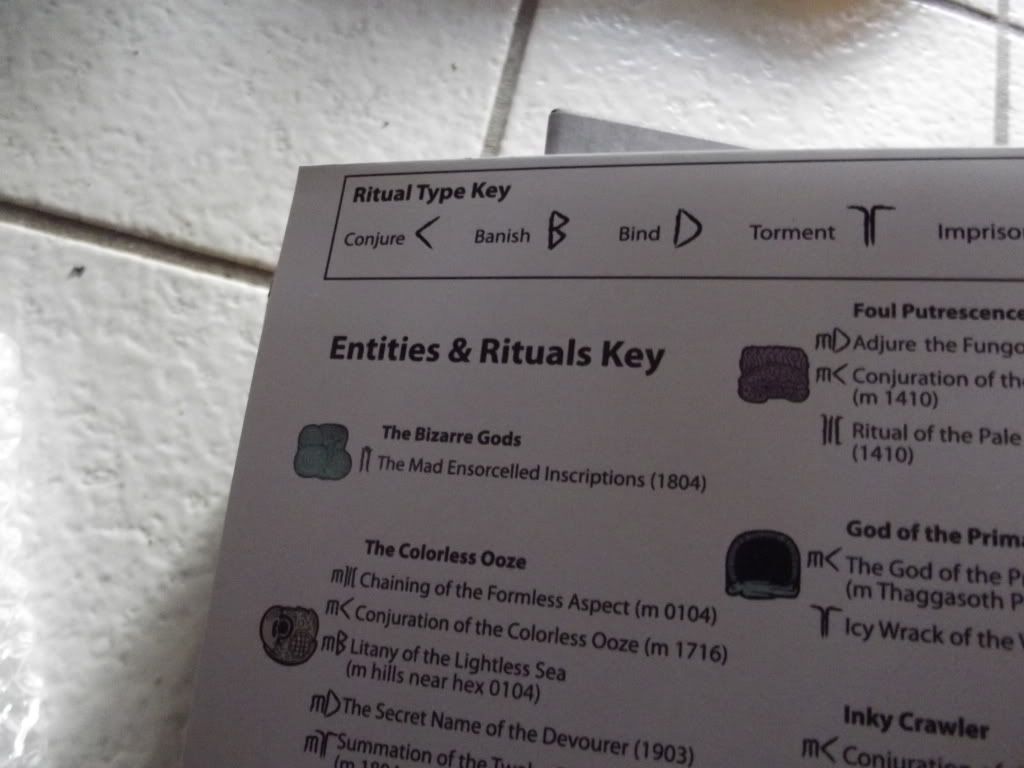
Oh that's neat!  One of the other extras is a little cheatsheet tying the rituals, creatures, and hexes together.


And it has another map on the reverse!  I haven't even opened the book and this is already awesome.


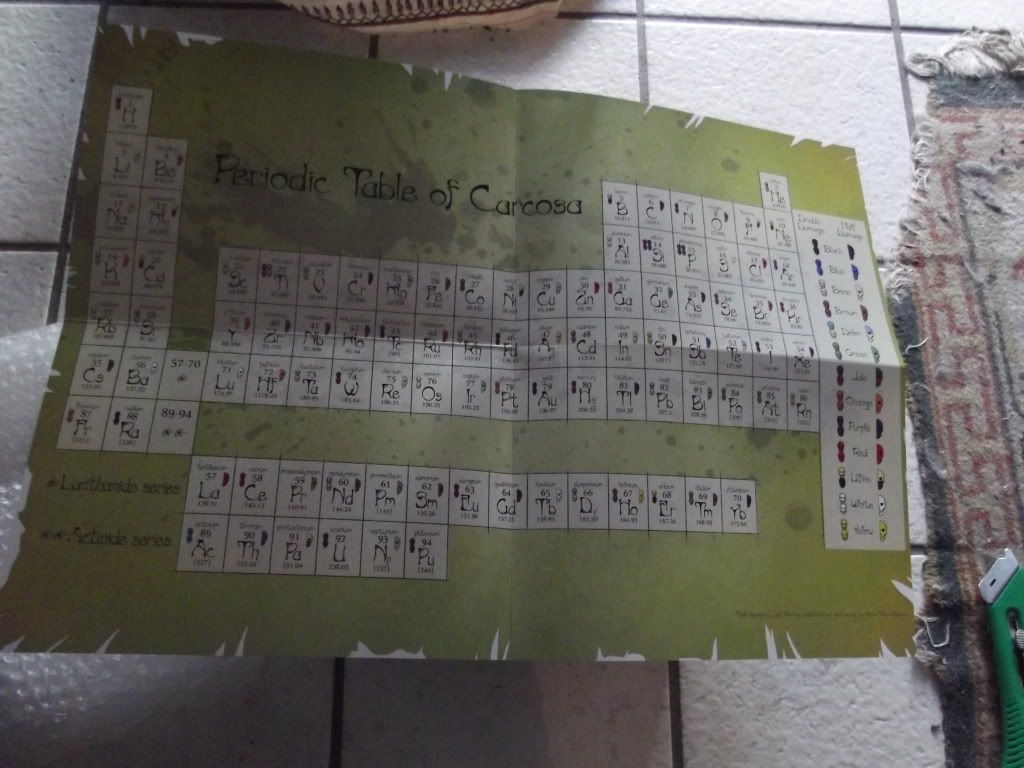
It's Jeff Rients' Periodic Table of Carcosa!  As in Paranoia, the different elements and different colors of laser do different things, and Jeff Rients made a little graphical summary.  It's fun with the Newtonian color spectrum!


And there it is.


There it is.  As noted elsewhere, it's a damn pretty book.  It wouldn't be out of place in a library.


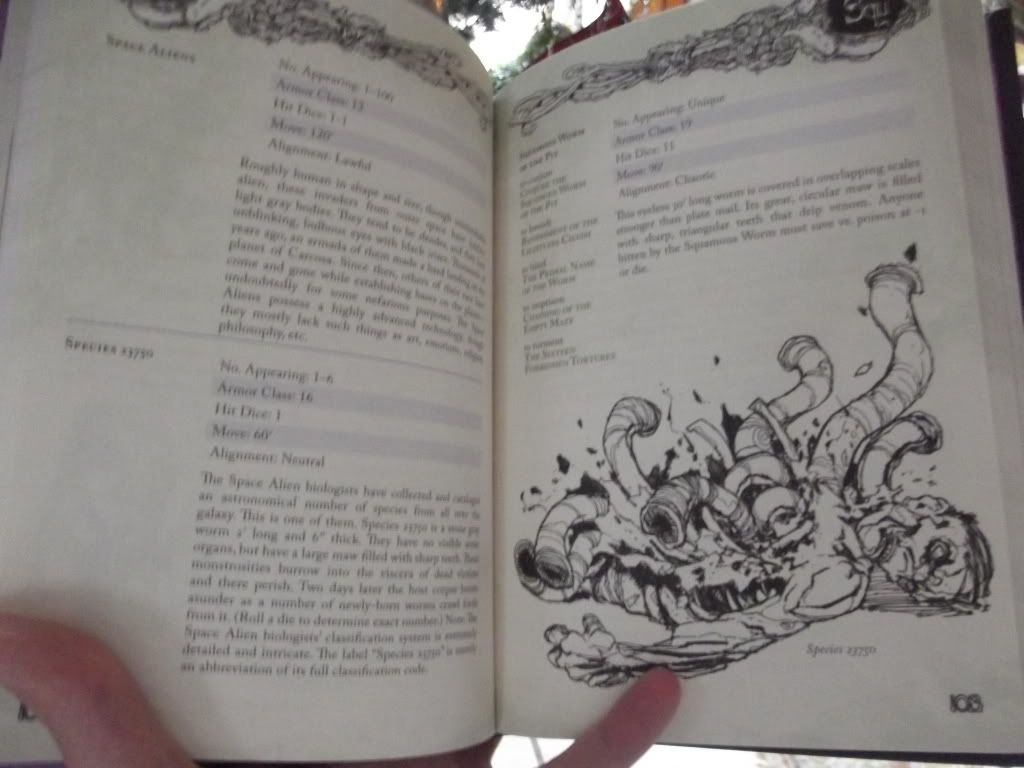
A typical sample of the layout and artwork.  In retrospect, I probably should have picked a page other than Species 23750 burrowing out of someone's cadaver, but that's just the way things go in grim Carcosa.

I know Mr. Raggi had some trouble getting the layout to work, but it was worth the wait.  I'd say —


Wait, what?  I don't remember ordering you...


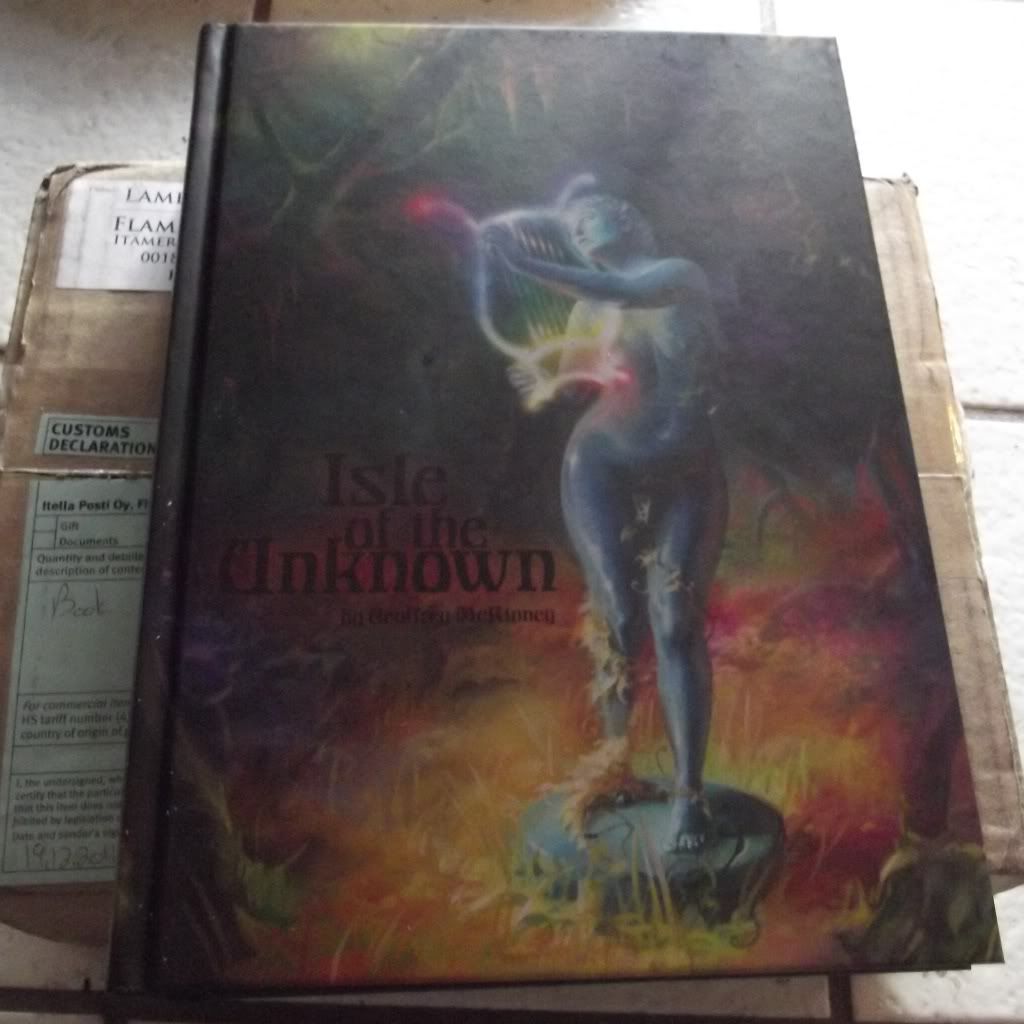
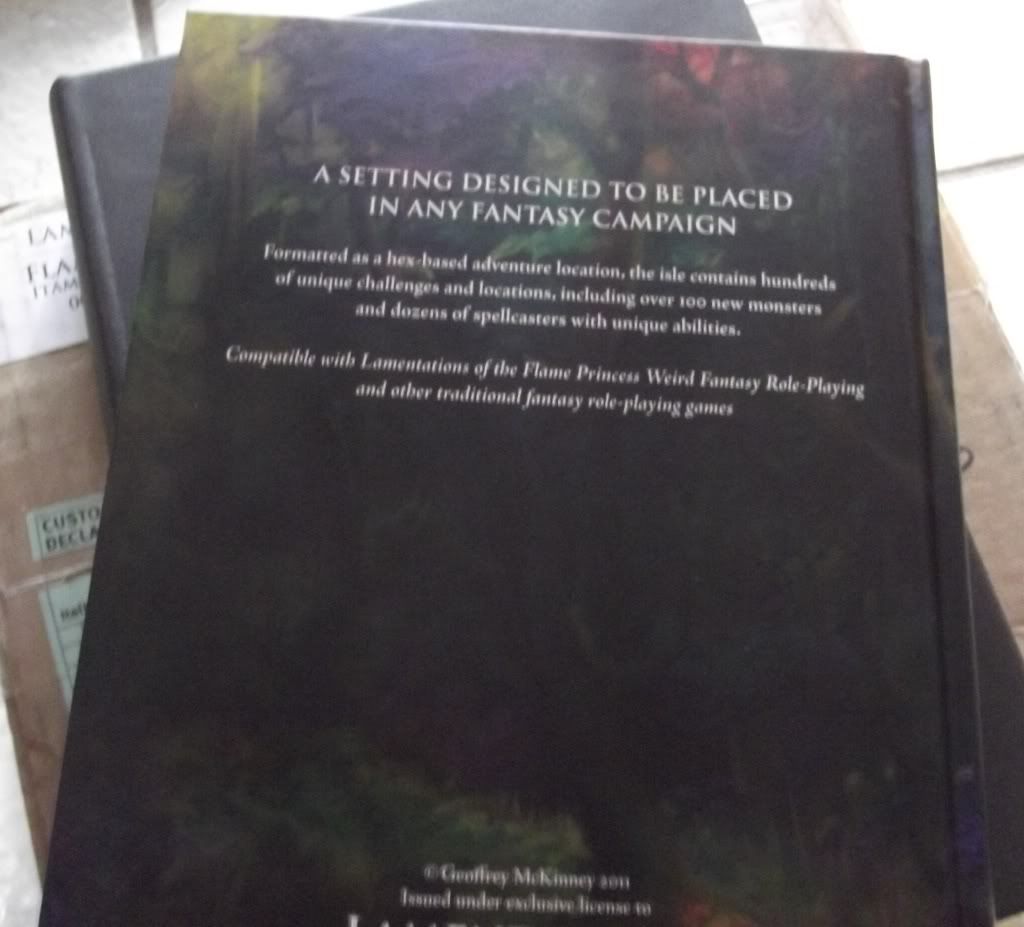
Yup.  This is Isle of the Unknown.  It's done by Geoffrey McKinney (the same guy who did Carcosa).  The format is similar to the location writeups in Carcosa, but this is an island sandbox chock full of stuff.  Awesome as a setting in its own right, a random place to visit, or a good thing for when that wavecrawl goes wrong and you suddenly need a location for the ship to wreck.


The map on the inside of the book.


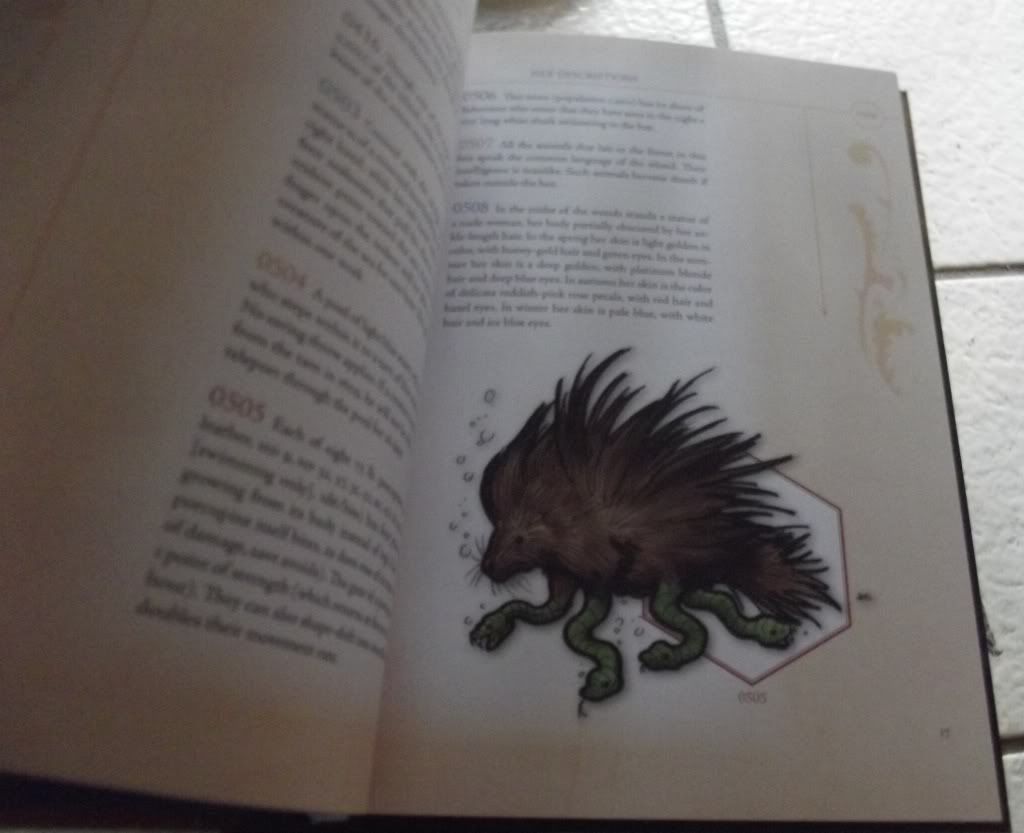
An example of the layout: hex listings with some illustrations pertinent to the subject matter.  For example, this hex is full of, um, aquatic hedgehogs with snakelegs.  Wait, what?

(For the record, that's exactly what those are; they have a gaze attack that weakens victims, and can turn into swordfish.  What did you expect?  It's the Isle of the Unknown, not the Isle of a Bunch of Stuff You've Seen Before.)

I'll chug through this and write about it when I have a spare moment, as I was hoping to lay my hands on it and serendipity found it here.  This pretty much cements the fact that I'm going to pick up a copy of LotFP: Weird Fantasy Roleplaying.

Incidentally, I wrote a little thing about the unadulterated gonzo awesome that is Carcosa, but don't take it from me.  Go read more on your own.  While you're waiting for me to get around to that Isle of the Unknown review, you can read some of those, too.

And as long as you're buying those things (because you totally will), go have a look at Vornheim: The Complete City Kit.  It's good for you!

Also, I found this fan-made addendum to Carcosa over at Teleleli, so why not increase your knowledge base?

Sunday, December 11, 2011

Request: Secret Doors

Happy Christmas from the Santicore!

This year, I participated in Jez's Secret Santicore, and the random number gods paired me with someone who has trouble with secret doors, and so wanted some sample secret doors with concrete methods of activation and specific reasons to be in the dungeon.

(At least I think I got that right.  If you happen to be the requester and find this doesn't suit your needs, feel free to comment — we do returns and exchanges here.)

Anyway, I made a table of thirty secret doors.  1-20 are "mundane," meaning that they use mechanical means, however improbable.  21-30 are magical, meaning that they use magic mechanisms or somehow require interaction with a supernormal creature, like a ghost or golem.  They might need slight modification depending upon where you put them ("Why is there an assassins' training ground in the Temple to Love and Squirmy Little Puppy Dogs?"), but they should at least be good inspiration.

Feel free to peruse the table or roll a d30.  If you just want a random mechanical secret door mechanism, roll a d20.  If you want a random magical or fantastical secret door mechanism, roll a d10 and add 20 to the result.

Without further ado, the table:

1 - This door is hidden behind a statue of a local lust deity recessed into the wall.  The statue and the section of wall swing open, revealing a secret passage, when the lips are pressed.  Supposedly, supplicants were to kiss the statue, and variants with switches placed to simulate other sexual acts likely exist.  Characters searching the area might notice the seams in the wall or the pedestal around the statue’s base, or they might notice seams around the statue’s arms.

2 - This door is hidden behind a bas-relief depicting showing historical scenes from the local kingdom.  The door slides open when the reliefs of the rulers are pressed in order according to the chronological order of their reigns.  Characters searching the area might notice the seams around the bas-relief, or seams around the buttons on the bas-relief.

3 - This section of wall contains a mechanism with a switch that vibrates at a certain frequency.  It will slide open when a certain note is played, requiring either an instrument, a singer with perfect pitch, or an appropriate tuning fork.  Characters searching the area might notice the seams around this section of wall.  Characters with supernormal hearing might notice the reverberations in the wall, indicating the presence of some small, acoustic chamber.

4 - This section of stone wall has a switch disguised as a stone.  Pressing the stone causes the wall to slide open.  Characters searching the area might notice the seams in the wall.

5 - A fresco depicting a local deity will slide open when a particular tune (a hymn or paean, perhaps?) is played on a nearby pipe organ.   Characters searching the area might notice the seams in the wall.

6 - A nearby message admonishing the faithful to not fear evil is accompanied by a statue of a black dragon recessed into the wall.  Reaching one’s hand into its mouth will allow one to press a switch in the back of the throat, causing a nearby section of wall to swing open.  Characters searching the area might notice the seams in the wall.

7 - A statue of a local deity of peace, its arms outstretched, stands in a place of prominence in the room.  A wall panel slides open when at least twenty-five pounds of equipment are placed in its arms — roughly the weight of weapons enough for six or so people.  Modern adventurers might not put their weapons in its arms, but the old supplicants did so before entering the secret passage.  Characters searching the area might notice the seams in the wall, or they might notice seams around the statue’s arms.

8 - A bookcase or other large, heavy object sits in front of an open doorway.  Astute characters might note scuff marks on the floor or a slight breeze.

9 - Astute characters might notice that this wall is hollow when tapped, or that there are seams in the mortar.  A simple people, the builders of the dungeon just used a prybar to open this wall, which can slide aside when pressure is applied.

10 - A statue to a local folk hero or maimed deity sits in the room.  A ceremonial weapon of the type who originally wounded this figure rests somewhere nearby.  Recreating the legendary figure’s wounds with this ceremonial weapon — in the order they were received — causes the statue to rise on a pedestal into the ceiling.  The pedestal has steps so that characters can climb it as a ladder, literally ascending into the heavens with the passing of this entity.  Characters searching the area might notice the seams in the statue’s base, or that the figure’s wounds contain seams or buttons.

11 - An astrological diagram has several recesses where nearby stones can be placed.  Each stone has an astrological symbol on it.  Placing the stones to recreate the birth chart of the Chosen One causes the wall with the diagram to iris open.  Characters searching the area might notice the seams in the wall where each wedge of the diagram is in place.

12 - This emergency escape route was installed by a corrupt ruler who attempted to eradicate the influence of the old regime.  This figure’s final affront was to place a tapestry of the region’s founder over the escape route, so that he would have to cut it open in time of strife.  This escape route was never used, and has lain that way since the ruler was killed by the servants.  Characters searching the area might feel a slight breeze from the direction of the wall.

13 - A subterranean river and a broken waterwheel dominate this room.  Anyone fixing the waterwheel — or harnessing enough power to turn the drive shaft — finds that a panel in the far wall slowly rotates with the waterwheel.  Characters searching the area might notice the seams in the wall.  Some characters might just wonder what the waterwheel powered.

14 - This room in a military barracks features a relief on the wall depicting an example of a hated enemy (“The 304th Dwarven Legion will exterminate all bullywugs!”).  Hitting the appropriate locations as per the old drills causes the wall to slide open for about five seconds, long enough for a few people to go through.  The old idea was that a recruit showed a superior officer his training by rapidly attacking the target, causing the wall to slide open and allowing the recruit to enter the next room.  Astute characters might notice the seams in the wall or in the “pressure points” on the foe diagram.

15 - Two statues stand is this room, holding their swords aloft.  If their sword arms are lowered, a trapdoor will open between them.  Characters searching the room might notice the seams in the floor or on the statues’ arms.

16 - A tangle of rooms was used as a training ground for assassins, and only those who recalled the teachings of the order could pass to the next chamber.  This room contains a statue of a humanoid resembling a typical member of the town watch.  As a mechanical feature, it rotates to face the largest concentration of weight in the room, either looking at a closely-packed group or the heaviest person in the room.  This room and the surrounding hallways are fitted with highly-sensitive pressure plates, built in such a way that they may be mistaken for old, slightly loose stonework by those who do not know better.  Passing through the secret passage is simple — the subtle handholds on the walls allow initiates to climb without touching the floor.  A hidden wall panel slides open if weight is removed from the floor tiles for more than a minute.  Characters might notice the pressure plates in the floor or the seams in the wall.  Some characters might grow suspicious at the rotating statue, particularly if they are unable to detect magic emanating from it.

17 - Strangely, the same room has another secret door — those who can leap from the wall and twist the statue’s head as if snapping the neck before the statue rotates to face them cause a trapdoor in the ceiling to open.  The trapdoor stays open for five minutes before the assembly resets.  Travelers must possess their own rope and grapple — or just be able to jump or climb very well — in order to proceed.  Characters might notice the pressure plates or the seams in the ceiling, as well as the seam around the statue’s neck.

18 - A large statue of a cyclops dominates one wall of this room.  If someone scales the statue and depresses its eye, the statue animates in a mechanical fashion and smashes the wall next to it (it may also incidentally hit the person activating the statue).  Characters might notice several seams on the cyclops statue, indicating articulation, or they might notice that the wall is weakened or hollow.  It is highly likely that the dungeon designers meant this as an escape route or a place for something well-hidden.  Some artisans also leave little trinkets behind, so this little treasure room might only contain some bizarre little fetish or some such.

19 - A treasure chest in the room contains treasure, but it also contains something else.  If the lock is locked while the chest is open, the key will turn past the point when it normally stops, opening the false bottom of the treasure chest.  A ladder leads down into another section.  Though it is time-consuming to clear out the treasure chest, the designers felt that most tomb robbers are too greedy to look further.  Characters might get suspicious about the fact that the treasure chest cannot move, and some might notice something strange about the lock.  Others might notice the seam at the bottom of the treasure chest.

20 - This circular room has a bas-relief on the wall depicting a sea deity or a legendary seafarer.  The ship’s wheel on the wall can be pulled from the wall and rotated.  This will rotate the entire room, closing some exits but opening others.  Some variants may not rotate the room, but may instead raise a pedestal in the middle, revealing a spiral staircase leading downward.  Characters might notice seams in the bas-relief, or in the floor or ceiling.  This very well may lead to a shrine to the deity in question, or perhaps a subterranean, aquatic passage leading elsewhere.

21 - This section of wall is a bas-relief or fresco depicting a local deity or folk hero.  If the proper supplication is performed before the wall, it swings open.  Characters searching the area might notice the seams in the wall, or the subtle arcane iconography in the wall revealing its magic.

22 - This secret passage is activated by a nearby painting of a local foe (likely historical).  Staring into the eyes of the painting for at least a minute causes the nearby section of wall to recess into the ground.  Characters searching the area might notice the seams in the wall, or the subtle arcane iconography in the wall revealing its magic.

23 - This section of wall isn’t stone at all, but an ooze that has taken on a consistency appropriate for the nearby wall.  Applying the appropriate reagent causes the ooze to assume its normal state and move aside.  Setting fire to the wall (or otherwise attacking it) prompts the ooze to attack.  Astute characters might notice that the wall quivers slightly, or that the acoustics in the room aren’t quite right.

24 - This section of wall bears an emblem of a local mage’s guild or equivalent.  The wall disappears briefly when struck by a particular spell, such as magic missile.  Inner chambers require higher-level spells to activate.  Characters might notice the subtle arcane iconography in the wall revealing its magic.

25 - This section of wall depicts the local deity of slaughter.  Spilling blood on the image causes it to open.  Strangely, spilled blood soaks into the image and is absorbed.  Characters searching the area might notice the seams in the wall, or the subtle arcane iconography in the wall revealing its magic.

26 - Invisible, incorporeal ghosts guard a crypt in this room.  They will open a hidden wall panel to any whom leave offerings to them in excess of 100 gp worth of coins or goods.  Unscrupulous characters who detect the ghosts might coerce them with pain or magic instead.  Characters searching the area might notice the seams in the wall, or they might detect the presence of the ghosts.

27 - In a chamber dedicated to a local deity, an oddly-placed statue of an opposing deity is recessed into the wall.  A holy book of the local deity sits in the room; reading a passage wherein the deity defeats the opposing deity causes the enemy deity’s statue to recess into the ground.  Characters searching the area might notice the seams in the wall around the statue, or the subtle arcane iconography in the statue revealing its magic.

28 - A large, flaming brazier sits in the middle of the floor, generating light and heat.  Following the temple’s instructions to be purified by flame, anyone who actually leaps into the brazier finds only a moment of pain before finding it is just an illusion.  A trapdoor leads into the floor.  Characters searching the area might notice the subtle arcane iconography in the wall revealing its magic, or perhaps that an object near the flame is not scorched.

29 - A sundial sits in the center of this room, whose entire far wall is dominated by a scene from an historical battle.  Shining a light on the sundial to recreate the supposed time of this battle (“Ah, yes, I remember from my time at university that the Battle of Gloaming’s Dark supposedly happened around the fourth watch after midnight, hence the name.”) causes the far wall to recess into the floor.  Other dungeons may make use of this trick, using times important to the builders of the tomb.  Astute characters might notice the seams in the far wall, or the subtle arcane iconography in the sundial revealing its magic.

30 - Undead stand silent sentinel in this room, but do not attack unless they are attacked.  If they are commanded to open the wall — possibly by a command word issued elsewhere, or possibly just by someone commanding them to open the door — they will do so.  Characters searching the room might notice seams on the wall.  Suspicious characters might make note of the fact that there are undead guarding the room with no apparent purpose.  Some magi architects, not wanting to delve into necromancy, might use golems instead.

Wednesday, November 16, 2011

Sharpened Hooks: Tomb Cats, Revisited

Though many tombs are remote or have hidden entrances, any tombs that are open to the elements frequently attract tomb cats.

Though feral cats descended from our own domestic cats would hardly be considered a credible threat, tomb cats can be truly terrifying.  They are vicious, and years of hunting amid the detritus of ancient civilizations have exposed tomb cats to various pathogens, turning the usual diseases they carry into highly virulent strains.

Tomb cats may be found in the vicinity of tombs on hunting forays.  They may also hunt in the catacombs themselves.  It is believed that larger tomb cats may be found beneath the surface.

Tomb cats act as basic cats with whatever modifications seem appropriate.  They frequently carry diseases such as filth fever.  Down in the depths, tomb cats can increase in size, and also frequently mutate from the magical energies frequently left in dungeons.  Zombie cats, skeleton cats, ghost cats, dragon cats, phrenic cats, fiendish cats, and celestial cats have been reported, as have truly fearsome variants such as paragon cats and pseudonatural cats.

As with domestic cats and big cats, tomb cats are predators, though their placement in the food chain varies from dungeon to dungeon.  The smaller cats are rarely apex predators, though a family of, say, pseudonatural cats may be an exception.

Monday, November 14, 2011

The Ecological Succession of Ruins and Tomb Cats

So I somehow missed Life After People when it originally aired.  A documentary series on the History Channel, I managed to see the pilot episode from 2008 today.  You can find the pilot in nine segments on YouTube.

Basically, the pilot explains how ecological succession and chemical reactions would alter man's cities after his disappearance, positing what would happen in stages out to 100,000 years.

For the ecology of dungeons, though, the implications are obvious.  Wood would rot first, and wooden structures would be reduced to their components after about fifty years without upkeep.  Brick and concrete would last longer, but might fall after a century or so.  Stone would last even longer, but salts and erosion would eventually destroy it.

Flooding would fill subway tunnels and absurdly spacious sewers within a couple of days after the collapse of civilization; constant water action would cause the support columns to collapse, collapsing city streets into the subterranean canals within 150 years.

After a millenium, most modern cities would be unrecognizable.  After 10,000 years, it is possible that only the Great Wall of China, the pyramids at Giza, and the granite faces of Mount Rushmore would remain recognizable.

(Obviously, this ignores fantasy worlds and magic, but it's still interesting stuff.)

Anyway.  Apart from fantasy streets collapsed into flooded tunnels, they mentioned something I knew, but had forgotten: tomb cats.

The Coliseum's cats are among the most famous, but cats are known to reside in the upper levels of catacombs and tombs, using them as shelters.  They go out to hunt, and then return to their homes to rest.

But what about fantasy tomb cats?  D&D tombs have all sorts of weird magics and eldritch energies, not to mention self-sustaining ecologies, so it is entirely likely that tomb cat colonies in fantasy settings are wholly different animals.

In such a case, it is possible the cats don't hunt outside the tomb, but instead push further into the tomb to hunt.

There you go, you just got a free one-shot — rather than adventurers roaming a tomb, you're a destruction of tomb cats (or maybe your tomb cats are more civilized and you're a clowder of cats instead?).

Anyway, apart from the obvious ecological implications, what about tomb cat adaptations?  Some are likely to just be feral cats, but others might swarm and still others might be dire cats (so, you know, you can reskin all those rat swarms and dire rats — and don't forget that cat mouths and claws are filthy, so infection is still a danger).  Of course, others might be weirder: negative energy cats, shadowcats, and zombie cats.

You should add some tomb cats to your next dungeon, is all I'm saying.

Addendum: Interested parties who wish to add some tomb cats can find a brief discussion, and some D&D third edition system resource document links, in this post.

Tuesday, November 8, 2011

Adventures in oD&D, Part 2: Escape from the Tomb of Theronna Onyxarm

Back on August 27, I ran a game of oD&D.  Go ahead and read that first, as it will tell you where we've been before.

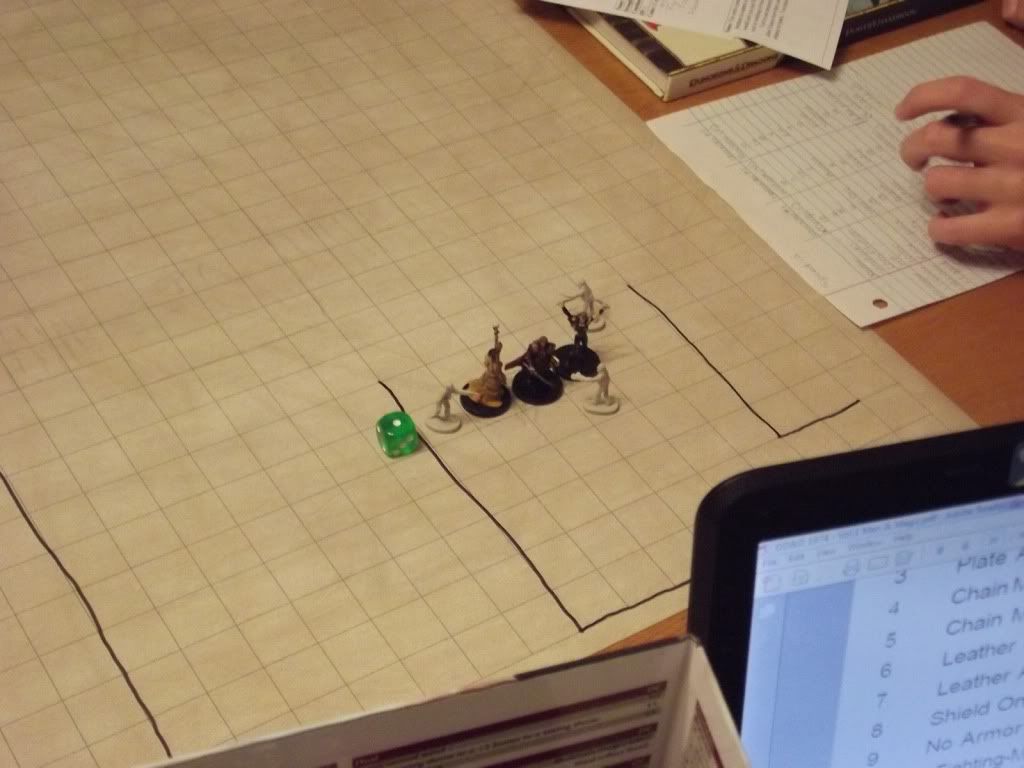
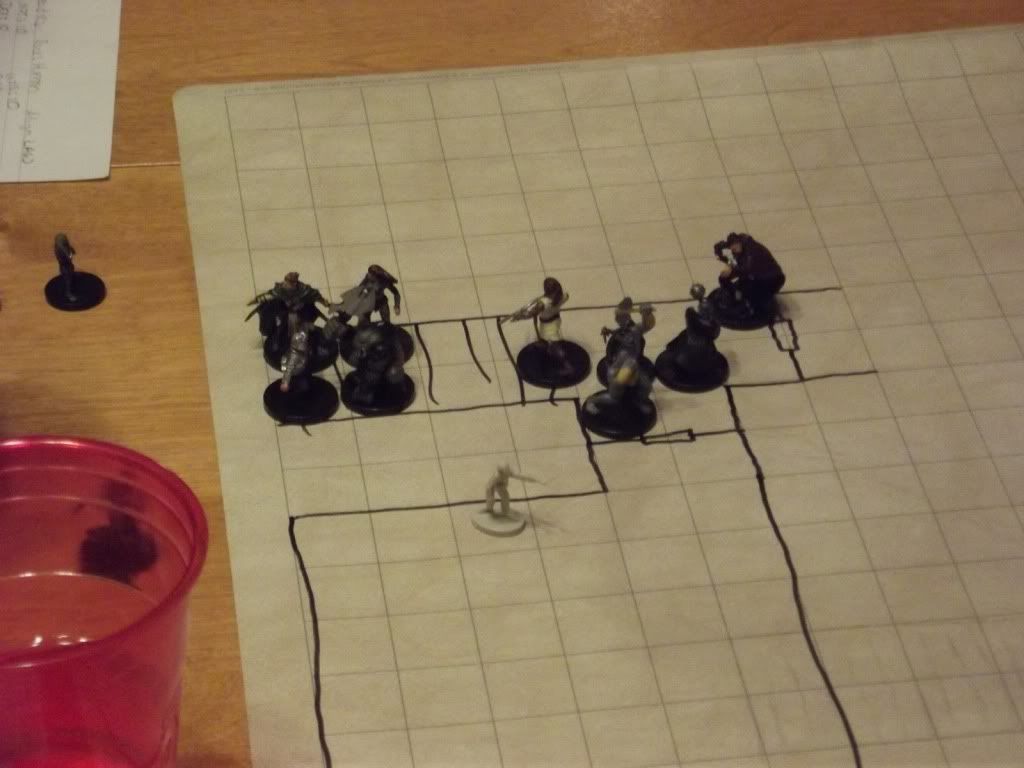
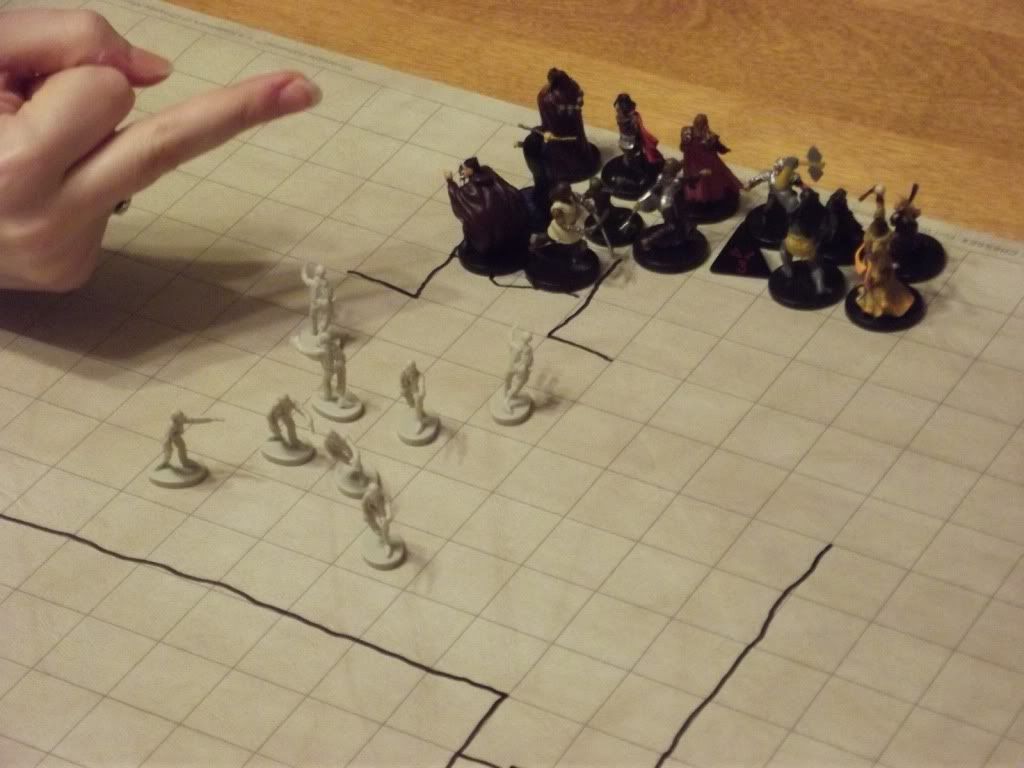
On November 5, I ran the same module again, this time for a different group.  This group is about half new roleplayers — I'm the only person who's ever DMed for them, and they've only played in my Crux of Eternity game for 4e.  One other has been roleplaying with me for over ten years, and another used to play AD&D back in the day.

I made the changes I mentioned last time; I added tactical movement and used the turn structure a little more.

As before, there were eight pregenerated characters.  The four players (one of our usual players was absent, which is why we played this in the first place) crafted the other twelve, for a total of twenty characters (five per player).

Weird things started to happen — a lot of old school habits came out.  Rather than skill checks, people started relying on descriptions and asking for details of rooms.  Tests became commonplace.  The group encountered a green slime and dropped a silver piece into it.  They also dipped a found ring in it.

Likewise, the group started with five live chickens and a goat.  Those chickens became valuable — PCs would throw them at enemies as distractions, and each new room was first entered by opening the door a crack and throwing a chicken inside.  All five chickens are dead, but each chicken who died saved a PC's life.

The goat is still alive.

Another vagary of life in the old school: Paul is at the front of every door with 1 hit point and he's still alive.  Meanwhile, we have people with six hit points who are among the dead.

Overall, it was incredibly fun.  We're not finished yet; the players have no idea how close they are to escaping the dungeon, but I think we might be able to finish with no more than two sessions, although I suspect just one would be sufficient as character creation and the initial panicked stumblings ate some time.

Anyway, enough of the thoughts.  An adventure synopsis after the jump.

***************************
 
There were two throwaway lines in my D&D 4e game.  One was a remark about college students in D&D being similar to modern college students.  The second was the idea that Sorgforge is built over all sorts of old ruins.
 
Thus, my D&D tribute to B-horror movies was born.
 
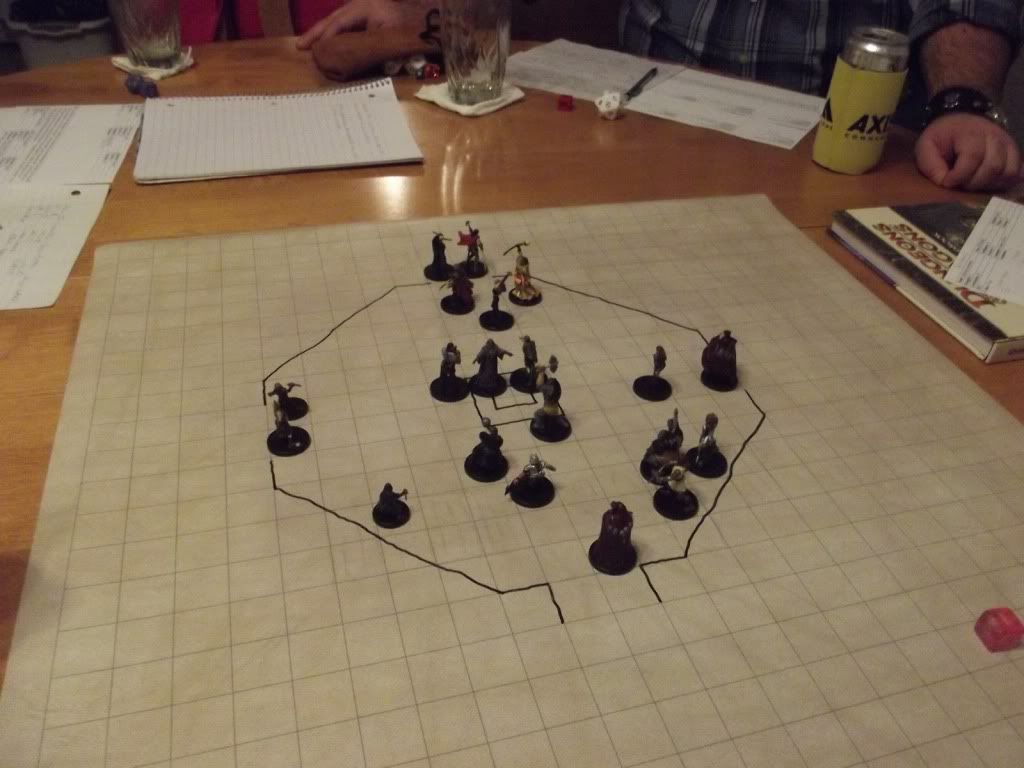
Twenty college students from Morgrave University decide to sneak into the goblin slums to party; they are Alek Baul Dwin the male goblin, Ander Heinsoo the male halfling, Babycakes the male half-orc (and his goat Duddits), Bree Leomund the female human, Davril Tarmikos the male human, John Smith the male human, Krisdove Soulaxe the female dwarf, Krisiries Loyalar the female human, Lorac Arien the male half-elf, Otiven Pegason the male human, Paul O'Trieadies the male human, Penelope the female elf, Quionna Loreweaver the female elf, Sally Proudfoot the female halfling, Shahorn Wyvernjack the male human, Tulip the female half-orc, Varis Battlestrike the male dwarf, Wandadove Huntinghawk the female half-elf, William the male human, and Zantiln Stoneheart the male dwarf.
 
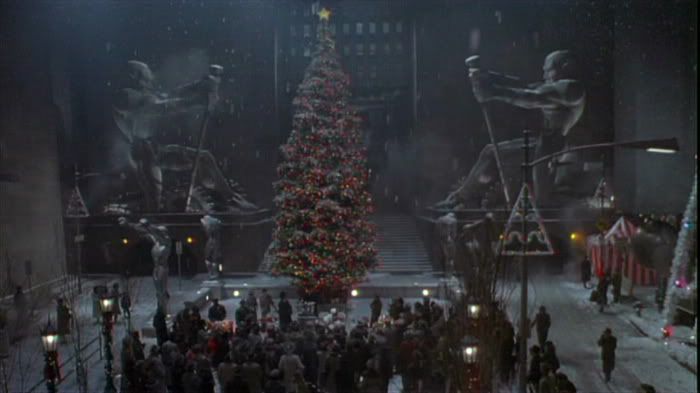
A tremor and a landslide later, the basement floor falls out from under them and they're in a dungeon, floating in a hot spring.  The chamber is at least fifty feet high, although nobody's a surveyor, so they don't have precise numbers.  A large statue of a dwarf looms over them, emerging from the wall; carved from the living rock itself, plunging a sword into the springs like one of the big, Gothic statues from Tim Burton's Gotham City.
 
They arrange themselves and swipe the two everburning torches from the walls.
 
Then they explore.  There's only one way out, so they start in that direction.  They enter the next room.
 
Twenty college students and one statue...should be easy, right?

This room is octagonal and bears bas-reliefs and frescoes praising Theronna Onyxarm.  There is a statue of a female dwarf in the middle of the room, presumably of the same person.  The statue bears a warhammer that is separate and is highly ornamented, likely magical.

A student makes a grab for it.

Before everyone manages to flee, two students have their skulls crushed by the animated statue.  All told, the students find rooms in each direction, and each is similar to the first — a room with a vaulted ceiling and a large, looming statue of a dwarf.  The room on the left depicts a dwarf with bellows, and a fissure in the ground blows hot wind from a deep crevasse.  The room on the right depicts a dwarf over a forge; the inside of the forge bubbles with lava.  The room straight ahead features a dwarf laboring over an anvil, and a path continues beyond, leading to stairs headed upward.

Three of the students try to flee and tangle with some animated suits of armor.

Okay. Plan B.

They manage to escape, and run forward into the hallway despite the fact that they lack torches.  The other fifteen students run up the stairs and hit a trapped doorway; eight students get hit with a confuse spell.  Interparty fighting starts.

PC on PC violence!

Some students die, but the fighting dies down.  The group decides to go in the same direction as the students who fled.  They cross the room, mostly avoiding the animate suits of armor — the group swipes some treasure (coins, magic arrows, and a ring), and use a chicken as a distraction (the chicken, by the way, manages to dodge the animate armor).

The trio who fled stagger through the dark.  One dies by stumbling into green slime, leaving only two.

The rest of the group follows.  They test the green slime a couple of times before somebody burns it with an actual torch.  It burns and they move on.

The bigger group meets with the two survivors.  The groups combine and continue.

A decision point: the group picks the second turn rather than the first.  They find a room.  The peek inside and throw a chicken inside.  The chicken is devoured by a swarm of kruthiks.  The group decides to go a different way.

After retracing their steps, they find another room with bas-reliefs and suits of armor.  They loop around, flip some switches to open a portcullis or two, and find their way back to the room with the suits of armor.  As there is no other option, they decide to race through it.

Run!

The group manages to run into a narrow hallway — only to be met by several large, segmented, chitinous, tentacled things.  The creatures are struck with baseballs and beer bottles as the party beats a hasty retreat to the last door they have not yet entered.

The group makes its way through the corridors until meeting one last door.  They peek open and throw in a chicken...only to have it devoured by dwarven zombies.

Zombies make players angry!

The characters decide on a course of action.  After deciding against sending the goat in as a distraction, or setting the goat on fire so that the zombies burn themselves as they try to eat it, they finally decide to set the bottle of Jepwine (a mage-brewed whiskey) on fire like a Molotov cocktail, and hopefully burn some zombies.

Sadly, the several minutes they spent at the door planning gives the zombies time to position themselves at the door in anticipation.  This delay also lets shadows from elsewhere in the dungeon approach from behind, cutting off retreat.

We're boned.

Despite overwhelming odds, the Molotov cocktail plan works.  Three zombies die, two are on fire, and three more are left — but enough of a path is clear for people to start fleeing.  Meanwhile, the shadows kill one person, and the last surviving chicken sees the shadows and immediately goes into a stress response (as I indicated, "It has seen Chicken Hell, and it is not coming back from there").  This allows the shadows to kill it as well, as a spectral chicken rises from its remains.  As people flee, the shadows close off the avenues of escape in the hallway, leaving those in the hallway trapped.  Bree Leomund gets one of the most awesome deaths, as she realizes the shadows are incorporeal and takes the risk to charge through one — her life-drained corpse falls through the other side, and a shadow rises from her remains.  In the mad dash to escape, all but one of the remaining zombies are killed.

The magic arrows see some use as people realize they can injure and kill shadows, but mostly everyone runs.  Krisiries Loyalar doubles back to collect the objects in the room, and finds that only the chicken shadow and a single dwarf zombie remain.  She manages to slay the shadow with an arrow, and she kills the zombie with her hammer.  She gathers the objects of the dead students, and finds another sack in the room, containing coin and a sword dedicated to the god Kord.  Also, the eight zombies all wear chainmail and hold bucklers, so the group manages to grab some armor.

Of the twenty students, only nine remain: Alek Baul Dwin, Babycakes (and his goat, Duddits), Davril Tarmikos, Krisiries Loyalar, Lorac Arien, Otiven Pegason, Paul O'Trieadies, Quionna Loreweaver, and Sally Proudfoot.  All chickens are dead.  However, the group is pretty much all armed with daggers, hammers, and one magic sword.  All but one of the group now wears chainmail (Alek is the odd man out), though Sally is having trouble fitting hers.  They also have a magic ring (they know it is magic because the acid didn't even tarnish it, let alone destroy it), although they do not know its function.

Hopefully, we shall complete this adventure anon.

Print Friendly