Yesterday, a friend asked about designing a "testicular torsion" spell, and despite not being framed as a particularly serious question, I've been thinking about it way more than I should. After all, it's a pretty good example of game design in microcosm.
What do you hope to accomplish? What are you trying to model? What genre are you emulating?
Let's start with what it is, in case you don't want to click the above Wikipedia article: as the name suggests, testicular torsion describes a twist in the spermatic cord, cutting off blood flow to a testicle. This usually causes extreme pain, and if not treated quickly, can result in necrosis of the testicle within hours.
As for a magic spell, that's going to depend a little on how the game designer views magic. Does it actually cause the medical affliction? Does it just cause the associated pain? Is it temporary or permanent? Can it affect only people with testicles, or does it cause an equivalent sensation in everyone?
Genre will also have an impact. In heroic fantasy, like Pathfinder or post-WotCDungeons & Dragons, it seems right that the spell might just cause the sensation and it will probably only last a short while. In sword-and-sorcery or horror or other "low" magic settings, it might cause the actual affliction and require medical attention to fix.
Frequently, systems with supernatural powers already have an appropriate pain spell, so that's a great starting place.
In no particular order, here are some thoughts across a couple of game systems:
A friend in the same conversation is much more conversant in Pathfinder 2e than I am, and so went with that system. He made it an Incapacitation spell with a Fort save that probably progresses in stages like a disease. Critically succeeding on the Fort save negates it, while any lower degree of success inflicts worsening penalties of Clumsy and/or Enfeebled.
For D&D 5e-ish games, I'd probably take inspiration from symbol; it lasts a minute requiring a Con save to avoid the incapacitated condition. Save again at the end of each round to negate it.
If it's a really low level spell, maybe it only lasts a short time or grants disadvantage, similar to (but not the same as) the frightened condition.
Different editions handle pain differently. AD&D 2e has symbol grant a -2 Dexterity penalty and a -4 attack penalty for 2d10 rounds. D&D 3e has a low-level power word, pain spell that just does damage over time for a handful of rounds.
It's more fiddly than I tend to like my rules, but I'd probably allow an appropriate medical roll or healing spell to alleviate the pain. We're talking something like a Healing check in AD&D 2e or a Wisdom (Medicine) check in D&D 5e. In games lacking defined proficiencies, it might involve your character's background, or it might be outside the realm of things that player characters can accomplish. Better get to the local hospitalier as soon as possible!
Outside of the D&D paradigm, I'd be more likely to just drop penalties on someone until the situation is resolved. For example:
In Unknown Armies, third edition, a testicular torsion spell is probably a minor spell causing immense pain (I might assess a -20% or -30% penalty), minor injury (maybe 1d10 wounds), and perhaps even a stress check (rank-3 or rank-4 in Violence or Helplessness). It might last a few minutes, although I tend more toward the "you need to go to the hospital" end of the paradigm. Maybe it depends on the number of charges?
My memory of World of Darkness and Chronicles of Darkness is a little fuzzy around the edges, but a substantial wound penalty (say -3 to -5) feels right. As above, the specifics of the power used determines if there's a duration or if you need medical attention. The victim might take a little bashing damage.
The spell Wrack in Call of Cthulhu is pretty similar to what one would want from a testicular torsion spell; it might be less intense, and won't have the physical side effects. On the other hand, the duration is probably longer than Wrack, lasting until treated.
The further you get outside of traditional systems, the more abstract the effects are going to be.
I tend to shy away from using hit points/wounds/etc. to model pain, but in a paradigm like Powered by the Apocalypse or Forged in the Dark, a point of Harm might actually get the point across: it makes you less effective when acting and brings you closer to something really bad happening. Get out of the action and to a healer as soon as possible.
A storygame that's even less focused on physical reality and more focused on emotional reality might wholly eschew physical consequences for such a spell. Instead, it focuses more on the experience of your friends getting you to the doctor and helping support your recovery. In fact, in contrast to many games that remove the afflicted character from the action, this spell in a storygame might actually thrust the afflicted player into the spotlight.
For any of the grittier systems, I'd probably also put something in place to model the severity inherent in leaving the situation untreated. Maybe something like, get medical attention within six hours or you might need surgical removal.
In addition to considerations of genre, you probably also have to think about your table. Tables more used to heroic systems probably find "save or suck" spells to be anathema to their play style, while tables more on the survival horror end of things probably consider such things a consequence of combat anyway. In a Pathfinder game, a spell that takes you out of the action for a prolonged period is an impediment to the combat sport. In a Call of Cthulhu game, a spell that takes you out of the action might be the lynchpin of another wild story revolving around horrible things that happen in a cosmic horror game. (I personally like to imagine that one character gets hit with the spell so another character helps them to the hospital; predictably, these two investigators are the only survivors of the scenario, as everyone else tries to carry on and so mysteriously disappears.)
This rumination doesn't solve anything, but in terms of game design, it's an intriguing question. What are you trying to model with a piece of design? What do you hope to accomplish? How do your goals change with the game you're currently playing?
Author's Note: I'm sure this post is due in equal parts to the classic World of Darkness plot about Clan Tremere infiltrating the Mormons to compile humanity's True Name out of their genealogy records, as well as Watch Dogs' plot about the Bellwether behavioral prediction algorithm. And maybe a little Ex Machina for flavor. So, uh, apologies. Also, despite being written for Call of Cthulhu, you could probably adapt it to another modern occult system with a little tweaking.
Magic in the Cthulhu Mythos is ultimately revealed to be not the product of symbolic interactions, as suggested in other occult traditions, but high-level theoretical physics and hypermathematics far beyond human comprehension. A symbol like the Elder Sign doesn't symbolically bar the transit of nonterrene entities — it physically bars them by interacting with subatomic particles to create four dimensional barriers through which nonterrene entities cannot pass.
In this way, the principle of sympathy still applies, but is more like balancing an equation than trying to trick the universe into identifying one thing as another. (Your average occultist probably can't tell the difference, though, and some philosophers would say this distinction is irrelevant, basically amounting to navel-gazing.)
The modern world generates lots of data, and requires several ingenious solutions to compile and interpret this data, lest it lie useless on hard drives.. (Some believe our ability to generate data will soon outstrip our ability to store it.) Whatever the case, data is big business, as modern data-crunching methods can use this to generate targeted advertisements, as well as enable espionage by compiling information about someone's networked habits. (If you're buying medicine at the local CVS and looking up symptoms on WebMD, you're probably ill. If you're buying unhealthy food, you're a health risk to your insurance company. If you're making the same credit card purchase at a local deli around 12:30 PM every weekday, you probably work nearby and are getting lunch there.) There's a lot of concern that someone — the government, hackers, or private corporations — could use this information to insidious ends.
You don't know the half of it.
In certain occult circles, there's a known rivalry between the Brothers of the Yellow Sign and the Fungi from Yuggoth. Tales about the two vary, but some have theorized that the fungi were instrumental in manipulating human evolution to create modern human thought. The Brothers oppose them, because modern human thought acts as a hyperspace grid binding their god, Hastur, and this entity can penetrate in regions where human thought has been corrupted by the Carcosa-mind.
As such, a group of hackers have appeared, evidently affiliated with the Brothers of the Yellow Sign. (Occultists in-the-know often call them by the cheeky name "yellow hat hackers.") While they engage in same sorts of espionage and sabotage that other hacking groups do, their true purpose is quite sinister. They are attempting to gain unfettered access to the global datastream, specifically search engines and social media platforms, as well as the processes that collate these disparate data. Once they have co-opted the processes that compile and analyze personal data, they can use these pieces of information as variables in a complex hypermathematical equation attempting to correlate human civilization with Carcosa. When the equation is solved, theoretically, Earth will become coterminous with Carcosa, and "the liberated Old Ones would teach them new ways to shout and kill and revel and enjoy themselves, and all the earth would flame with a holocaust of ecstasy and freedom."
Looks like you'd better stop those hackers before they get that far; rumor has it that they broke into Google's servers last week, and who knows how long it'll take for them to finish their calculations?
"The idea of trying to 'cover this race' in any conventional press-sense was absurd: It was like trying to keep track of a swimming meet in an Olympic - sized pool filled with talcum powder instead of water. The Ford Motor Company had come through, as promised, with a 'press Bronco' and a driver, but after a few savage runs across the desert – looking for motorcycles and occasionally finding one – I abandoned this vehicle to the photographers and went back to the bar." — HST, Fear and Loathing in Las Vegas
As previously noted, GenCon 49 (August 4-7, 2016) was the first for me and Nicole. Pretty early on, I determined you can only talk about those things at GenCon which happen to cross your field of vision. Before I begin, though, a general statement:
I managed to meet (briefly, of course) a bunch of industry people over the past few days. With no exceptions, everybody was particularly gracious and enthusiastic. (The most enthusiastic person I met is probably Sandy Petersen — it's hard to gush about your game in a way that makes it really intriguing without sounding pretentious or self-aggrandizing, and Sandy does both those things extremely well. He's pumped about it, and now I'm pumped about it.) I mention this, because I had the following anecdote from Monte Cook in mind before I went.
It was the summer of 1991, at the GenCon game convention. I was still fairly new to the industry and my friend, Rob Bell, the Champions line editor, was "showing me the ropes" at GenCon. He asked me if there was anything I'd seen at the convention that interested me. I said that there was a really interesting-looking game with a rose on the cover where you played vampires. I had been interested in vampires since I was very young. I had written a research paper on the topic in high school, and in so doing practically memorized the encyclopedia entry for "vampire." (There weren't a lot of source options back then.) While this was before the vampire and goth subcultures really existed, among some of my friends, I was known as the "vampire guy."
Anyway, Rob took me over to a little table with one guy behind it. On the table were arrayed a number of freshly printed Vampire books. Rob chatted with the guy behind the table and introduced me to Mark Rein*Hagen. I told him that I thought his new game looked amazing and gushed about it a little. He silently listened to me with an expression that spoke volumes: I wasn't telling him something he didn't already know. Out of the corner of my eye, I saw Rob give Mark a knowing look and motion with his head toward me. Mark sighed, and then said as condescendingly as I’ve even been spoken to, "Here you go, kid." He didn’t need to add, "Now get away from me, son. You bother me," because it was already clear.
That was both my first and my last interaction with Mark. I did (and still do) love and appreciate the book.
Nothing like that happened during this convention — everybody was uniformly rad, even if they were somewhat busy. (Incidentally, Mark Rein*Hagen was over at the Chaosium/Petersen Games booth, promoting I Am Zombie. I likely would've spoken to him, but there's a surprising amount to do crammed into four days, and I tried super-hard not to be an annoying fan. Maybe next time.)
Anyway, since it makes the most sense, I'll try to tackle the majority of this chronologically. Photographs by either Nicole or me.
Wednesday, August 3, 2016
The trip to Indianapolis was spent taking turns driving and listening to most of The Disaster Artist. (It's just as good as you've heard.) It takes roughly ten hours to get to Indianapolis.
This billboard is yuuuuge.
Trump andvasectomy.com? Truly this is God's country.
USA! USA! USA!
Finally, we arrived.
Pictured here hiding from the Trump billboard.
We got to the hotel, which despite being about twelve miles away from the convention center, was pretty swank. Note the chemostat bioreactor hot tub.
I've been in apartments smaller than this. My hat included to scale.
We went to the con briefly, determined that the will-call line was completely insane, and decided to tackle it on the morrow.
Thursday, August 4, 2016
Nicole by the welcome sign. Featuring someone's random legs.
The will-call line was slightly less mad this morning, and we managed to navigate it with time to spare to get to our 10:00 AM game. We also met Eric Cartman:
If we didn't eat Cheesy Poofs, we'd be lame.
The 10 AM game was Black Forest Patrol for new World of DarknessChronicles of Darkness. We played American soldiers in World War II. Something weird happens — there's panic and fear and Nazi zombies. We finally trace the source back to a Nazi base, which has been overtaken by grey aliens doing some interdimensional something. Our radioman calls in an airstrike, which doesn't work (force fields or some such), but we end up destroying their plans the old-fashioned way: grenades and satchel charges. Our superiors probably thought we were nuts, but we saved the day.
We also uncovered this infinite bathroom. Spoooooooky.
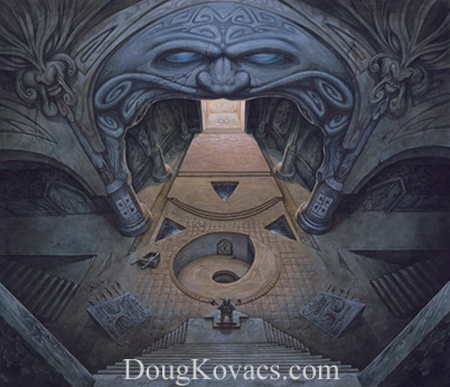
We originally signed up for an Onyx Path freelancing seminar, but decided to (sadly) skip it in favor of the dealer's room. (We had our own shopping list, as well as rushputin's shopping list, so we had business to attend.) We had to pick up a bunch of Dungeon Crawl Classics stuff (in addition to the new modules and such, we also got a gaggle of Doug Kovacs prints, including his Moria piece for a Middle-earth RPG, possibly late-stage MERP; Green Mary; the classic DCC wizard corruption picture; and his take on Dürer's Melencolia I), peruse the new shirts from Lamentations of the Flame Princess (sadly, I otherwise had everything at the table), and swing by Modiphius in the hopes of signing up for the new Star Trek RPG playtest (and getting Kirk and Picard miniatures). We were largely successful while also getting to meet James Raggi.
The first and only time you'll probably see my dumb face on this blog.
I don't even know what's happening.
We also met Sarah Babe of Plot Points, working at the Modiphius booth. Having started listening to them, they largely cover industry news and product reviews — useful if you want somebody else to digest a thing before you decide to buy it. Check it out! (I was just listening to the one about Shadow of the Demon Lord, and while I was interested before, it just jumped to the top of my list.)
We also had the opportunity to talk to Robin Laws about Worldbreaker, a globe-spanning, apocalyptic campaign for Esoterrorists wherein the unthinkable happens and the esoterrorists come incredibly close to penetrating the Membrane. (Or possibly succeed, if your players fail.) We also learned about Fear Itself, 2nd Edition, at the Pelgrane booth. (I just learned that there's apparently a second edition for Esoterrorists, too.) I'll have to grab all these things at some near-future point, but I was largely budgeted for DCC at the convention.
Also also, we had the chance to talk to Sandy Petersen (and his wife, who was somehow even more gracious and excited than he was, if that's even possible) about his miniature games, Cthulhu Wars and Glorantha: The Gods War. He also teased an upcoming project that is a board game or miniatures game similar to his work on Doom, so that's exciting. We also managed to score some autographs from him. (And if I'd thought about it, I would have brought a bunch of Lovecraftiana to shove at him and get him to sign. Long-time listener, first-time caller.) Another situation in which I'll need to pick up more Call of Cthulhu, 7th edition stuff at some near-future point.
The rest of the day was subsumed in wandering. We returned to the hotel to rest for the night's event: Glitter Guild Burlesque. It was very good, although Nicole really summarized it well — there were so many acts that the whole thing was a little rushed. The acts were all pretty good, although the people doing DC Comics acts (particularly the people from Plan 9 Burlesque) really stood out. Despite all that, the hands-down best act had to be Bazkua Joe's Speed Racer. The guy got a standing ovation for reasons I'm sure the following video cannot fully convey.
Of course, in our show, he didn't end with the checkered flag, but with only the helmet.
Friday, August 5, 2016
After a somewhat late night, we missed Zzarchov Kowolski's book signing at the Lamentations booth, but we did revisit the Goodman Games booth to get the tome signed by the band. We also got Aeron Alfrey and James Raggi to sign stuff. (And we picked up one of Alfrey's Baba Yaga mini-prints.)
Greg Stolze, Cam Banks, Colleen Riley, Jeff Tidball, and John Nephew. If you followed the podcast blitz for UA3, there is nothing new or earth-shattering as Stolze discussed most of the revelations on the podcast circuit. Things include the idea of wiping away the metaplot as per Chronicles of Darkness, and tying the Shock Gauges into skills as per A Dirty World. Stolze's writing a new book (although he again said that the next Unknown Armies book has already been written, and it's Big Machine by Victor LaValle), and it's apparently going to be written in second person. So there's that. The Atlas Games crew also discussed probable release dates. They (unofficially, of course) expect to hit it earlier than April 2017, and they'll probably release ebooks and dice as they're ready. (They have to ship dice separately because adding dice to books throws them out of media mail and so changes the shipping charges.) The first three books are more-or-less in layout, and they're working on Book 4 and 5.
In personal news, they did a giveaway for your best Unknown Armies anecdote, and I won by describing my old Chicago game. ("A group in Chicago hunting ghosts and doppelgangers with their friend's magick-detecting erection.") I got a copy of Break Today on which everybody in the room (including the panelists) scribbled strange things.
Me, after winning that book.
We again wandered and rested, as we had a LARP at midnight.
The teeming throng of humanity.
Saturday, August 6, 2016
Midnight was "Nundercover" by Kettle of Fish Productions. They cite it as Cthulhu LIVE 4th edition, but it's actually a super rules-lite variant. There aren't any stats (unless you can do something special on your character sheet, like the super-strong nun who can break limbs and knock people out); just take logical actions and they'll probably work. The big rule is that you get tokens, and you can spend them to establish facts. ("Fortunately, I hid a gun in the desk earlier!") If something bad happens, you also spend tokens to not die. Pretty simple.
The setup was everyone is in a convent, and some people there are not nuns. (I was playing Paul Giamatti, preparing for a role. Another player was playing Anne Hathaway with the same rationale. Nicole, on the other hand, was playing Regan MacNeil, who joined the clergy after her ordeal.) The big issue we found was that comedy games are really hard to do (or possibly just hard for strangers to enter; the regulars seemed to have fun with it) — it was wacky and zany and we had no clue what was happening most of the time. It was fun, but not the style of Cthulhu LIVE game to which we are accustomed.
Return of the son of the teeming throng.
After sleep, we returned to gather autographs from Jobe Bittman. We then had a conspiracy theory panel, but skipped it in favor of the Delta Green panel. (The audio is available here.) Shane Ivey, Dennis Detwiller, Adam Scott Glancy, Kenneth Hite, and Greg Stolze. (I mean, if your options are a conspiracy theory panel without Ken Hite, or a panel with Ken Hite, the choice is obvious.) They went over some of the information regarding the Kickstarter, a few products coming down the pipeline (I'm excited for Hite's Fall of Delta Green — he had me at the psychedelic Burroughs option), and talked about some of the new rules and integrating the new Delta Green into the world. (If you're like me and missed the Kickstarter, there are now two Delta Greens — the reintegrated official one, that now has a massive budget but has to deal with bureaucracy, and the cowboy operation still out in the cold, which has no support structure but still plays by its own rules. Also, bonds act as sanity armor — so you can either go mad by yourself, or prevent madness by slowly losing touch with those around you. Fun times all around.) The panel got me pumped to revisit it, and I'll have to pick it up, you know, eventually.
We left the panel to go meet Zak S. at the Lamentations booth and get stuff signed, and managed to get there before the line got insane.
Zak and Nicole
We also had the opportunity to meet Charlotte Stokely and Stoya. I'm guessing it's odd that we primarily know them as D&D players, but them's the breaks. (I'm guessing it's also odd that there are famous D&D players, but them's also the breaks. Will role-playing games be added to the Olympics soon?)
I'm pretty sure interrupting a D&D game is a sin, but it was cool to say hello.
They talked some about Lankhmar and Michael Curtis' upcoming DCC supplement for that as well as some potential upcoming releases (like teasing Punjar 50,000), but the big news was the reveal that Goodman Games has the license for Dying Earth by Jack Vance with Jobe Bittman developing. It will be separate from DCC but broadly compatible.
With that, we returned to the hotel to prepare for the last day of Gen Con.
Sunday, August 7, 2016
We had only one mission today: the Goodman Games raffle. (We also got the pictures with James Raggi, seen in the Thursday entry. The camera always tells the truth, but it also always lies. Also, after days of attempts, we finally got our Kirk and Picard miniatures. Score! Also also, Nicole got a print of The Song You Sing by Nen Chang.)
The raffle, of course, began with awards:
Joseph Goodman presents the Enter the Dagon II championship belt
The champion!
Joseph Goodman presents the Carnival of the Damned trophy
The champion!
Jim Wampler and Bob Brinkman with MCC Reliquary of the Ancient Ones tournament trophies
And the winners!
Another winner!
The Warlords of the Purple Planet trophy
And the winner!
And then, the raffle:
It takes a while.
Many of the tickets were unclaimed (whether their pairs were not in circulation or their owners did not attend is unclear), so they eventually allowed those whose raffle number is off by one to claim prizes. One of Nicole's tickets and another raffler's ticket were each off by one, so it came down to a dice-off.
With that, we were on the road again. We finished The Disaster Artist before proceeding to Wigfield: The Can Do Town That Just May Not. (The audiobook is also as good as you've heard.)
Also, the parking garage stored their Christmas garlands here. For some reason.
These guys had Cartoon Network corporate backing, so maybe they don't count as cosplay?
Final Thoughts
Gen Con was very fun, but I think you have to go once and stumble through it to determine how best to tackle it in the future. Trial by fire. Next year is the fiftieth anniversary of Gen Con (and, perhaps more importantly, Zak's party), so I think we're going to try to go. And do it correctly this time.
(Plus, Unknown Armies will have released by then, so I'm sure there'll be something awesome at Gen Con.)
Also, there is nothing that has gotten me more jazzed about DCC than interacting with the DCC band. I was originally going to run some games (first DCC, then Unknown Armies), then (probably wisely) decided against it. Next time, I'd definitely like to do so. (But I'll probably just stick to DCC.) Playing more games next time would be good. (Admittedly, a lot of that was because I registered late. Ah, well.)
One last thing, to reiterate: everyone we met was uniformly generous, helpful, and enthusiastic. Every industry professional to whom I spoke got me jazzed about some game or other. (Naturally, it helps that I talked to people whose games I already enjoy, but still.)