Pages

Friday, August 31, 2012

On Scandshar

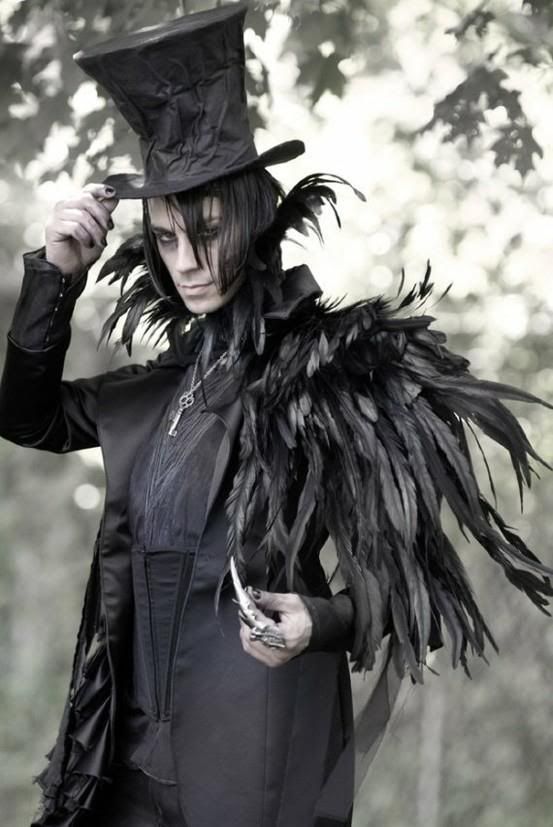
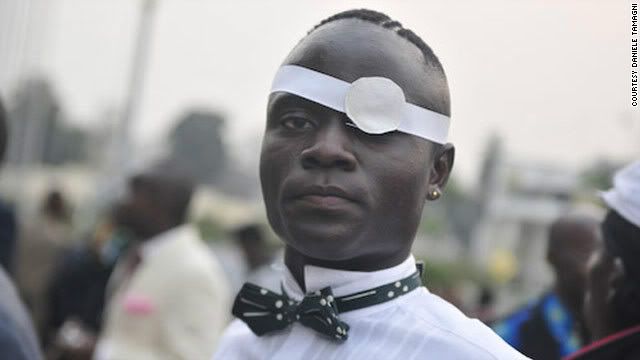
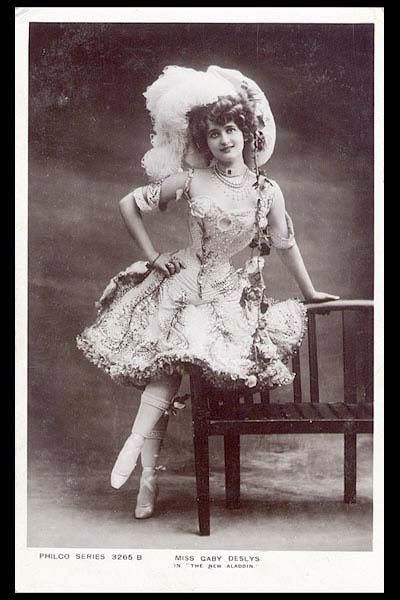
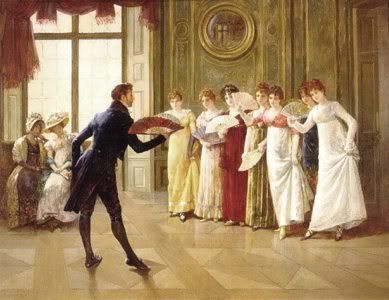
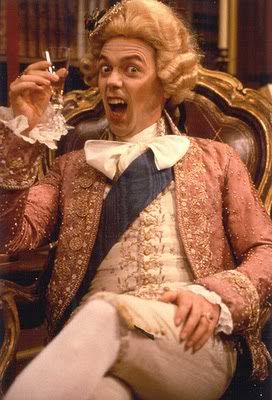
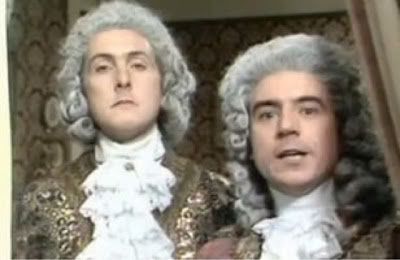
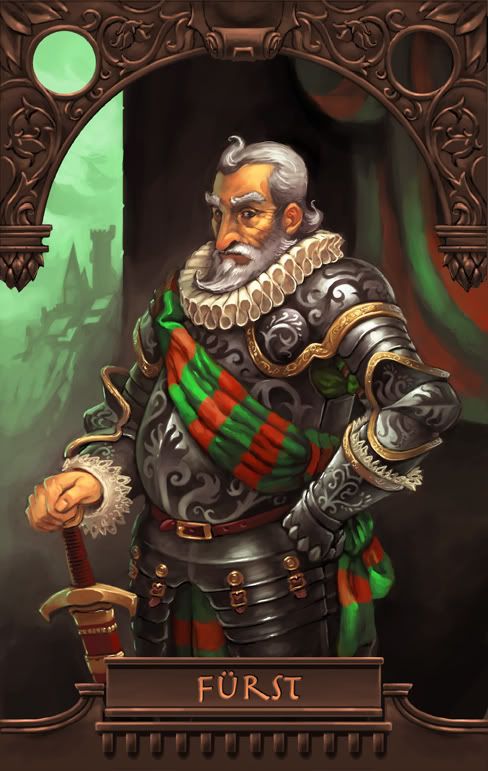
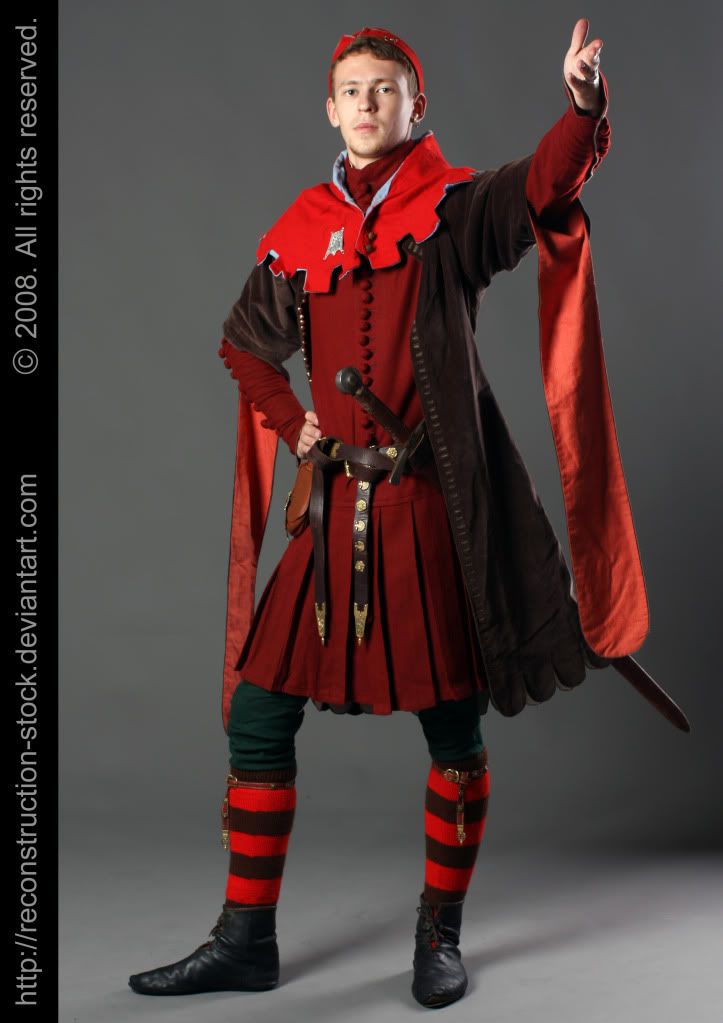
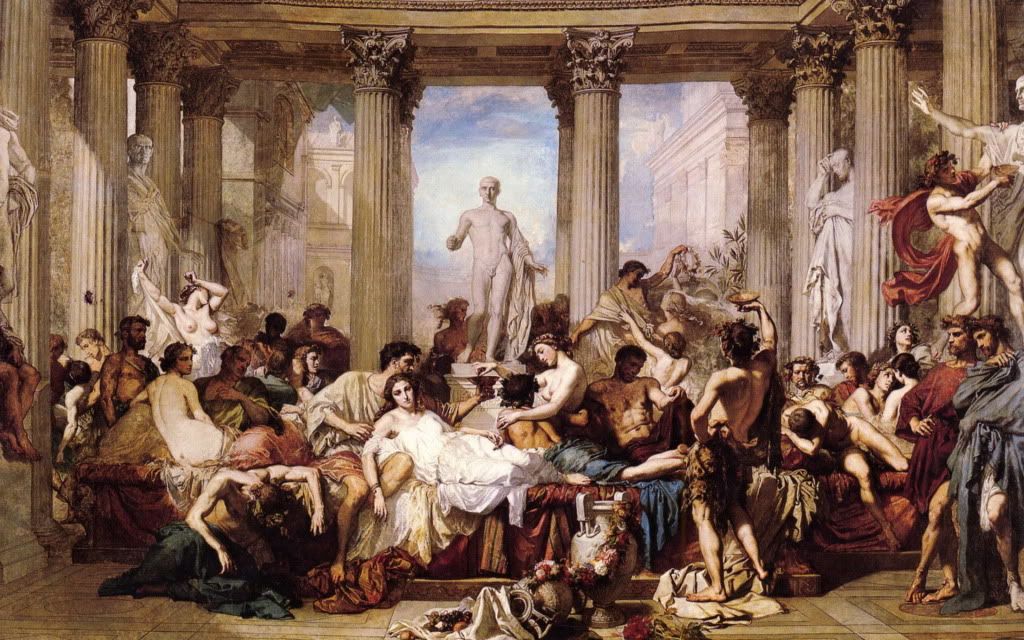
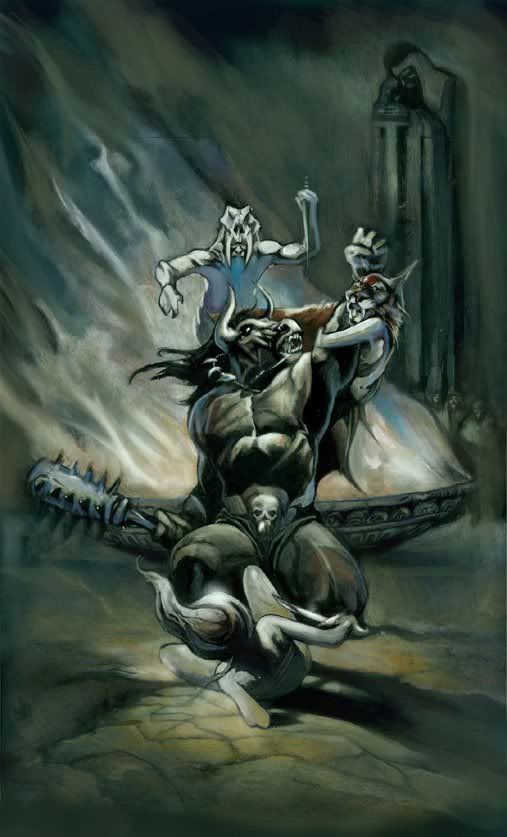
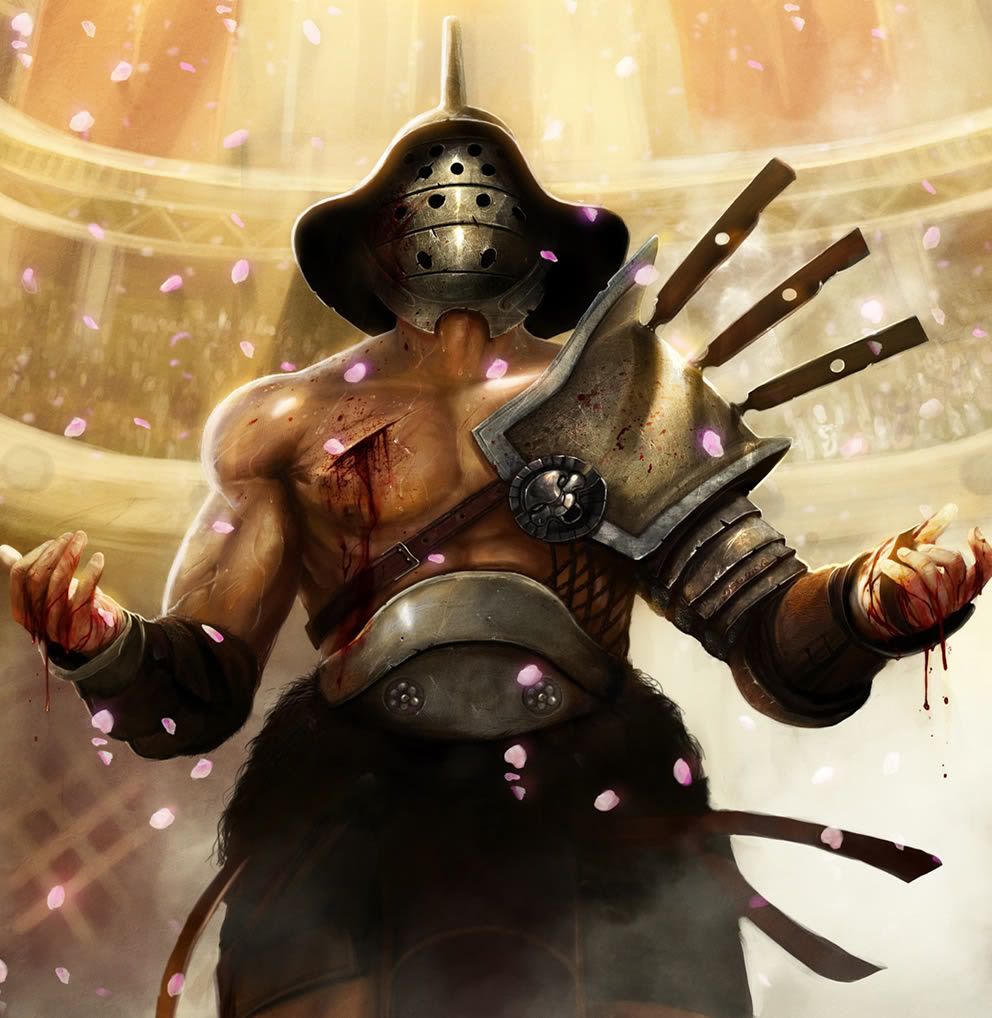
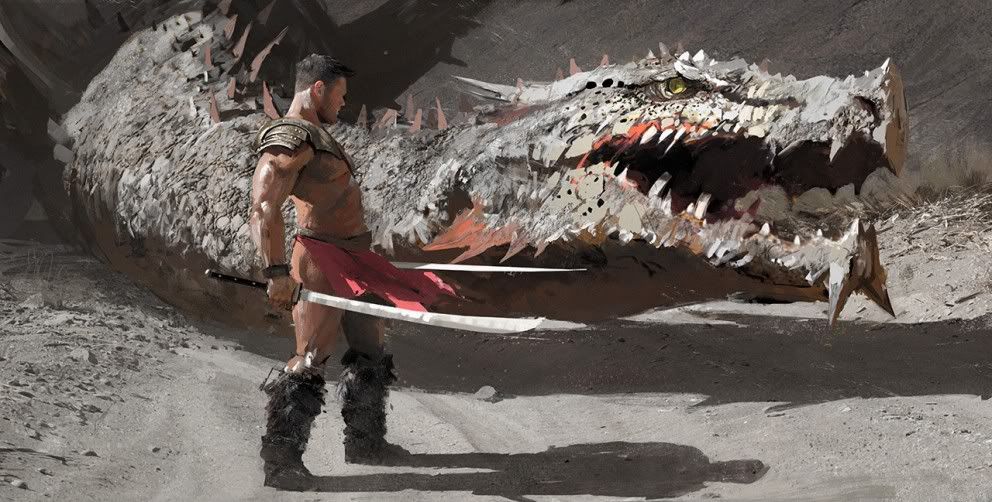
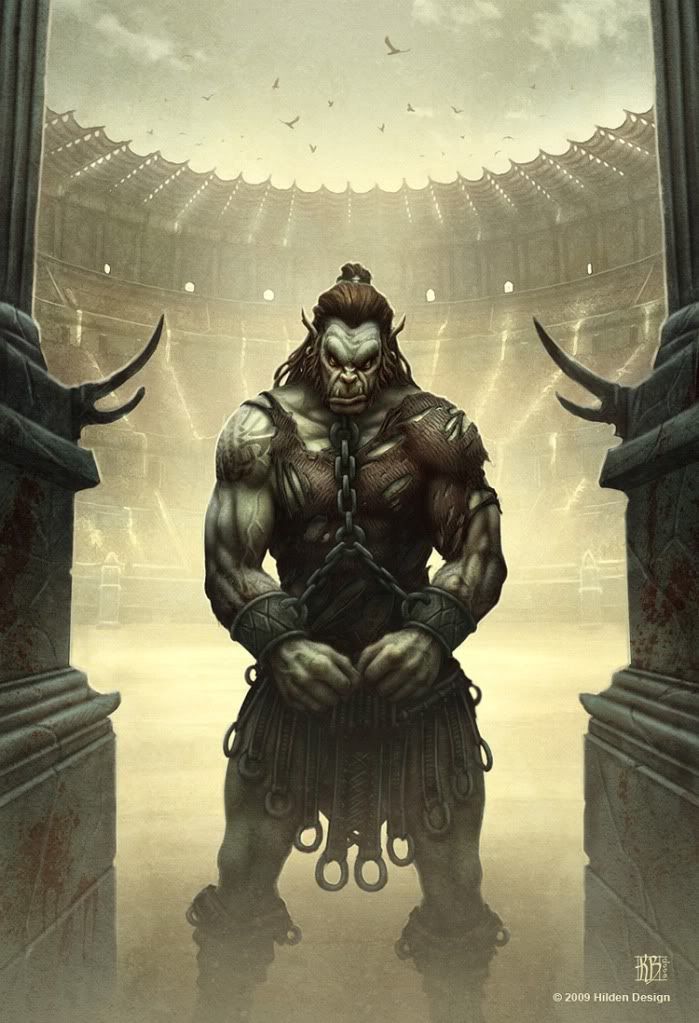
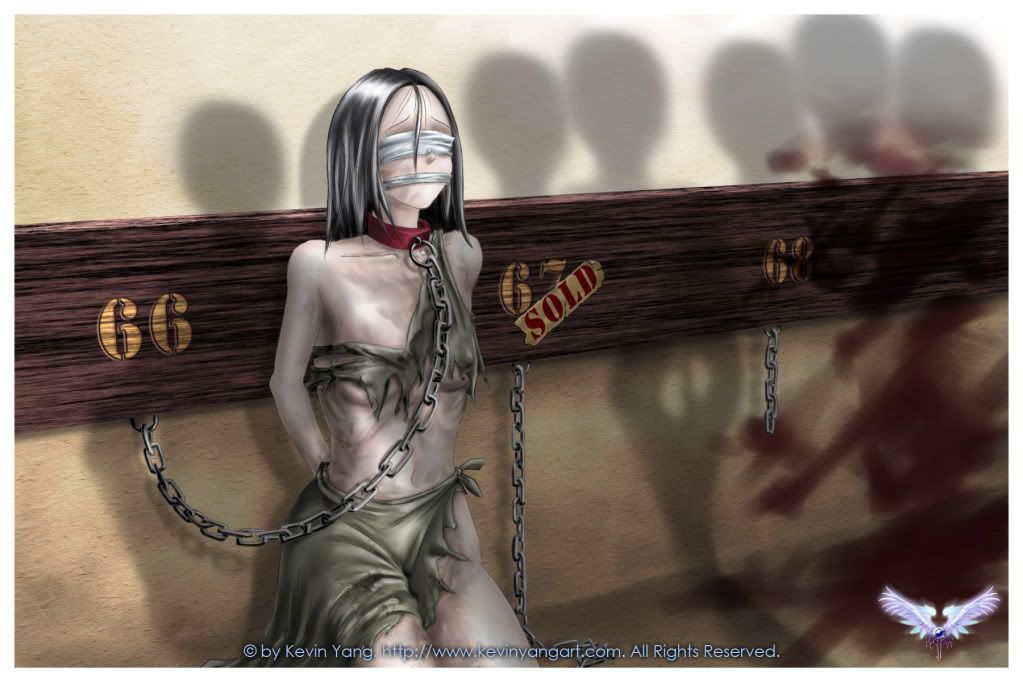
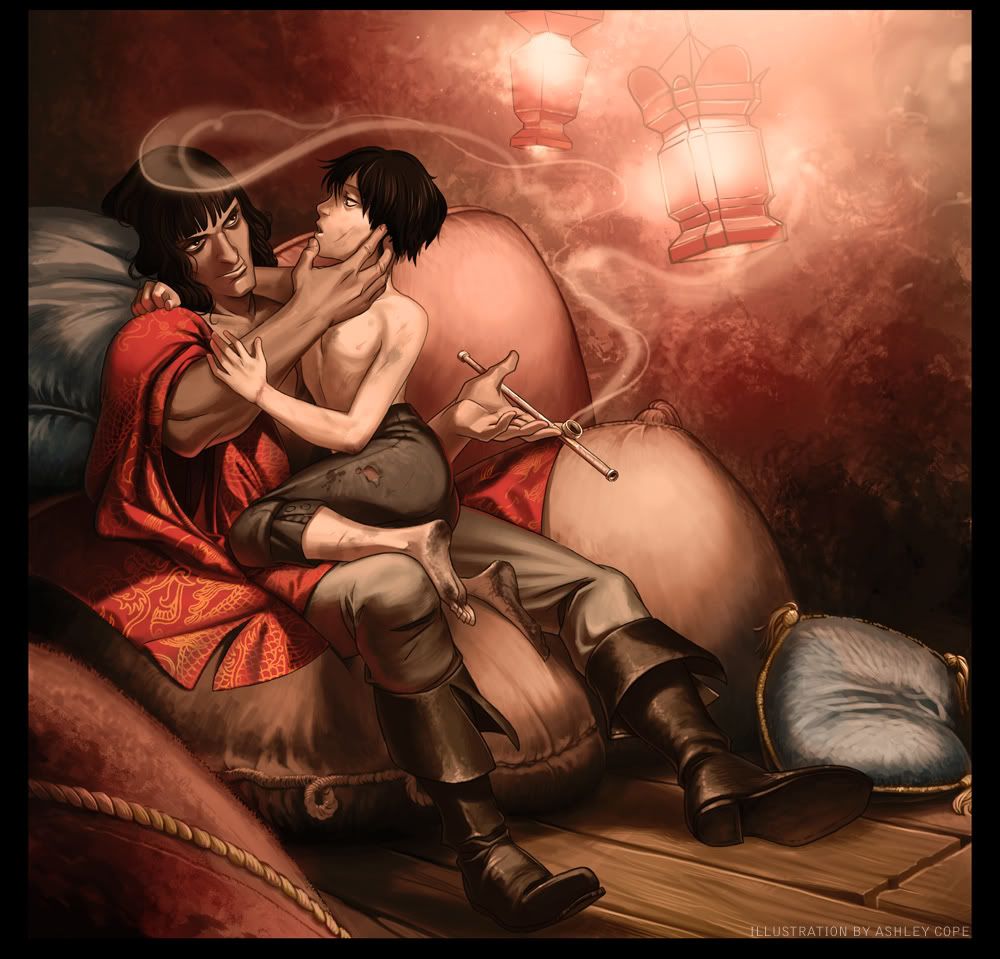
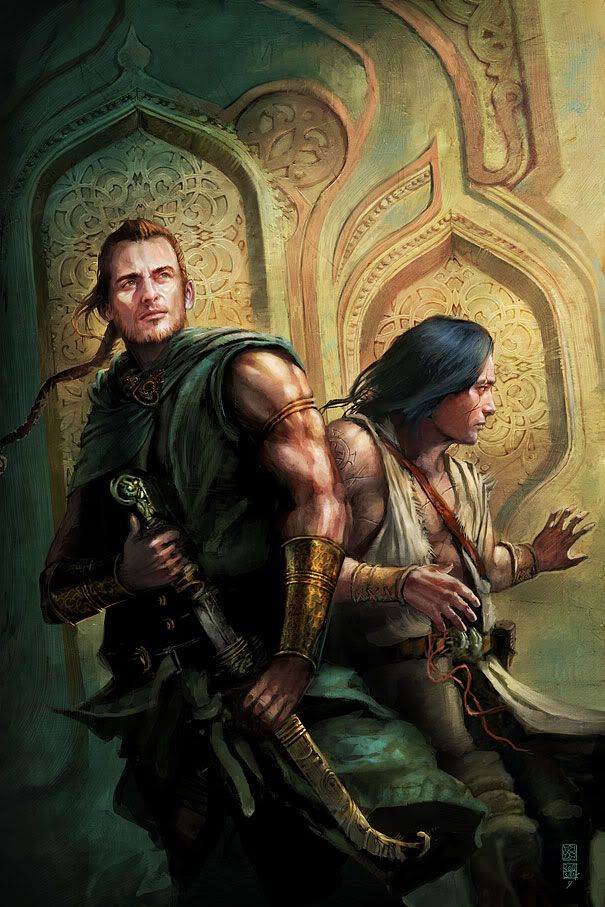
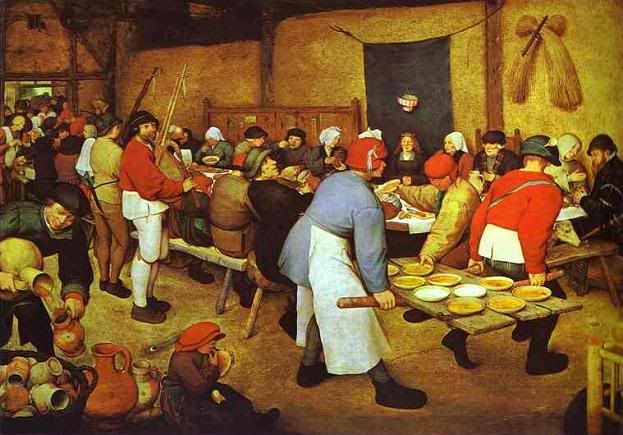
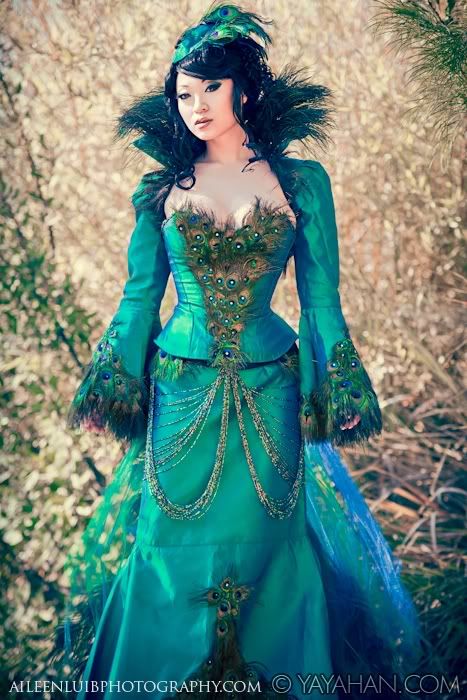
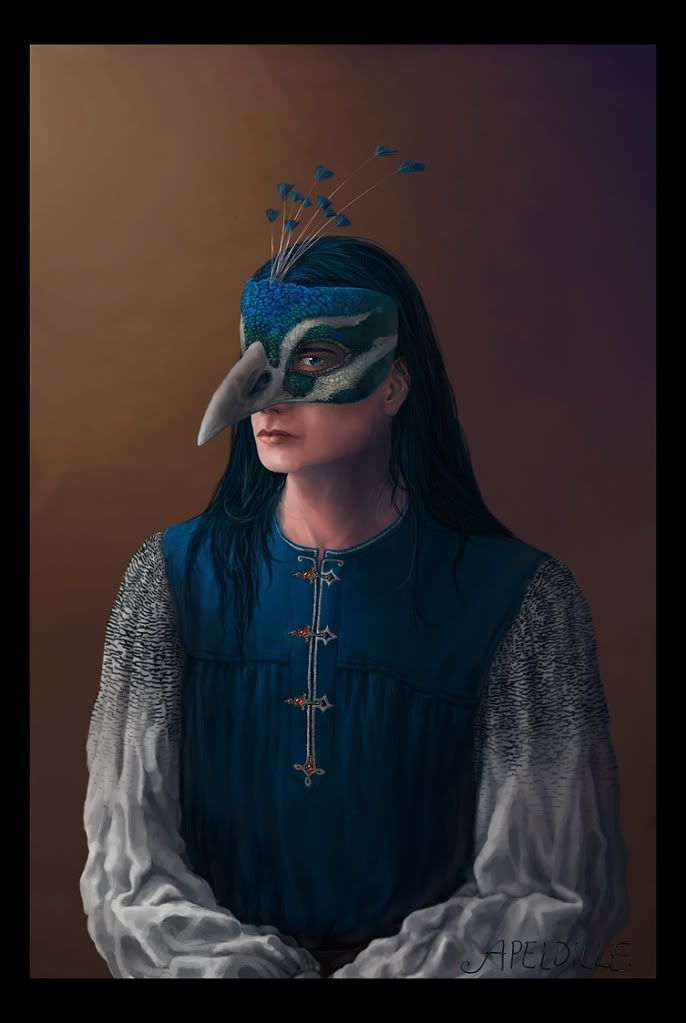
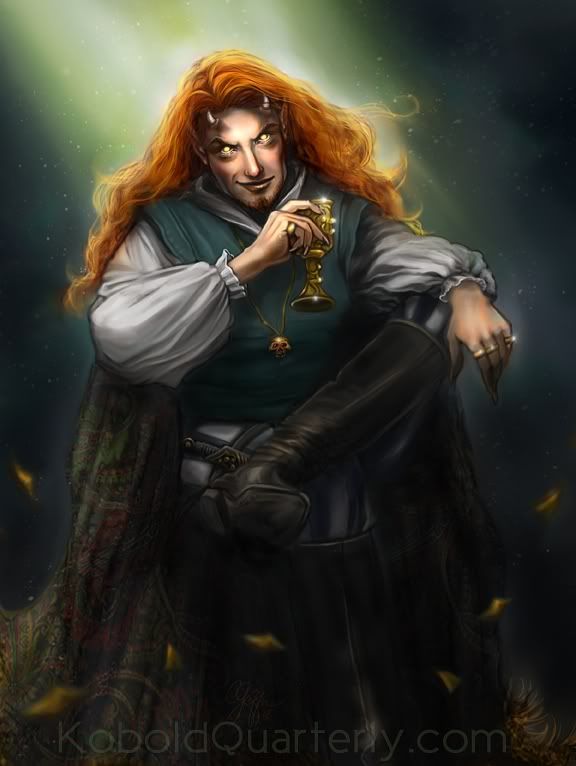
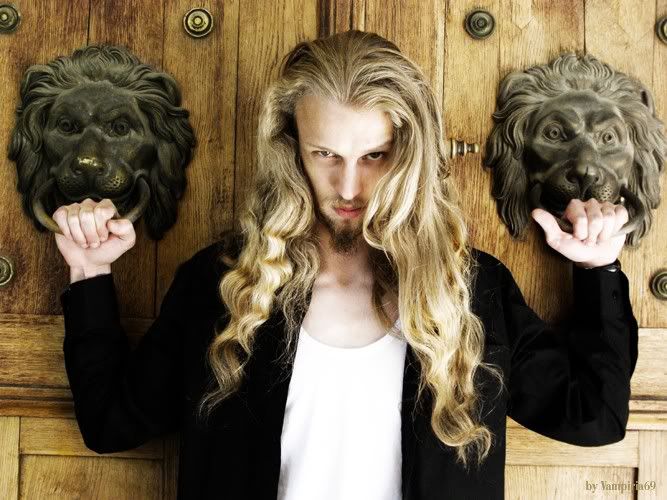
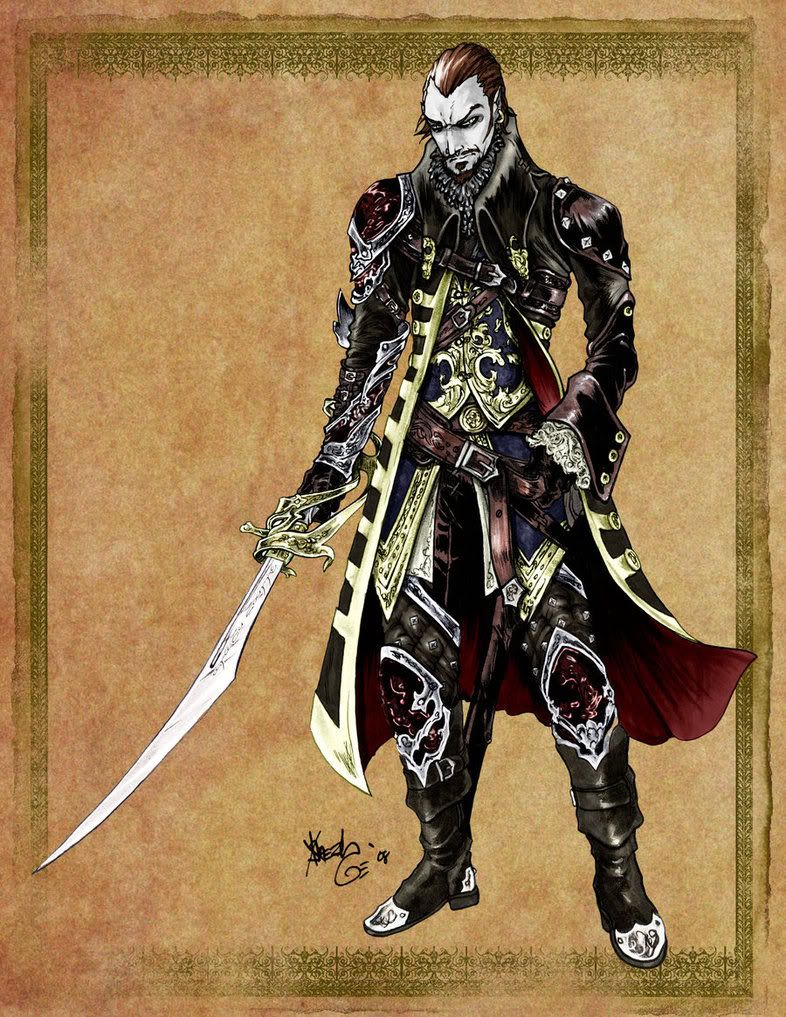
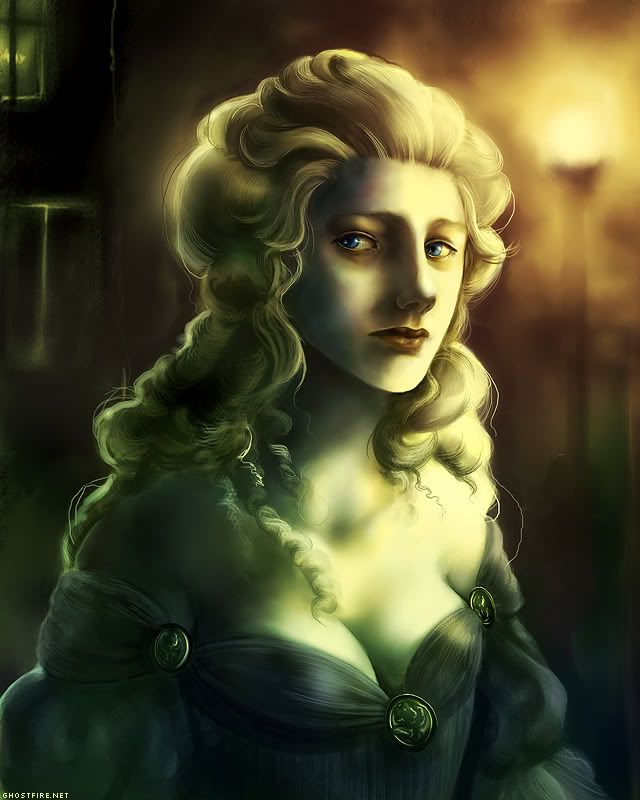
I've occasionally mentioned Scandshar from my D&D home game. Since there's a better-than-even chance that my PCs will end up there next (to help the revolutionary abolitionist movement most likely), I felt like posting some of the influences in one of those lovely picdumps that seem so popular.

(As one might surmise from the following pictures and video, it's an anachronistic mess.  Scandshar has taken a little from every culture it has contacted.  They're late medieval/early modern, but the local fashion reflects a little Enlightenment, a little Regency, a little Victoriana.  I developed Scandshar before reading The Hunger Games, but one can easily liken the weird fashion trends of Scandshar to the description of the Capitol.)

(Oh, also, all the pictures should be linked to their sources.  A lot of these pictures come from image collections, so you can totally lose your day by clicking those links.  Assuming they work, of course.  You're welcome.)


Wednesday, August 29, 2012

Dial 9-9-9 If You Really Want The Truth

Rushputin just brought Magical Monstrosity Press to my attention.  This blog just started in June, and as the website states, it's "an online book of beasts, art gallery and blog inspired by pulp fantasy & sci-fi, medieval bestiaries, vintage role playing game books and classic death metal album covers."

They only have six posts as of this writing, but the artwork is pretty keen, and the monsters they've posted thus far are sufficiently awesome to merit investigation.  I mean, check out this sweet Wormhound:


Go ahead and check 'em out, would you please?

Wednesday Werk: Elajess

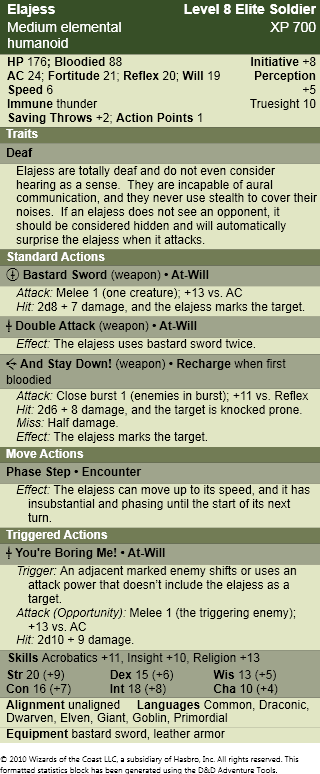
In this week's Wednesday Werk, we'll look at the Elajess.

The Elajess are a race of insectoid humanoids that absolutely abhor boredom.  It is easily their most recognizable trait, and is the cause of most consternation between the creatures and the other races.

The Elajess are planar travelers that appear to trace distant ancestry back to one of the Chaotic planes (in the World Axis cosmology, scholars typically connect them with the Elemental Chaos, whereas Great Wheel adherents typically trace them to one of the Chaos-aligned planes, typically Limbo; at least one crackpot claims that they come from a formless dimension of sound, and that their eyes are specially constructed to see in that eldritch place).  Whatever the case, they bear a rabid hatred of ennui, and will attempt to destroy it wherever it is found.  Make sure they stay interested, or else combat will likely follow shortly.

Elajess are also highly visual, being totally deaf.  They barely even recognize sound as a concept, never bothering to hide their footfalls.  Despite their lack of audible speech, they are quite familiar with languages, communicating using visual signs and prizing books and other visual media as valuable objects.  Those who feel comfortable with the proper signs have been known to draft contracts to hire them.  They are among the few races who can communicate with Dabus without any real difficulty.

Elajess typically do not resort to combat, but their crusade against boredom can cause them to easily clash with most humanoid races (seemingly with no reason to those who know little of them).  An Elajess will typically open with Double Attack, although it will use And Stay Down! whenever it is surrounded by opponents in quantity.  If it hopes to reposition or tactically retreat, it will use Phase Step if necessary.  They also have a habit of just leaving when they feel boredom has been banished, and so may attempt to leave in the middle of a particularly interesting combat.

Friday, August 24, 2012

Deadlands, Part XXI

The watchword of this session.
When last we left our heroes, they helped the rabbis retrieve a book, fought some prairie ticks, killed a Dustman, acquired the Box of Kakisis, returned to David Hood's house, were awakened in the night by the humanoid bat creature that may or may not be the Angel of Death, and chased it off.

Also, said creature is Ruby's mutated brother.  Cue hilarity.

One can hear the baying of hounds.  Like, all the hounds in Boston.  There's some talking.  David, Jake, and Jeb repair the broken barricade on the window; while doing so David peeks outside to note that a huge pack of dogs is going up the street.  Their eyes glow unnaturally, and they sniff each door before pressing forward.  Father Seward lays on hands and heals Rufina's wounds.  The sound of glass breaking is heard down the street.  Screams follow.

Content that the dogs bypassed the house, Father Seward sticks his head out the door to see a veritable army of dogs outside a house about six doors down.  They are forcing their way into the house through the window.

Astute observers also recall the next symbol on the Doomsday Clock face — a jackal's head.  The second hour (or day, if you prefer) has passed on the clock.  Eleven to go.

Since there isn't much to be done against an army of several dozen dogs, the group closes the door.  David Hood has the seemingly insignificant but ultimately brilliant idea of investigating the bowl that the John-Michael-Patrick-bat-thing brought.  Between he and Father Seward, they determine it to be a heavy-ish metal, perhaps pewter — odd, considering that the maker's mark suggests it was made by Paul Revere.  However, it seems likely that the lack of silver in the composition means that it was either a special commission, or that no silver was available — Seward posits that perhaps it was made during the War, and supply lines were scarce.

With the excitement complete, everyone returns to sleep.

Morning comes and everyone awakens.  David wanders upstairs and looks out a window — there isn't much activity on the street, although he notes something at the house that was attacked by dogs in the night.  A couple stands on the roof.  They are well-dressed, standing at the edge of the roof.  The woman has a sling around her neck; it obviously contains something and the bottom is stained crimson.  The pair raises pistols to their temples and pulls the triggers, their lifeless bodies falling into the streets below.

At the sound of gunshots, everyone is on alert, but David explains what he just saw.

It's another day, and another time for a foray into the city.  Food needs to be acquired.  Father Seward needs some more .44 bullets (although Ruby has some).  David needs about $20 more dollars to hit $500 so he can pay his boat captain.  After some discussion, David, Jeb, and Rufina will go out.  Father Seward, Jake, and Ruby will stay to guard the rabbis.

David, Jeb, and Rufina go to the house six doors down to look at the bodies and see what can be scrounged. Upon examination, it is clear the couple is relatively well-to-do, although not super-rich, and they are wearing their Sunday best.  The woman wears diamond earrings and other assorted jewelery; Rufina leaves the wedding band, but takes the other jewelery and the two pistols (later determined to be Colt Army pistols, each with five shots remaining).  Upon turning the woman over, it is clear what she is carrying in the white sling — the largely clean bones of a child, one ripped to shreds by animals.  The dogs must have gone from house-to-house killing newborns.

The trio then goes through the rest of the house, finding $17 (quite fortunately, this brings David Hood's total to $500.25), three more .44 rounds, and assorted jewelery that is largely ignored.

David, Jeb, and Rufina then go into town, raiding what food they can before heading to the docks.

On the way, they pass the cathedral.  A crowd is gathered out front, and a man in a top hat appears to be addressing them.  David and Jeb somehow see through the shroud to determine that he is Bashiel, the demon responsible for slaying the religious leaders in Boston.  They inform Rufina that that's the guy, and everybody hears what he's saying — he claims the city's Jewish leaders performed this atrocity, and that they should be purged.  David and Jeb decide to continue to the docks, while Rufina will hustle back to Hood's house to warn the others.

David and Jeb make it to the docks without incident, and David finds the boat captain.  He pays him the $500 and the man takes the riverboat out into the harbor; upon positioning it, the captain realizes this is the Peerless and says it is a cursed boat owned by a cursed family.  David and Jeb crawl onto the overturned hulk of the Peerless before the captain notes that it will sink if they cut through the hull.

David decides to return to his house while Jeb stays behind to make sure the captain doesn't run off with his $500.

Meanwhile, Rufina returns to Hood's townhouse to inform everyone of Bashiel's gathering anti-Semitic army.  She also delivers some food — the rabbis appreciate, although they do note that they're not as appreciative of the ham (Rufina didn't know) — then leaves to get a good vantage point.  She picks the abandoned house six doors down and sits on the roof and sees some movement and isolated fires, but no roving gangs just yet.

While she's away, Father Seward continues his reading, but seriously considers blessing his guns and going after Bashiel.  Jake and Ruby go off alone to discuss things — largely about an attempted kiss the previous day, and where their relationship is headed.

David Hood returns and informs everyone of the situation, being sure to mention that they probably shouldn't mention his surname in the captain's presence.  The rabbis pull Father Seward aside and inform him that there's a chance of stopping the clock, but it appears to require a holy man, and since he's one of the few remaining, he should stay safe.  There's some bickering as Father Seward thinks they should be focusing more on stopping the clock than moving the clock, but the group decides to head in the direction of moving the clock (it'll need to be accessible to stop it, right?) and finally determines that the best way to handle the problem is by using leather bladders to keep the ship afloat.

Still early in the day, it is decided: David, Jake, and Rufina will return to the shipyard to meet with Jeb and start filling bladders.  Father Seward and Ruby will stay behind to aid the rabbis.  Rufina leaves one of the Colt Army pistols with Father Seward and he makes certain it is fully-loaded.

It's about 3:30 when Rabbi Ezekiel says there is a ritual.  It is mostly translated, and they expect to complete the translation sometime that night.  Rabbi Ezekiel says that the ritual does require some components that are absolutely necessary — a holy man (it sounds like this person has to be an actual clergy member, although the religion isn't important), holy water (although the holy water can be any water prepared by a person of faith, not necessarily full-on holy water), and a silver bowl.

Father Seward thanks them for the information, and he and Ruby discuss what to do.  She wonders if her brother/bat-thing was trying to perform the ritual; Seward says the thought occurred to him.  After some discussion, they decide to go get a silver bowl.  Father Seward asks if the rabbis will be all right, and leaves the loaded Colt Army with them.

Father Seward and Ruby go a few blocks over and find a silversmith that is still open.  They enter and Father Seward asks for a silver bowl of rather large circumference.  The proprietor of the shop asks if it should be the size of a baptismal, and Father Seward says that will be fine.  The proprietor asks when Ruby is due, and Father Seward says it's nothing like that — although he does shoot her a quick, quizzical glance knowing that she's spent some recent time alone with Jake.  He does confirm the proprietor's suspicion that the children have been killed.

The shopkeeper brings a silver bowl with cherubs on it, and Seward says this is acceptable.  When he explains that he can't pay for it, but his friend has very good credit, the shopkeep says he'll trust him if he'll bless four silver crosses and promise to pay for it when he is able.  Father Seward agrees and a deal is struck.  He throws a cloth over the bowl and he and Ruby start to return to Hood's house.

They arrive just in time to see Bashiel and the mob exiting the house.  Bashiel throws a lantern into a second story window and the mob leaves.  Both come to the entrance, and Seward tells Ruby to stay there with the bowl.  He goes inside, pulls out a burning rug so the house doesn't catch fire, and then makes the trek into the kitchen.

All five rabbis are dead.  Four have been badly beaten and stabbed; one has been relatively untouched, but has been impaled against the wall by a lamppost.  All six shots have been discharged from the Colt Army.  Father Seward makes a quick examination and determines the following:

  • The Box of Kakisis is still in the closet, and is closed.  It appears totally unmolested.
  • Of the Fall of Man and the book of translations, there is no sign.
  • The impaled rabbi died roughly an hour before everyone else, and apart from the impalement, has barely a scratch.
  • A box sits in a corner of the room.  Atop it sits a note in Hebrew.
  • The box itself contains a human tongue.
Content that everything is relatively safe, Father Seward invites Ruby into the house but tells her to avoid the kitchen.  They make sure they have everything.  Father Seward takes the note in Hebrew and blesses two of his bullets; they are considered blessed against Bashiel only until sundown.

Father Seward and Ruby make it down to the docks by 7:30 PM.  Father Seward informs everyone that the rabbis are dead and that Bashiel took the notes.  He suggests he's going to confront Bashiel and the mob and then turns and leaves.  Jake follows.  Ruby follows Jake; when Father Seward notes that they're following him, he tells Ruby to stay behind because she has no hope of injuring Bashiel.  Jake might be able to do so.

As Father Seward and Jake walk away, both David Hood and Jake notice a man on a nearby rooftop, staring down at them while shuffling cards.  Jake doesn't recognize the man, wearing top hat and tails, but David certainly does.

It is the ghostly Gentleman, the one previously only manifesting to David Hood and Father Seward.

Wednesday, August 22, 2012

This Accurately Depicts LotFP

It's fantasy, it's metal, and the dude even gets frustrated and flips a table when he realizes that the adventure just isn't going to work in his favor.

That accurately captures Weird Fantasy Role-Playing.

 
But nobody does it like Alan Rickman. 
 

Wednesday Werk: Yirgao

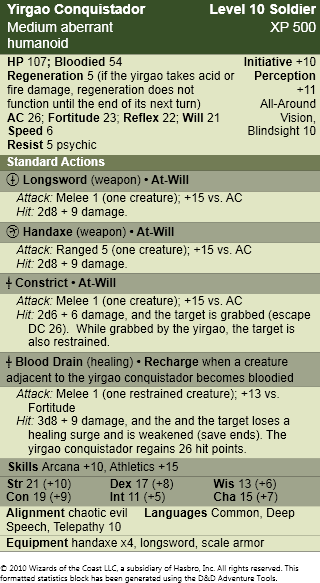
In this week's Wednesday Werk, we'll look at the Yirgao.

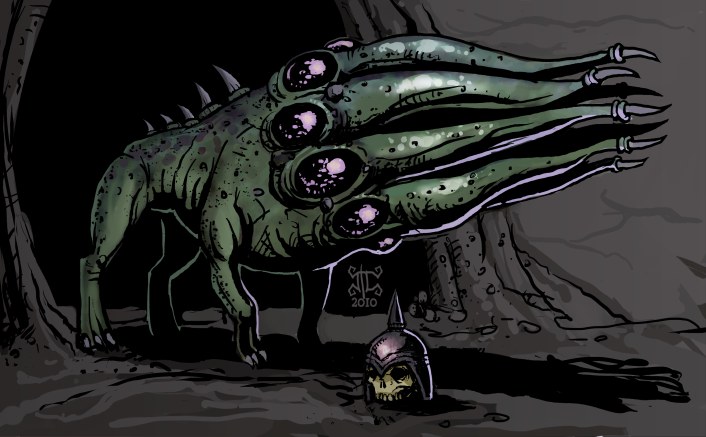
The Yirgao, also known as the "Horrificus," is a brutish creature from planes beyond human reckoning.  Driven by hunger, pride, and cruelty, the Yirgao see themselves as the rightful inheritors of the planes.  In their warped minds, the Yirgao should be the dominant race of a multiversal empire, spanning countless worlds and planes.  They seek to subjugate and enslave the other races, using them as chattel in their quest for supremacy.

Fortunately, the Yirgao are hardly organized enough to perform this feat.  The Yirgao are barely capable of cooperation, typically falling to bloody in-fighting and cannibalism at any disagreement.

Some scholars claim that these behavior patterns of megalomania and xenophobia, coupled with a Far Realm origin, suggest beholder heritage, while others claim that Yirgao are most frequently encountered in planes where beholders are relatively unknown (typically being replaced by the ecologically similar but less megalomaniacal Eye of Terror).

Yirgao have not been heavily observed, but evidence suggests that they drink blood, possess rudimentary psionic abilities, and regenerate when injured, much like trolls.  Additionally, they reproduce asexually, forming monoclonal lineages; smart Yirgao keep a large food supply handy when gestation is complete, because the young eat their way out of the parent.  As they regenerate quickly, adults can frequently survive this onslaught, although the young will completely devour the parent if other food is not present.

The Yirgao Conquistador represents a Yirgao specimen that is probably part of some conquering horde.  Yirgao fight as an intelligent unit, and will frequently attempt to strike foes where they are weakest, drawing ranged combatants into melee and attacking melee combatants at range (these tactics may fall apart if the creatures are hungry or angry enough).  Frequently, a Yirgao will open with Handaxe before moving into melee, next attempting to grab the opponent with Constrict and then attacking with Longsword.  It will first consider using Blood Drain when falls below 81 hit points, and it will then use it whenever it is able.
Monday, August 20, 2012

Sharpened Hooks: Planescape Fusion

Dig this.  You're going to get a lot of background, so feel free to skip it if you like (and you're already down with magnetic confinement fusion reactors).  This all has a point.  Trust me.

There are two types of nuclear power: fission and fusion.  Both types of power rely on the mass-energy and binding energy of elements: iron and nickel have the lowest mass per nucleon and the highest binding energy of any element, making them the most stable (binding energy measures the amount of energy needed to break bonds, meaning that a high binding energy suggests a more stable system that is harder to break).  All other elements, under duress, will strive for this low energy state.  This is most striking for particularly heavy or particularly light elements, as they'll release the most energy when they are transformed.
We'll talk about fission first, because it's necessary to differentiate the two.
Nuclear fission provides 13.5% of the world's electricity.  (If you don't like my description, The Simpsons provides a fairly succinct summary.)  The principles behind nuclear fission are the same as those behind an atomic bomb: certain heavy elemental isotopes (such as uranium-235 or plutonium-239) are inherently unstable, throwing off energy and neutrons.  If you bring them in close contact, those released neutrons collide with other atoms of (for example) uranium-235, causing them to become more unstable and release more neutrons and more energy.  This nuclear chain reaction is a positive feedback loop.  If one performs it too quickly, it forms a nuclear weapon; nuclear power requires a more controlled reaction.

This energy is harnessed in a fairly simple way, recognizable to Vitruvius, Hero of Alexandria, Thomas Newcomen, and James Watt.  Since these reactions throw off a lot of energy as heat, the fissionable materials are usually shaped into rods and placed in a vessel to transfer the heat to water or liquid sodium.  This heat energy is then transferred to water, which turns to steam, which turns turbines, making the whole apparatus a steam engine.

But what about fusion power?

If fission power breaks down atoms into their component pieces, fusion power builds them up.  Taking light elements such as hydrogen (typically as heavy deuterium or tritium) or helium (typically as helium-3), one can build these elements to helium-4.  This operates on the exact same principle as fission — helium-4 has less mass-energy than heavy hydrogen, and so is more stable.  Fusion reactions are extremely energetic, releasing lots more energy than fission reactions (it's why the hydrogen bomb is much more powerful than uranium bombs).  From there, modern fusion reactors look a lot like fission reactors — keep it controlled so that it doesn't explode, and the heat energy is diverted to a steam engine.

Of course, fusion reactors have a lot of problems.  There's a very successful one that produces most of the energy on Earth, but it's the near black-body called the Sun.  The Sun is so successful because it's so massive; a lot of energy needs to go into a fusion reaction, and so far, scientists haven't made it efficient enough to be viable.  That's why cold fusion is such a big deal — if scientists could figure out a way to produce fusion reactions under low-energy conditions, fusion would be much easier.

It seems unlikely, though.  For the moment.

Fusion reactions require a lot of energy, produce a lot of heat, and require a lot of space.  One approach is  magnetic confinement, best exemplified by the tokamak reactor.  Magnetic confinement uses magnetic fields to contain the superheated plasma, and typically takes place in a torus-shaped reactor.  (Compare with inertial confinement, which uses lasers to confine the pellet; inertial confinement can withstand higher temperatures, but magnetic confinement lasts longer.)

Which brings us to the actual point of this article: where can one find a big, indestructible torus among the Planes, complete with its own injection system?

Sigil.

Sigil contains portals to everywhere and everywhen, and some of those portals are either permanently open, or can be opened at will with the proper portal key.  Some enterprising scientist with enough manpower could divert power from the portals to the Inner Planes in the Lower Ward to act as the injection and containment center, and then open another portal to allow heat transfer to a site in another Plane, likely building a steam engine on the other end.  Containment would likely be a non-issue; it's called the Cage for a reason.

Sure, it would kill everyone and destroy all structures in Sigil, while also venting hot plasma out of every open portal to Sigil, but that's a small price to pay for nearly limitless energy.

Of course, the dabus and the Lady of Pain would likely have something to say about it.  As might any enterprising adventurers and Faction-types who catch wind of the plot.

It's also notable that Sigil contains roughly 50,000 residents, while hosting as many as 200,000 transients at any given time.  Certainly no entity would consider that a sacrifice of any kind, would they?

Also, didn't Vecna wrest apotheosis and change 2e to 3e by causing mayhem in Sigil?  What would happen to the scientist who finally does what Ravel Puzzlewell and Vecna could not?

What happens to the person who breaks the Cage?

Print Friendly