Pages

Wednesday, June 13, 2012

Wednesday Werk: Ractur

"Ractur?  Ugh.  Nasty little blighters.  Thicker'n Vistani, they are.  You never find just one; you're facing a small army of them, swarming with chattering teeth and sharp knives.  They come for your gewgaws and dungeon loot, but their attentions have been known to be fatal.  Bastards pack a vicious bite, stewing with more disease than a portside whorehouse.

"Inevitably, some clueless berk starts lamenting the plight of the 'poor, fuzzy little woodland 'umanoids.'  A week later, 'e's leading the torch-wielding mob, 'cause 'alf 'is village is dead from dysentery." — Ogden "The Glaive" Thursson

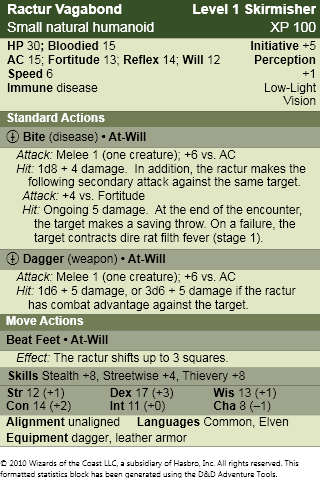
In this week's Wednesday Werk, we'll look at the Ractur.

The Ractur are every bit as nasty as their reputation suggests.  Thieves and marauders in the vein of goblins and kobolds, the Ractur are outcasts and refugees, welcome nowhere.  In the case of Ractur, this has less to do with any sort of vicious degeneracy and more to do with the fact that they are disease carriers.  Bards indicate they were driven by their ancestral woodlands by fire — and that those fires were set to drive them away.  Like the komodo dragon, the Ractur carry a loathsome disease in their bite, which has been known to kill afflicted victims in hours or days (very rarely, someone will die within minutes of infection).

Other than their notably virulent saliva, the Ractur are known for their love of shiny objects and their typical illiteracy.  They do not recognize the written word as valuable, and so have been found with nests composed of rare books, ritual scrolls, treasure maps, and the like — some of them still readable, if only partially.

This Ractur Vagabond represents a standard, urban-dwelling specimen.  The Ractur attempt to attack from surprise if possible; otherwise, they typically attempt to move into flanking positions to make the best usage of their Dagger attacks.  They reorient with Beat Feet, and use their dreaded Bite to keep foes on the defensive.

Astute observers will note that they do not actually carry dire rat filth fever, but their disease could be considered similar enough to not warrant different rules.

Friday, June 8, 2012

Roll out the blogroll...

...you'll have a blogroll of fun.

Here's some stuff you might find interesting.

Goblinoid Games has an IndieGoGo campaign for Starships & Spacemen, a 1978 RPG based on Star Trek.  They're reprinting it to be compatible with Labyrinth Lord.

Richard's Dystopian Pokeverse (the mastermind behind Carcosa Wacky Races) talks about D&D as an early modern game, riffing off this post at Dreams at the Lich House.

Lurking Rhythmically (y'know, the gun-brony RPG blog behind Unknown Ponies) has a post about 7th Sea and Julie D'Aubigny, noted opera singer, swashbuckler, and bisexual.

Down the Glen Tramp Little Men

The alternate title for this was "Fifty Shades of...Followers," but I decided to nab a line from a classic poem instead.

Ahem.  So, this past Monday, (that's June 4 if you're reading this in the grimdark future), I hit fifty followers.  (Ironically, as with my first follower, my fiftieth follower is someone I know personally in my Monkeysphere.)

Incidentally, I was at 271 posts at the time.  So I guess that's something, too.

At any rate, to celebrate, here are fifty things you can find at the local Goblin Market, Swap Meet, or other genre-specific eldritch market.

Fifty Strange Objects

1. Several sheets of flash paper containing several examples of Victorian erotic art.  If the pages are burned together and the smoke is inhaled, the character will get a vision of the location of a hidden sorcerer's crypt containing untold riches and rituals.

2. A thumb drive containing a .mpeg file depicting an elementary school play.  It appears to be a play about woodland animals learning to live in harmony, but during the final musical number, a soloist steps forward and begins reciting a monologue from The King in Yellow.  Screaming starts just before the media player crashes.

3. The Box.

4. Nineteen left socks.

5. A mad sorcerer's grimoire written on a single, continuous piece of tanned hide.  Analysis suggests it's human skin.

6. A Glock 17 that oozes human tears whenever it is fired.

7. A singer's voice in a wooden box.

8. The memory of a comical loss of virginity.

9. A box containing several years' worth of the Fortean Times.  Someone has written "True" or "False" next to each article heading.

10. A clay figurine which is supposedly some sort of homunculus, although the activation commands are forgotten.  In truth, it is merely a prison for the soul of a dead magus.  Note that both things may be true — if the proper syllables are spoken, it may be forced to animate and obey the petitioner.

11. A vicious knifing.

12. An aluminum water bottle of purple liquid.  This liquid has all the typical effects of LSD, save that the user can also see ghosts.

13. The memory of a mundane family vacation to the beach.

14. A hamburger in sealed lucite.  The plaque indicates that it was purchased from McDonald's on December 12, 1948, making it one of the first hamburgers sold at the renovated San Bernardino location.

15. Bigfoot's Social Security card.

16. Something off this Goblin Market table.

17. A snowglobe, depicting a small town in the Midwest and evidently originating from their chamber of commerce.  When the snowglobe is shaken, it rains (or snows) in the actual town.

18. A silverware set made by Paul Revere.  Old stains that look like strange rust cover some of the pieces.  If any old DNA can be extracted, it is revealed to be wolf blood.

19. A black garbage bag full of fingernail clippings.

20. A copy of the famous August 1991 issue of Vanity Fair featuring a nude, pregnant Demi Moore on the cover.  If examined closely, one can see the vague outline of an inhuman shape in her pregnant belly.

21. A fleeting memory of the color jale.

22. The Axe with the Edge of the Sun.

23. A ball-peen hammer.  Any slot machine touched with this ball-peen hammer will release its jackpot.

24. A dog's corpse, prepared with taxidermy.  Any cavities in the body are filled with fortune cookie fortunes.

25. A jar of baby teeth.

26. A brown glass eye.  If placed in an empty eye socket, it renders the user completely immune to injuries sustained from car accidents, even if she is thrown clear of the vehicle.

27. A set of polyhedral dice made of meteoric iron.

28. A dirty speculum.  If touched to a wooden object, an image of the woodwright will appear in the user's head, along with an impression of the person's name.  If the object is mass produced, the user will get an impression of everybody involved in its creation.

29. An unlabeled VHS tape.  The tape appears to be an amateur documentary on a man named "Phil" as he goes through his errands.  Any person, place, or thing with a supernatural talent or origin exudes a golden halo.  Phil is not supernatural, but several things in the background of the video are.

30. A hatchet head, pitted with rust stains.

31. A collection of 57 wheat pennies.

32. A musket ball, retrieved from a human cadaver.

33. Something off this Random Magical Junk table.

34. A CD of The Art of War by Bone Thugs-N-Harmony.  The CD is heavily scratched and cannot be played, although when held to the light, the scratches appear to form arcane symbols.

35. A recipe for a medieval immortality elixir, pieced together as a collage of magazine clippings.

36. A clump of bees, pickled in formaldehyde.  Close examination reveals that the bees' legs have grown together, forming the clump of bees.

37. A child's drawing of a black shape labeled "CENTER TOOME."

38. A toy steak, carved from wood and painted.

39. A leather wallet stuffed with joss paper in the form of Hell bank notes.

40. A rattle.  It appears to be a Barbie leg jammed into a baby doll's head, and the head is filled with some sort of object (beads? bones?) to make it rattle.  The baby head is haphazardly decorated as a jester's ninny-stick.

41. A yellowed sheet of vellum containing a recipe for hummus.  The Latin writings sarcastically refer to it as a work of alchemy, which might confuse a modern scholar.

42. A violin that makes music so terrible it causes actual psychological stress in victims.

43. A monocle.  If dipped in milk, it allows the user to diagnose any illnesses currently affecting any person the user can see.

44. A jar of dappled light, filtered through autumn leaves.

45. A Ziploc bag of black piano keys.

46. An unlabeled 5 1/4" floppy disk.  Assuming the operator can run the program, the screen will read, "COORDINATES?"  If the operator inputs a valid address, the program will read "Y" if a magical item is present in the location and "N" if one is not present.

47. An elephant's leg, hollowed out as an umbrella stand.  It still emanates the infrasonic signals used by elephants to communicate over long distances.  If somehow decoded, it appears to be a mating signal.

48. A baseball cap which, when worn, makes the wearer seem appropriately dressed.  It does not alter appearance, and it does not allow the wearer to enter places where he would not be allowed, but it does mean that the character can wear a T-shirt and jeans to a formal affair and not be turned away based upon his mode of dress.

49. A sardine key that opens any lock it touches.

50. Six hairs in a jar stoppered with wax and human blood.

Wednesday, June 6, 2012

Wednesday Werk: Hagtessa

"When we was young, we saw a maulkin lady what had a malmsey nose down by the refuse dumps.  Thought she was a beggar.


"Like I said, we was young.  Weren't on our guard in the city.  Thought it were 'safe.'  Whatever that means.


"She was on us in an instant.  Geezer Geoff raised his staff, but she put some sort o' hex on 'im, 'fore he could even cast a magic missile.  Whilst he was staggering, insensate, she pounced on Shae.  Was only Brother Melech what kept 'er at bay, and even at that, it was tenuous.


"We did the smart thing.  We ran, 'alf draggin' Shae and Geoff with us.  Took several days of the Brother's tender mercies to get Shae back on 'er feet.  We didn't go down to the refuse piles for quite a time after that.  Just weren't worth it." — Ogden "The Glaive" Thursson

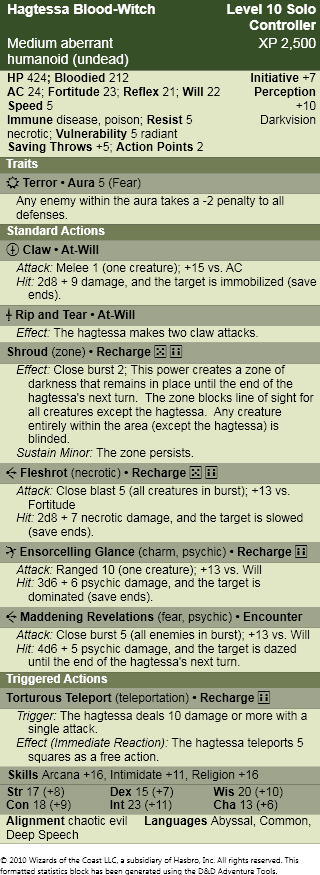
In this week's Wednesday Werk, we'll look at the Hagtessa.

Combining some of the worst traits of ghouls, hags, and magi, the Hagtessa are wizened, mad old women thought to emerge from beyond the sane planes known to mortals.  It is likely that they were once mortal women, but have been transformed by some black curse; indeed, some scholars claim they are enslaved by mad, eldritch things beyond mortal comprehension.

Whatever their origins, they are now decrepit, old, undead hags with immense magical powers and terrifying strength.  While the creatures are capable of devastating attacks, vile sorcery, and innate magical abilities, they are also known for their abilities to enact magical rituals with nonstandard components.  Most notably, they engage in planar travel using humanoid sacrifice as a ritual focus, and they have also been known to travel on the same plane through lesser versions of the same.

Basically, they're bad news, and their hatred of free-living things prompts them to hatch insidious plots and enact grotesque tortures.  Petitioners can learn rituals or gain their aid, but it will almost require a reprehensible task on the part of the petitioner.

The Hagtessa Blood-Witch is a terrifying combatant.  It will try to lure its opponents into range of its Terror Aura and use Maddening Revelations.  It will then spend an Action Point to drop Shroud, negating any attacks that require line of sight and granting concealment to the Hagtessa.  It then uses Ensorcelling Glance to force a character against its allies, and will use it whenever available; when it is bloodied, it will only use it if doing so does not provoke opportunity attacks.  It will proceed to use Fleshrot when it is available and Rip and Tear when it is not.  As it attacks, it uses Torturous Teleport to refocus and flee large groups of enemies.

Friday, June 1, 2012

Magic in Carcosa

Forgive a spot of rambling, but I have this Carcosa megadungeon in mind.

Don't get all excited.  I don't know when I'll be ready to run, and this is the same megadungeon I noted back in January.  Since I'd almost assuredly open it to FLAILSNAILS, that means I have to consider Clerics and Magic-Users that might arrive from other games.

Is it absolutely necessary to change the magic rules?  Probably not.  However, I would like to highlight the weirdness that is Carcosa, and accentuate the fact that native Carcosans are probably the best equipped to handle Carcosa (although I really like the persistent idea that some planeswalker will arrive and start organizing the populace like John Carter of Mars or Lawrence of Arabia).

Here's the thing, though.  To tackle this subject, we have to consider D&D magic — after all, Crusssdaddy already wrote a post about this on the Doomed World CARCOSA (and one for magic-users), so why am I doing it again?

Simple.  I really like the concept, but the magic works differently in my head.  Here's where I'm coming from.

(Also, as an aside, I might not keep these rules, but here's my current thought.)

Clerics

Clerics are fanatics and faithful who pray to the divine and are rewarded for their efforts.  That's really simplistic, but the bottom line is that clerics devote themselves to the divine, and so the divine devotes itself to clerics.  Whatever the particulars (some clerics pray to multiple deities while others only revere one), there's a give-and-take relationship present.

Clerics may not specifically pray for spells, but it's obvious their devotion grants them a pipeline to the gods.  In order for their magic to work, they have to maintain that open channel.

Carcosa interferes with this in two ways.

First, as noted in the Doomed World CARCOSA post, "The Old Ones dominate CARCOSA and the other Gods of the multiverse aren’t too keen on intruding."  I agree, although I'd also point out that Carcosa has a limited connection with the spirit world, suggesting the people are more familiar with corporeal things.  I'm inclined to keep the divine spell failure rules posited in that blog post: "Cleric spells have a base 50% chance of failure, modified downward by 5% per level of the caster (ex. a 3rd level Cleric has a 35% chance of failure, an 8th level Cleric has a 10% chance of failure, at 10th level and above the chance of failure is removed).  A failed spell counts as spent."

Second, as noted, "Praying for spells can be dangerous and calls to distant Gods are prone to attract unwelcome attention."  However, the some of the rules and comments in the article seem to imply that the Old Ones are divine and hold dominion over the gods.  In my head, as in Call of Cthulhu, they're not.  They're physical entities, and for all his power, Great Cthulhu with 57 HD is just a variation (albeit a weird variation) on a Fighting Man around level 57.  Power level has nothing to do with it; although the world's greatest boxer might be able to physically defeat the Grey God of Lightning and Tailors, one's a god and the other is not (although a Fighting Man at 57th level is hardly just a normal human anymore, either, he's not divine).

As such, casting cleric spells doesn't risk drawing the Old Ones' wrath.  However, it does draw their notice: a cleric must save vs. spells/magic at +2 or else have the expenditure of power be noticed by one of the Old Ones.  Within 1-10 days, the servitors of one of the Old Ones will arrive to investigate and likely kill the cleric.  Which Great Old One notices the expenditure of divine power (and subsequently sends servitors) is up to the DM, who is free to use the d10 chart on the above blog post.  Common sense may also apply — if you're in the middle of the desert, Cthulhu probably isn't going to send deep ones after you.

Unlike Crusssdaddy's post, I assume that turning only works on undead, and that spells tend to work the same, albeit with some Carcosa trappings.  Clerics seen casting spells are considered to be sorcerers, mutants, or stranger things, and so will be treated accordingly.

Magic-Users

Arcane Vancian magic is a strange animal, typically abstracted in D&D and its incarnations.  As D&D is implicitly post-apocalyptic (and some settings imply magic is modular and almost technological in its origin; see this Jeff's Gameblog post on sufficiently advanced magic for an example), magic is typically seen as a lost art.  Its heyday has passed, and only shadows of once-great power remain — Chaucer even writes about long-gone days of magic in The Wife of Bath's Tale, saying, "In th' olde dayes of the kyng arthour, / Of which that britons speken greet honour, / Al was this land fulfild of fayerye. / The elf-queene, with hir joly compaignye, / Daunced ful ofte in many a grene mede. / This was the olde opinion, as I rede; / I speke of manye hundred yeres ago. / But now kan no man se none elves mo."

-C at Hack & Slash recently tackled Vancian magic in his post, "On a Change in View."  As noted in the post, the best summation of Vancian magic is, "The design of this mosaic we cannot surmise; our knowledge is didactic, empirical, arbitrary."  Vancian magic is vague because even the wizards don't understand it — they merely understand how to access it.

But what if Vancian magic is vague not because it's dense but because it's unsafe?  Carcosa, pg. 111 states, "At the height of their powers, the Snake-Men destroyed themselves by releasing ultratelluric forces impossible to control."  What if that powerful ancient magic from the histories messes with the same fundamental forces as the Snake-Men's sorcery?  What if civilizations with powerful magic are rare (almost every D&D setting shows magic in decline) because they tend to destroy themselves — see the Doomsday argument and Fermi Paradox for real-world theories regarding the same problem.

Whatever the case, it is assumed that arcane magic taps into the fundamental forces of the cosmos without divine intercession.  The magus is the intercessor, and he has to deal whatever happens.

In Carcosa, that means he has to deal with the leftover energy from the Snake-Men's disaster.  Those ultratelluric forces are still available, and wreak havoc on the fabric of magic.  Unlike clerics, who become more adept at contacting their patrons from anywhere in the multiverse, this never gets easier for magic-users. Low-level magic-users cannot adequately prevent backlash, although they tend to throw less power around.  High-level magic-users become much better at preventing backlash, but channel more magical power.  The problems of control and efficiency effectively cancel each other out.

As such, whenever a magic-user casts an arcane spell, the player should roll a d20.  Nothing happens most of the time, but if he rolls a "1," the caster is struck by a backlash of cosmic force.  The DM should roll 1d10 and consult the following table:

1 - The magic-user is subject to unnatural aging, aging from 1-5 years instantly (roll on the Unnatural Aging chart).

2 - The magic-user takes 1 die of damage.

3 - The magic-user gains a random mutation.

4 - The spell fails, and the magic-user can cast no more spells that day.

5 - The magic-user acts randomly, as if affected by confusion.

6 - The magic-user goes insane as if struck by an insanity weapon.

7 - The magic-user loses a level, to a minimum of 0.

8 - The magic-user takes a number of dice of damage equal to the level of the spell.

9 - The magic-user summons a random creature.  The creature appears within the caster's line of sight, almost as if summoned by a summon monster spell.  This creature is not predisposed to like the caster and will likely attack.  The DM should determine such a creature by either rolling on a local encounter table or by generating a random Spawn of Shub-Niggurath.

10 - The spell goes awry, with twisted effects: attack spells hit allies, or even the caster; healing spells deal damage; protection spells grant vulnerabilities; and so forth.

Astute observers will note that incurring backlash does not necessarily cause the spell to fail.  Even if backlash kills the caster, he will cast the spell unless the particular backlash in question contradicts this claim.

Conversely, if the magic-user rolls a "20," something unexpected (but positive) should occur.  Roll 1d10 and consult the following table:

1-4 - The magic-user does not expend a spell slot by casting the spell.

5-7 - The spell's variable effects are maximized.

8-9 - The spell's effects (range, duration, damage, etc.) are doubled.

10 - Instead of the spell the magic-user intended to cast, the magic-user casts a random spell from the magic-user spell list.  This spell is always appropriately targeted — attacks hit enemies and protection spells target friends — but can otherwise be any spell from the list.  Yes, your Level 1 Magic-User might cast wish, although that's probably just more trouble than it's worth.
Print Friendly