Pages

Saturday, October 1, 2011

Review: Call of Cthulhu

I was about to do Unknown Armies, but how can I do that when I haven't even hit Call of Cthulhu yet?  Yeesh.

After I encountered World of Darkness, I'm pretty sure Call of Cthulhu was the second roleplaying game I encountered.  I hardly knew enough to know how old school it was, but there were several things I liked about it.

First, it was my introduction to H. P. Lovecraft.  If you're reading this and have somehow avoided H. P. Lovecraft, you should read one of his stories ("Call of Cthulhu" is included with the game of the same name).  Being in the public domain, most of his works are online, so you shouldn't have any trouble finding them.  Local libraries also tend to have collections of his work.

Second, it was deadly.  If you get hit more than once, you're probably unconscious or dead.  Assuming your opponent is mortal.  If your opponent is some atrocious alien thing, you probably only have to get hit once.  Fighting is not your friend in Call of Cthulhu.

Third, weird things are scary.  Say what you will, but when the zombie apocalypse comes, you're not going to cock your shotgun and unload both barrels into the head of the thing that used to be your sister.  You're going to weep, and blubber, and possibly lose bowel and bladder control.  The supernatural is frightening, and even if you can accept it, you're still not comfortable with it.

Fourth, it's one of the simplest game systems I've seen.  Your skills are expressed as percentages.  Roll a d100 under that percentage.  Easy.  Stats and the resistance table are a little trickier, but ultimately, everything is expressed as a percentage.

If you've read Lovecraft, there really isn't much to say about Call of Cthulhu; like Lovecraft's stories (and the stories of his imitators), you are normal people who discover that this world hides a secret, awful one.  Once you have seen the truth, however, you are frequently cursed to keep investigating.  Unfortunately, the world only gets more awful, because the ultimate secret is that the carefully cultivated human world is the oddity, not the "supernatural" world (the alien science of the Cthulhu Mythos isn't actually supernatural).  The universe is probably not actively malevolent, but it certainly doesn't care about you; humanity is a cosmic accident, one that will eventually suffer extinction just as many species before.

Of course, roleplaying being what it is, Call of Cthulhu is frequently a little action-oriented (Lovecraft's original sources hardly used as much dynamite as Cthulhu characters), and a little pulp (many games take place in the 1920s).  Even so, Call of Cthulhu rewards scholarship and investigation more often than combat.

But in every case, the fun of Call of Cthulhu comes less from the thrill of accomplishment, and more from making the most of the downward slide into death or madness.

Deadlands Replays

I just added another label, "Deadlands replay," for the Deadlands game I am currently playing.  So look for that if you're interested.

Also, I figured I would mention a couple of things I left out of the retelling of the first session.

First, this game doesn't use the Deadlands setting.  It takes place in historical 1877 with Deadlands elements added, playing a bit more like Wild Western Call of Cthulhu than the standard setting.  Father Seward is a blessed and Jake is a huckster, so those things (along with Rattlers) are still currently the same.

Additionally, while staying in Boston, each member of the group received a letter or other form of communication indicating that something near and dear to that person may be found in San Francisco.  These missives also included a single playing card.  Father Alex Seward noticed that the ticket vendor who sold David Hood his train ticket is also the same man who delivered the priest's letter.

In addition to the PCs, there's a Mr. Butler who also received a playing card, but there is some suggestion that he's into some weird and evil stuff.  For example, there was a priest in Mr. Butler's sleeper car on the train to St. Louis (this same priest bumped into Father Seward in the baggage car, presumably performing some form of pickpocketing or switcheroo, though Father Seward never determined what he actually did).  This priest started getting sicker and sicker; at night, he would cough and go to the bathroom.  His hand was wrapped with a bandage.

After several nights of coughing beside our door, we finally confronted him.  Father Seward met him in the hallway, but the priest responded with horror when he saw Seward, wishing he were not there.  He then removed the bandage on his hand, revealing a wound.  He smeared the blood on Seward's head and then he died.  A mysterious presence filled the car and everything fell silent before it subsided.

Granted, Mr. Butler had nothing to do with this (he was asleep at the time, as best as anyone can tell), but even so.  Things are weird.

I'm sure we'll find out about these events, though.  In time.

Review: Deadlands

Despite only recently playing this one, I grabbed a bunch of books and read them years ago.  For a long time, this was my favorite system and setting, having only been recently supplanted by Unknown Armies.

Deadlands is an alternate history Wild West game typically taking place from 1876-1879 (various editions advance the year).  Something happened in 1863 to change history; the Battle of Gettysburg went weird, as did many Civil War battles thereafter, causing them to end inconclusively.  The Civil War basically ground to a slow crawl as fighting became more difficult.

In 1868, the Great Quake shattered the California coast, creating a series of waterways known as the Great Maze.  This also revealed a new superfuel known as ghost rock; much more powerful than coal, ghost rock has since enabled super-science.  Unfortunately, this has further slowed the progress of the Civil War, as America is now fighting using Victorian tactics but World War I technology.

In the 1876-1878 period (according to Deadlands: Reloaded, the Civil War ends in 1879), the Civil War is almost in a state of cold war between the North and the South, with the West trying to plod along despite the setbacks.  Thanks to Doctor Hellstromme, the Mormons are now the most technologically advanced civilization on Earth, and have formed their own nation of Deseret.  The American Indians have also found new strength, forming the Sioux Nations in the north (who adhere to the Old Ways), and the Coyote Confederation in the south (who gladly use the white man's rifles).

It's the Wild West.  It's steampunk.  It's horror.  It's Deadlands.

In addition to the weird setting (think spaghetti Westerns meet Call of Cthulhu), the rules have a D&D level of detail without being too overwhelming.  You will, however, need every common die type imaginable: d4, d6, d8, d10, d12, and d20.  Basically, your stats tell you what type of die to roll and how many.  You try to beat a target number (3 is the lowest, 5 is average, 13 is well-nigh impossible), but you only count the highest die.  However, if a single die rolls the highest number (4 on a d4, 6 on a d6, etc.), you get to re-roll and add it.  So, if you have a trait at 3d8 and need to beat a 13 (good luck!), you might roll a 3, 5, and 8.  Re-roll that 8, and say you get a 6.  8 + 6 = 14, so you beat the target.  Damage does the same thing, but dice are added together; so, the previous roll would be 3 + 5 + 8 + 6, or 22 if it were a damage roll.

Like D&D, the basic rules are fairly simple, but there is a lot of complexity atop those rules.  For instance, playing cards are used during initiative (as well as some of the magic-users), and poker chips are used to modify rolls (you get poker chips at random intervals, and can spend them to improve rolls).  The game also uses a hit location system, and the non-combat parts of the game have enough detail that you could use the Deadlands engine to run an Oregon Trail game (prices, disease, starvation — it's all in the rules).

Having actually played it, I can say that it actually runs pretty quickly, and combat is delightfully deadly.  However, there can be a lot of stuff to remember, and you will use every die in your arsenal.  Despite the crunchiness of the rules, though, it retains its place as one of my favorite game systems.

Review: Terra Nova

I'll take a break from RPG reviews to do a review about a science-fiction show on Fox (meaning that it might last a whole season — maybe).  It's related, though, for reasons that will become obvious.

So far, Terra Nova has only had one episode, "Genesis" (that's the Hulu link, by the way, if you want to go see it).  That reveals the basic premise, as more-or-less shown in the adverts: future Earth has been more or less depleted (I think Earth being "used up" was the phrase used by another Fox television show), but humans have determined some method to travel back in time.  So, they develop a colony 85 million years ago.

That's the simplified setup.

Anyway, upon seeing the adverts, my father referred to it as "Jurassic Lost," but I was reminded of Dennis Detwiller's Delta Green opera, Future/Perfect (in case you're interested in running it, Part 4 is here).  Spoiler (highlight to read): In Part 3, it is revealed that a group has been hiding a gate to the past, and that group has created a human colony in case some disaster befalls present-day Earth.  Sounds similar, right?

At any rate, I didn't liveblog it, but I will record my thoughts here, more or less in order.  Spoilers ahead, though I'd gather my thoughts don't make much sense unless you've seen it.

• Not just Future/Perfect, but Future/Perfect meets Soylent Green.

• Oh yeah, teenage love lasts forever.  I'm sure you'll figure out a way to return through the one-way portal and be reunited with your girlfriend.  That seems like a perfectly reasonable story arc.

• Scratch that; Future/Perfect meets Soylent Green meets The Prisoner.

• Did...did they just refer to someone as "Six?"

• Confirmed.  The rebels are called "Sixers."  Nice Prisoner reference.

• Forgot about your girlfriend quickly, didn't you?

• Are those alien geometries?  I'm not sure if Serpent Men or aliens would make this show better, but I desperately want this show to be Lovecraftian, so I'll allow prehuman civilizations.

• Teenagers are dumb.

• I know armor is only marginally helpful, but why is the new security guy still running around without armor?

• Ah.  No aliens, just a crazy Chekhov's Gunman.

• ...and now the struggle between Terra Nova and the Sixers is Unknown Armies.  This is acceptible.

All-in-all, not the greatest show, but worth watching.  Dinosaurs are in every Monster Manual for a reason.  I'd like to keep up with it, so I can at least see where it goes.

The only thing detracting from the show (for me) is that I want it to be Lovecraftian, where time travel is less a deus ex machina and more a horrible, horrible mistake.  There's still time for that, though.

If there are Serpent People, though, I'm all in.

Another Blog Shout-Out

Yesterday, when I mentioned the new followers and their blogs, I somehow missed this one.  Crockett gives us Digital Orc.

Keeping with yesterday's post on names, I might recommend "What's in a Name?"  I would also be inclined to recommend the post on the Ralph Bakshi's Wizards RPG (yeah, I didn't know it existed, either).

The real gem of this one is the same sort of stuff to which I direct readers, though: the world-building tables.  Enjoy that.

Finally, I give you xenomorphs in D&D, because I routinely want to make my players nervous about the xenomorph mini in my collection.

The Micro Machines xenomorph is roughly 30mm scale.

Happy Birthday, Dave Arneson!

Happy birthday to Dave Arneson, co-creator of D&D and creator of the oldest roleplaying setting in existence, Blackmoor.

I actually have a shout-out to Blackmoor in Crux of Eternity; the Black Moor is the swamp located in the crater formed by the crashing of the Fatehammer comet, fifty years ago.  The Armor of the Black Moor is a rumored item, supposedly forged from the metal core of the Fatehammer comet itself (but as far as anyone knows, nobody's ever found remnants of the comet itself, which begs the question of how the rumors were started in the first place).

[Editor's Note (1-3-2014): The Fatehammer comet has officially been revealed as the wrecked hull of the Sentinel, an extraplanar flying vessel accidentally brought to the Sorrowfell Plains.  The Sentinel itself is a 4e version of The Expedition to the Barrier Peaks.]

I've never run in Blackmoor, but I dig the setting.  Particularly all the weird ancient astronaut stuff that tends to appear in it (a spaceship crashed near Blackmoor a long time ago, and there are some weird alien devices in circulation).  It also forms the prehistory of Mystara.  Perhaps I shall run a game in Blackmoor, someday.

A Dungeon Trick

So I've been having more and more conversations about dungeons recently, and I had a thing occur to me.

I've seen Zak Smith use Super Mario Bros. as an example when talking about dungeons, primarily in the "otherness" of dungeons — there's happy music and blue skies up above, but the dungeon is foreboding, oppressive.  It's a change in mood.

And Super Mario Bros. was pretty unabashedly inspired by Alice's Adventures in Wonderland, itself a known inspiration for Dungeons & Dragons dungeons (and go check out Dungeonland for Gary Gygax's direct adaptation).

Anyway, there's a trick in one of the Mario levels where platforms shape the hallway into one with three paths.  Going the wrong way will cause the character to be stuck in a loop, but going through the passageways correctly will lead to the exit.

(By the way, after some research, I determined this to be World 7-4, though World 4-4 also has one.)

Why not use this trick in a dungeon?  Just make a selection of hallways, and create a puzzle like this.  Here's an example:

We'll say this is D&D.  The characters find themselves in a little village, largely because there's a tomb nearby, and they want to loot it.  The village elder spouts a lot of cryptic stuff — something about all things being true, and false, and meaningless — but he lets slip a piece of wisdom which may or may not stick with the characters, because they're just being polite and convincing him that they're foreign pilgrims who seek to pray in the temple, rather than foreign treasure-seekers who seek to loot it.

Ahem.  Anyway.  The village elder says the following thing, "The adolescent man, he rebels against the teachings of his elders, he seeks to couple with young women, and he seeks to experience the fullness of life.  He seeks the left-hand path.  The adult man, he accepts the teachings of his elders, develops a code of honor, and understands the wholeness of his mind, body, and spirit.  He seeks the right-hand path.  The old man, the wise man, he has walked both paths and returned with the wisdom of the enlightened.  He seeks the middle path."

After another hour of tea and philosophy, the characters finally manage to extricate themselves from the old man's conversation under the pretense of a bathroom break (they just spent two hours drinking tea, after all).  With his blessing, they enter the temple.

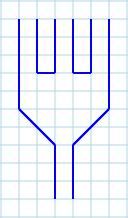
As they're walking, they come to a room that looks like this (for that matter, this might be the whole dungeon; solve this puzzle, find the hidden shrine):

This should be easy.
 They prepare their magic and their weapons, the thief takes point, and the group decides to head down the center path...

This time, for sure!

...only to find themselves in another room that looks similar to this one.

They do it again to find...

Is it just me, or do all these rooms look alike?

...another room!

So, they decide to backtrack, but they don't pass through three rooms.  Instead, they find themselves exiting the dungeon.

So, they sit and think.  This is obviously magic, because there is no way for these rooms to bend back on each other.  Finally, one says to the other, "Hey, didn't that old guy say something about left and right?  What was that..."

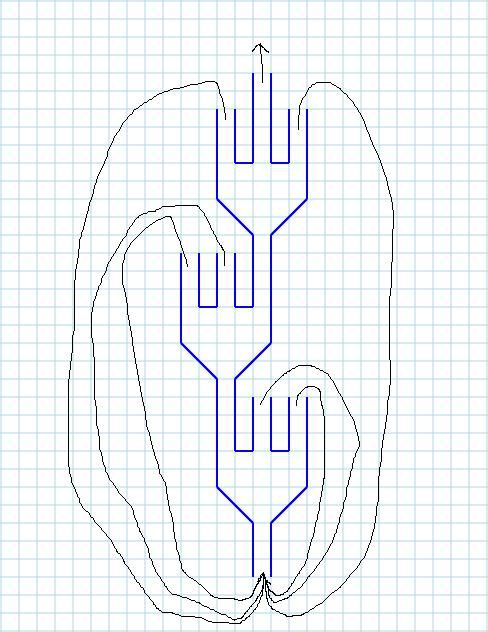
After some thought, they piece together the parable and return to the dungeon.  This time, they navigate according to the parable, and find that going left, then right, then straight, leads to the shrine.

Ultimately, the dungeon looks like this:

Be jealous of my MS Paint arrows.

Obviously, this structure can be altered.  The magic that makes the dungeon "loop" could also subtly change the rooms so that it is not immediately obvious that the same room has been entered.  More or fewer paths could be given.  The clues could lie in the dungeon itself, or maybe the structure only loops for those who do not hold a "key."  (For another Mario example, in Super Mario 64, the stairs leading to Bowser's Lair appear infinite unless the traveler has at least 70 Power Stars.)

The above images were made using Graph Paper and MS Paint.

Print Friendly