Pages

Wednesday, October 17, 2012

Persons of Interest: Loturik the Bound, Kolyarut

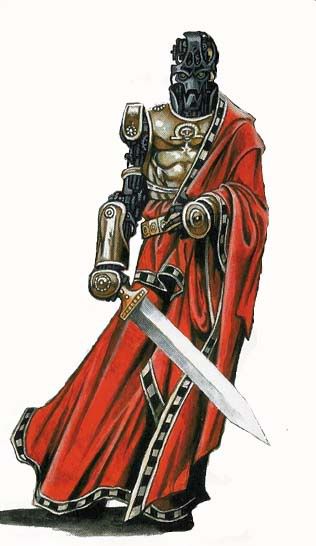
Loturik the Bound

Loturik the Bound is one of the Inevitables, order-aligned extraplanar constructs originating from Mechanus (and thusly making them spiritual kin to the Modrons).  Specifically, Loturik is a Kolyarut, a type of Inevitable that hunts oathbreakers.  They are known to be the most personable of the Inevitables because they will actually deign to speak to their chosen prey, and may even attempt to negotiate a settlement (so, rather than killing the oathbreaker, they may simply convince the person to uphold the broken bargain).

In this case, Loturik the Bound is occasionally seen around Sigil, and is identified as a member of the Planar Trade Consortium.  Scholars can think of no reason why a Kolyarut would willingly serve any authority less than its duty, but rumors suggest that Loturik, as his moniker suggests, is bound to the will of the Planar Trade Consortium.

Rumors suggest that no less authority than Estevan himself (an oni mage and a key leader of the Consortium) tricked this rogue Kolyarut into forging an oath with the wily magus.  If this is true, Loturik is bound to serve because it cannot break its own oath without defying its base nature.

Loturik is currently thought to be gathering adventuring parties to help cultivate the town called Skyfall in a grim and distant Prime Material World known as Carcosa.  Special attention is to be paid to the ruins below the town, as there is apparently wealth to be had down there.

(Also, the above image was found on http://www.themistway.com/Ravenloft-Session14-DMC.html at the phrase, "human-shaped clockwork automaton.")

An Auspicious Time for Megadungeons

I go silent for a week and a half, and a bunch of stuff happens.  The OSR blogosphere (yes, I hate that Web 2.0 Newspeak as much as you do, but sharks die if they stop swimming*) has been blowing up with things regarding megadungeons, largely because of the perceived failure of James Maliszewski's Dwimmermount (truly, you're just best off reading about the whole debacle on The Other Side, because he gathers several of the salient links for your perusal).

For my part, I don't really have an opinion on the matter.  I supported the project, but I have no real issue with the delays ("Do you want the job done right, or do you want it done fast?").  And I don't have an opinion on the "empty space" thing because I haven't read the digital materials Autarch has been releasing, mostly because I've just been that busy.

Ah, well.

Anyway, this is humorous because I received several parcels on Monday.  One was a blotter pad of graph paper so I can start sketching the first few levels of my Carcosan megadungeon.  Another was a miniature of a Kolyarut (here's the D&D 3.x version and the Pathfinder version) whom I plan on using to represent a Planar Trade Consortium agent with business regarding that very same megadungeon.  Finally, my copies of Barrowmaze I and II arrived that very same day.  I haven't had the chance to read through them yet, but still, megadungeons.

Friday, October 5, 2012

Bene Gesserit for B/X


I must not fear.
Fear is the mind-killer.
Fear is the little-death that brings total obliteration.
I will face my fear.
I will permit it to pass over me and through me.
And when it has gone past I will turn the inner eye to see its path.
Where the fear has gone there will be nothing.
Only I will remain.

One quick thing this morning: Stuart from Strange Magic gives us the Bene Gesserit class for B/X, a cleric sub-class.  Check it out!

Deadlands, Part XXIV

When last we left our heroes, they were infected with cholera and successfully stopped the Doomsday Clock from opening a Hellgate in Boston.  Father Seward, Jake, and Rufina are all dead or missing.

It's pouring rain so hard a body can barely see, but one-by-one, the group reunites.  Rufina crawls out of the ocean; she's burnt, but she's fine.  She finds Ruby in the rainstorm.  They find David Hood.  Eventually, they stumble into Jeb.  They take shelter until the rain dies down a little.

The group determines that Jake is dead — dynamite — and that Father Seward was on the burning ship.  Rufina swims a bit, but finds no evidence of the Father.

With no other options at the moment, the group decides to return to David Hood's parents' house.  Despite reeking of ill shits and decomposing corpses, it's a home of sorts.  Good enough until they move on.

They start to hear noise in the distance, noises of drums and activity.  A knock at the door reveals a corporal  who asks for an accounting of the house; David notes the survivors.  During the conversation, the corporal indicates that someone is looking for them.  An older, blind man with tousled hair greets them and feels their faces.  He indicates they are the people he seeks, although a fifth should be with them.  The corporal indicates a General Sully wishes to see them, and David Hood asks if they can freshen up and go to the docks to look for another of their party.  The corporal, reluctantly, agrees.

Meanwhile, Father Seward awakens on a vast grassland overlooking a lake.  On the other side of the lake stretches an enormous tree, stretching heavenward.  He is compelled to walk toward the water.  As he approaches, he sees several boats moving hither and thither.  They are piloted by Dustmen, taking people to the island with the Tree.  He climbs into a boat and the Dustman starts rowing.  Ahead of him, he sees a boat containing Jake, also headed for the island.

He hears a splashing, followed by something climbing into the boat.  This is followed by a much heavier splash.  Whatever climbed into the boat curses Jake's foolishness, and turns the boat around.  Father Seward can see the Dustman rower floating in the water.

As the boat returns to shore, Father Seward starts to regain control of his faculties.  When the boat reaches the shore, out splashes none other than Cornelius Cobb, the man with purple gloves.  Father Seward expresses surprise at seeing him — he's figured out he's dead and certainly didn't expect to see the former Satan.  Cobb indicates that, as much as he'd love to let the Father die and move on to the afterlife, Father Seward has some information in his head that Cobb needs.

Cobb beckons him to follow.

Father Seward steps from the boat and goes to step into another boat.  Before he can board, Cobb grabs him and starts dragging him into the grass.  He indicates that Seward's returning to the land of the living whether he wants to or not.

He drags him over by an old cowpoke, and indicates that this man is going to ensure he gets what he wants.  Cobb then reaches his fingers into Seward's breast and opens his ribcage, allowing the other man to climb inside.  Before he disappears into the Father's chest, the man tells Seward to say hello to Henrietta, whomever that may be.

Father asks one final question: what did Cobb do with his daughter?  Cobb says he sold her to him — gesturing to an American Indian shaman with a flayed head.  Against his will, Seward pushes off the ground and starts trudging to the shaman.  As he does so, he feels the sensation of dipping into water, and is fully submerged before he can reach the shaman.

It is dark when he awakens, and he is surrounded by water.  There is some flailing and panic before he realizes that he does not have to breathe.  He fumbles around until he finds an exit — he is in the burned wreckage of the riverboat's hull, and he is underwater.  He starts walking toward land, and climbs up a rigging.

With the light, he can see himself — he is completely naked, and completely burned, like a singed corpse.  He thinks, and returns underwater to the hull.  He fumbles blindly until he finds the sword — he accidentally touches the edge, and it keens and burns — and then returns to land.

He starts moving from shop to shop looking for clothes.  He finally finds a clothing store, breaks the window, and swipes oversized pants and an oversized shirt.

As he's walking out, a soldier is investigating the door.

The man raises his rifle and shouts, "Shit, it's a Negro, and he's armed!"  Father Seward chides him for foolishness and then snaps at him for raising his rifle at a burned man.  As the soldier stands, dumbfounded, Father Seward walks past him, then apologizes for snapping at him and says a quick blessing.

In the commotion, Father Seward is sighted by the group.  Rufina jumps out to greet him, and so he is reunited with the others.  He returns the sword to Rufina.

With the Army nearby, Seward says little, but implies that he's dead (Rufina seems to miss the subtlety), but he does take David Hood aside and reveals part of John Michael Patrick O'Flahertie's confession: the focus containing Bashiel's spirit, as well as some real estate papers from Seward and Taft, are all at City Hall.  With this information, the group goads the Corporal into taking another detour from General Sully to City Hall.

Upon arrival, they find Bashiel, some Dustmen, and several knife-wielding babies loading things into a cart.  With minimal Army presence, and still injured from the previous battle, the group decides to reluctantly let them go.  For now.

The group goes to the Army encampment outside the town and is introduced to General Sully.  After introductions are made and food is brought to them, General Sully indicates that he has something of the group.  From Denver.  He asks to address the leader, and when no one immediately speaks (Father Seward explains they typically just do things by committee), he chooses David Hood.

They walk outside and go around a cart to reveal a man in a tattered Union uniform.  He is bound.  Some discussion indicates that he is Rex O'Malley (of the same O'Malley clan as Detective O'Malley in St. Louis and Officer O'Malley in Boston), and that he is a dangerous man.  Conversation suggests he has familiarity with the occult, and probably hunts the creatures of the night.  David Hood accepts the man as his charge, and has him untied.

The trio returns to the tent.  General Sully then indicates that they have been sought by the blind man who greeted  them.  A consultant with the United States government in things occult in strange, the man has predicted where the group is to go next.  Apparently, the group is to travel to the small town of Buena Vista, Virginia and speak to a man in the local bar, who will tell them a tale of import.  The man indicates they have been chosen for this life amongst strange and horrific things, and he is truly sorry for the group's burden.

General Sully gives the group an opportunity to tie up any loose ends regarding those they have lost.  Father Seward indicates that Jake's next-of-kin have already been notified.

Finally, General Sully addresses Father Seward, saying that he has met those who have returned from beyond the grave.  Many regret it.  If he wishes, General Sully can execute him.  Father Seward says he has to speak with his associates first.

Outside the tent, Father Seward addresses the group.  Rex O'Malley says he will allow them to be alone, but the group pretty unanimously indicates that he'll have to know this stuff eventually if he's traveling with them, so he remains.  Father Seward explains his time in the afterlife, and his experience with Cobb, his possession, and the reference to Henrietta.  He says he can no longer be trusted, and intends to take General Sully's offer.  When some argue, he says this is a democracy, so he'll put it to a vote.  He'll abstain.

There is a pause, when finally Ruby puts in a vote for execution.  Father Seward appreciates her honesty.  After some dithering, Rufina follows suit.  David thinks Father Seward is still useful and still a friend (and shouldn't commit suicide in such a manner), so he should be spared.  Rex has little idea of what's happening, but more or less agrees with David.  Jeb, after some thought, suggests that as all people are on Earth for a reason, perhaps Father Seward is still here for a reason.

Father Seward accepts the decision, although he warns them that he does not know what his rider shall force him to do in time.

The next few days are full of preparations.  With Army resources at their disposal, the group outfits for the journey ahead of them.  They also prepare to bury their dead.

*******************************************

This was a comparatively low-key session with a couple of Shocking Swerves!  Bashiel got away, Rufina survived, and Father Seward is Harrowed (basically a revenant if you're unfamiliar with Deadlands lore).  And we're off to Virginia, ostensibly to prepare food.

Arashi was pretty surprised to be the only person making a new character this session.  And everybody looked at me with suspicion when I asked for Father Seward's chips (his fate was a surprise to everyone save me and the GM).

Also, as Nicole was quick to point out, the vote for Father Seward was split amongst females and males — the women thought he should die, while the men did not (Jeb doesn't quite count, as his player couldn't make it, so the GM made the decision on his behalf).  Admittedly, I'm not sure that says anything about gender identity — it pretty much makes sense for the characters involved — but it was still an interesting thought that she had (and that I honestly didn't notice).

Next session should be pretty grueling and emotional, as it's time for eulogies.  Father Seward should probably invest in a mask before then.
Thursday, October 4, 2012

Review: The Magnificent Joop van Ooms

I can accept the lack of an early modern supplement with The God That Crawls because I got The Magnificent Joop van Ooms.

This is acceptable.

The Magnificent Joop van Ooms continues a recent Raggi trend of setting adventures in real-world early modern locales.  In this case, it's Amsterdam in 1615.  The Dutch are a major power and Amsterdam is their cultural capitol, featuring notable financial, political, and technological achievements.

As Raggi writes, "The city competes with London not just as a center of commerce, culture, power, and influence, but for the bragging rights to be the de facto 'Capital of the World'—in European eyes at least."

A few pages are devoted to encounters in Amsterdam and trading in Amsterdam's black market.  The rest of the book details the man himself, Joop van Ooms.

Joop van Ooms is an iconoclast in the vein of Wilmot, de Sade, or Wilde, with shades of fictional variants such as Henry Fool or Brian Slade.  Ooms is a celebrity, artist, and Renaissance man in Amsterdam, and he is no stranger to controversy.  He is a whirlwind of scandal, and a proponent of the relatively shocking idea that everybody should just get along.  He is mildly tolerated because he routinely donates his money to various causes — and if he were killed, many of his critics' revenue streams would dry up.

He travels with two attendants: a hulking, African slave he jokingly named "Gilles de Rais," and Ooms' fabulous attendant whom he calls "Henry VIII" (because he's quite the ladykiller, you understand).  They cause as much trouble amongst the high society of Amsterdam as one would expect, and are always the center of attention.

As one might expect, Ooms is more than he seems, and holds a great many secrets, some of which are potent indeed.  He's hardly the sort of man a group of adventurers and scalawags would be inclined to meet...but then again, a great many things are said about Ooms, and he is quite the intriguing character.

Despite not being a traditional adventure, I always appreciated books such as this from my days in World of Darkness and Unknown Armies.  No dungeon, no plot, no setup, just an interesting NPC to insert into ones' own game.  If you're looking for a typical D&D adventure or dungeon crawl, you're probably out of luck (although you can always rob his house if you want a classic site-based adventure), but if you want a brief history of 17th century Amsterdam or a fascinating NPC with secrets and adventure hooks galore, then look no further.

Review: The God That Crawls

Imagine an Indiana Jones movie set in the 17th century, and with Indiana Jones as a total murderhobo rather than a misguided murderhobo for science.

That's basically The God That Crawls.

The book says it all:
A murdering cult.
A religious order dedicated to protecting sacred history.
An ancient catacomb full of danger and reward.
The God that Crawls
This features several things that are Raggi's trademark, including an historical setting (the book assumes 17th century Britain and includes various references to the Catholic church) and a moral component (most of Raggi's modules assume that the adventurers are greedy bastards who will "dig too deep" and receive their comeuppance in the form of a cursed treasure or terrible monster).  Adventurers aren't precisely punished for being greedy, but at the same time, they totally are (although, as per usual, adventurers are also rewarded for being clever).

Most dungeons assume no time limit, other than more time in the dungeon creates more risk (in the form of random encounters).  This dungeon, on the other hand, mostly lacks random encounters — save one, in the form of the titular God.  While this can be handled as a random encounter, the Referee may also treat it as another participant in the adventure, keeping track of its movement and so forth to make the result less arbitrary.  The Referee also has the option of treating the thing as a random encounter for easier bookkeeping.

Mostly, though, the God ensures that smart parties try to balance getting rich with not making noise, which is always a tough consideration.

As for the dungeon itself, it is a series of catacombs underneath an otherwise unremarkable church.  Adventuring-types in the village or church might hear rumors about the catacombs and go investigating.

All-in-all, The God That Crawls is an excellent site-based adventure and a decent horror module.  There is a lot of risk, but a lot of reward — it's totally worth it to enter this dungeon, although odds are that the cost will be quite high (like The Grinding Gear or Death Frost Doom).  Additionally, the dungeon requires a little planning; like The Grinding Gear, it pays to be prepared when tackling this dungeon, as resource management is quite important.

In terms of graphic design, layout and artwork is delightful, as always.

I do have a couple of notes about the module.  The magical axle really bumps against the horror-versus-whimsy line that Raggi likes to flaunt.  I rather appreciate the strange device, but I understand why some (which is to say, many) would consider it a bit silly.

More importantly, I received this through the Indiegogo campaign and the initially-promised early modern supplement was not ready.  This is hardly an issue — Mr. Raggi has indicated it will be released as its own supplement, and sent to Indiegogo backers — but it's still a fact of life.

Overall, I'm pleased with it.  It's an easy locale to drop in your own hexcrawl (although if you're using a fantasy setting, there needs to be a little conversion from early modern Britain), and provides a challenging adventure site.  As with most Raggi modules, it's meant for low-level characters.

Game Masters with a fondness for kitbashing may also want to translate the system to the horror system of their choice — the church could easily appear in World of Darkness or Call of Cthulhu.

Most Raggi modules have some sort of secret hook that shouldn't be spoiled.  I try to avoid doing this, but the secret is part of the module's design, so if you plan on playing it, you should probably leave now.


...okay.  The deal is this: this church conceals several holy secrets.  One is St. Augustine of Canterbury, whose mutant corpus forms the shoggoth-like God That Crawls.  Cursed by ancient pagan magics, he hunts down here eternally.  The other secret is that this place has been used as a dumping ground for old holy relics and strange pagan artifacts, as well as heaps of coin.  There's a lot of wealth down in the dungeon, but the God attempts to devour anyone who arrives in the catacombs.

As for the church, they're in on it, but they're running a grand deception.  The community pretends to be a decent, God-fearing lot, which is just a front for the cult that worships the God That Crawls, which is just a front for the decent, God-fearing lot which realizes it must protect the secret of the God That Crawls on behalf of the Catholic church.  They will subtly suggest that interlopers investigate the dungeon, but they will not force them to do so unless they have uncovered uncomfortable secrets.  However, they will maroon anyone who descends into the dungeon, presuming that the God That Crawls will devour them and preserve the secret.

They will experience great remorse for doing so, however.

As with many Raggi modules, this is a lot of information which may never be learned, but it adds to the atmosphere of the scenario and helps keep the Referee focused.

As noted above, the crux of this adventure involves trying to grab treasure and escape before attracting the attention of the God That Crawls, as adventurers are unlikely to be able to face the thing directly.  Moving quietly is pretty important if one wishes to survive, and breaking into treasure caches is hardly quiet.

If you want a thrilling chase through darkened dungeons, or a good horror-themed dungeon crawl, this is probably one to buy.

Wednesday, October 3, 2012

Wednesday Werk: The End?

I've skipped around a little, but I've been doing Wednesday Werk entries more-or-less in order, skipping creatures only found in Mutant Future.  So, when I looked for the entry for this week, I found Gore-Worms.

I'd been debating how to end the weekly feature for a while, and since that's where I started, and I have recently become stupidly busy (I haven't posted in a week? Madness!), it seems like a good stopping point for the moment.  I may revisit Wednesday Werk at some future point, but we're stopping the feature for now.

So, What Did We Learn?

I was inspired to do this by garrisonjames in the comments on my Gore-Worms post, and there's a lot of creative stuff over at Hereticwerks.  I encourage you to continue checking it out for your own games.

When I started Wednesday Werk, I was neck-deep in my D&D 4e game, but I was still running a couple of modules for my group.  I had not yet gotten into modifying and creating creatures with any frequency.

Creating creatures for 4e is pretty simple, but can be incredibly time-consuming.  All-in-all, it falls somewhere between 3e and earlier editions; 4e creatures lack the detail of 3e entries, but are way more detailed than 2e and earlier creatures.

In the end, it all comes down to game balance.  Creatures in 4e are a collection of formulas with a certain narrative hook — it looks like an elf, or it hunts like an intellect devourer, or whatever.  On the one hand, scanning other monsters of similar level and sticking to the formulas ensures a creature that is "fair" by the rules (if game balance is a concern, of course).  On the other hand, determining number of hit dice, AC, and any special attacks is way more simple.

This process is rather time-consuming.  The best way to go about it is to reference the monster math (which scales with level and "creature role" — is it a meaty sack of hit points which dishes out damage, or does it strike from the shadows every couple of rounds or so?), and then compare other creatures of the chosen level.  Again, this is to ensure "game balance" — 4e adventurers are assumed a certain level of competence, and tend to encounter challenges they can survive.

At the beginning of Wednesday Werk, this could take a couple of hours.  Now, it only takes me about an hour to crank out a creature, including brainstorming, research, and writing its write-up.

Additionally, I found the things that make 4e monsters unique are not the same as the things that make early edition monsters unique and memorable.  Many of Hereticwerks' creatures are planar travelers with spells or spell-like abilities.  In 4e, these creatures have a tendency to be fairly similar, with only the "fluff" differentiating them from one another.  Unique, memorable creatures in 4e are typically molded by strange tactics and odd powers; the story surrounding a creature helps differentiate it to the players, but makes it feel similar in play.  In early edition games, monsters have few statistics, so the fluff is absolutely necessary to differentiate them.  In 4e, powers and tactics serve to differentiate monsters.

(As an aside, the 4e DM has a role in differentiating monsters — there is absolutely nothing wrong with taking a monster and using it with a different description to make a "new" monster; describing those orcs as barbarians will change the encounter for the players, although it will still probably feel familiar to the DM.)

Basically, 4e is fun, and making monsters for 4e is fun, but the simpler approach of earlier editions is easier when planning and playing.

If you want to see everything, here's the backlog of Wednesday Werk posts:

0. Gore-Worms


1. Gronk Sword, Octoscholar, Synchronocitor

2. Gronk

3. Petrocloptrian, Flytaur, Queen Lobster

4. Bruthem, Glimp-Shell, Xulg

5. Irving the Impressionable Shoggoth

6. Acephali, Almas

7. Candle Head, Grikflit

8. Zaldrim, Scarletscales

9. Walmakash, Urglun

10. Triloo, Rattong

11. Quindra, Hallimox

12. Phorain

13. Ordrang

14. Pseudoblepas, Nerglid

15. Molg

16. Lurm

17. Koponu

18. Drilg

19. Jaladari

20. Illigom

21. Mind-Slime

22. Plodder-Shell

23. Quintapoidal Fungi

24. Necropixies

25. Hagtessa

26. Ractur

27. Sanguinovore

28. Withering Mist

29. Rulak

30. Fantomist

31. Vilg

32. Grobbly-Bonk

33. Miasmagaster

34. Flutter Worm

35. Monoptrian

36. Yirgao

37. Elajess

38. Blatherer

39. Crannit

40. Crudiv

41. Xilmpa

Print Friendly